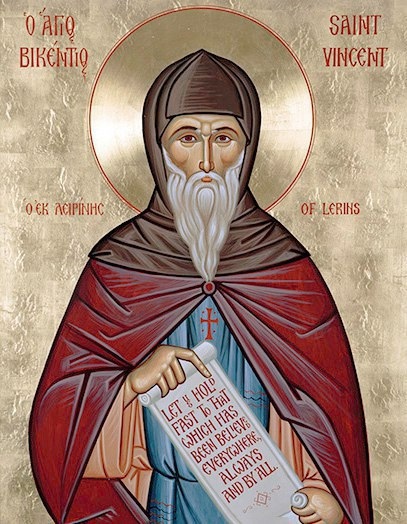
Historical depiction associated with Vincent of Lerins.
Portrait sourceWikivorker · CC0
Vincent of Lerins · Author Profile
Vincent of Lérins (Latin: Vincentius Lerinensis; died c. 445) was a Gallic monk and author of early Christian writings. One example was the Commonitorium, c. 434, which offers guidance in the orthodox teaching of Christianity. In this library, Vincent of Lerins is linked to 1 document, including Commonitory.
- Activity
- 5th century AD - c. AD 445
- Documents in this library
- 1
- Corpus date window
- AD 434
Works in This Library
History and Context
Vincent of Lérins (Latin: Vincentius Lerinensis; died c. 445) was a Gallic monk and author of early Christian writings. One example was the Commonitorium, c. 434, which offers guidance in the orthodox teaching of Christianity. Suspected of semi-Pelagianism, he opposed the Augustinian model of grace and was probably the recipient of Prosper of Aquitaine's Responsiones ad Capitula Objectionum Vincentianarum. His feast day is celebrated on 24 May. Vincent of Lérins was born in Toulouse, Gaul, to a noble family, and he is believed to be the brother of Lupus of Troyes. In his early life he engaged in secular pursuits; it is unclear whether these were civil or military, though the term he uses, secularis militia, may imply the latter. Vincent of Lerins is described in reference records as monk, writer, and presbyter. Place associations in major reference datasets include Toul and Lérins Islands. The documents preserved here span AD 434 and include Commonitory (1 total).
What We Know
- Activity window in reference data: 5th century AD - c. AD 445.
- Approximate lifespan is debated in scholarship; dates vary across surviving witness traditions.
- Roles in major reference data: monk, writer, and presbyter.
- No securely dated office chronology is preserved in current reference records.
- Associated places: Toul and Lérins Islands.
- Tradition or confessional marker: Catholic Church.
- Languages linked to writing or transmission: Latin.
- Notable works cited in reference data: Commonitory.
- Documents in this corpus: 1 (Commonitory).
- Corpus date range for attributed texts: AD 434.
Legacy
He entered Lérins Abbey on Île Saint-Honorat, where under the pseudonym Peregrinus he wrote the Commonitorium c. 434, about three years after the Council of Ephesus. Vincent defended the Marian title of Theotokos (God-bearer) in opposition to the teachings of Patriarch Nestorius of Constantinople, which were condemned by the Council of Ephesus. Vincent of Lerins's reception in theology and church history is closely tied to ongoing study of Commonitory.
Source Notes
Wikipedia biographical overview
Wikidata entity record
Primary text in this corpus (Commonitory)
Portrait source