Mind joins bodily regulation, experienced welfare, representation, and action within a living subject. Each relation can fail while another remains: an experience can outlast memory of its cause, a true judgment can fail to guide movement, and fluent performance can conceal poor monitoring. Explaining their coordination requires tests that separate them. The resulting account must connect neural mechanisms to what the person experiences, knows, and can do.
Experience and recall
Feinstein, Duff, and Tranel showed emotionally evocative films to five people with severe declarative-memory impairment following bilateral hippocampal damage. Compared with healthy controls, their recollection was impoverished, yet induced emotion persisted. One participant recalled no details and recognized them at chance while remaining sad for more than thirty minutes. Happiness could also outlast recall of its source.
They could report their feelings; what failed was access to the preceding event, not awareness as such. Remembering an encounter, retaining its effects, experiencing its effects, and identifying its cause are separable achievements. Mind science must explain both their coordination and their dissociation.
Embodied action
Perception is a loop: sensory activity directs movement, movement changes the evidence, and further evidence changes action. Turning toward a sound, approaching an indistinct object, or touching a latch supplies differences unavailable from the previous position. Attention selects among them; emotion prepares responses and assigns urgency. Hunger, fatigue, fear, and familiarity alter what receives attention without determining whether its interpretation is correct.
An affordance is relative to an environment, a body's capacities, and an activity: a reachable latch may be unusable by an injured hand. Knowing how to act therefore requires more than identifying an object's intrinsic properties.
Agency has distinguishable forms: regulation, learned discrimination, flexible pursuit of an outcome, representation of absent possibilities, and evaluation of one's own goals. They need not occur together. An organism may redirect its activity without deliberating; a person may know a rule without being able to execute it under present conditions. Evidence for any of these capacities remains distinct from evidence for subjective experience.
Action also changes the body that acts again. Practice, trauma, sleep, and recovery can strengthen or restrict later powers. Deliberation uses these acquired capacities and can help revise them. Chapter 15 develops the further conditions under which that activity is attributable and responsible.
Prediction and control
Rao and Ballard's visual model used higher-level predictions of lower-level activity and residual errors to revise representations. Training on natural images produced features resembling cortical responses, including contextual effects. This supplies a computational explanation for particular findings. Predictive processing extends the proposal across cognition; a testable version specifies its architecture, update rules, and neural implementation, and the discriminating tests are those where alternative processes predict differently.
Reliability can be specified mathematically. With a Gaussian prior, unbiased Gaussian observation noise, and correctly assigned variances, a distance estimate combines prior and observation by their precisions:
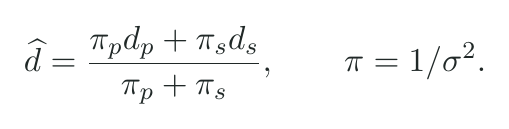
A prior of 6 metres with variance 4 and an observation of 10 metres with variance 1 yield 9.2 metres; raising observation variance to 16 yields 6.8 metres. The observation's content is unchanged; only its influence shifts. A system must also learn how much reliability each source deserves.
Friston's free-energy principle treats perception, learning, and action together in systems whose persistence confines them to restricted states. Variational free energy belongs to approximate inference and bounds a model's surprisal; minimizing it can improve inference under specified assumptions. It shares a name with thermodynamic free energy; a physical connection between them takes a further argument.
In active inference, candidate policies are evaluated through expected free energy, including preferred outcomes and information about uncertain states. An action can advance a goal and resolve uncertainty. Predictions depend on specified states, actions, observations, preferences, and learning rules.
Other approaches make different commitments. Optimal feedback control corrects deviations threatening an objective while tolerating variation in irrelevant dimensions. Reinforcement learning changes value estimates and policies through outcomes; some forms learn directly from reward, others learn models for future consequences. Ecological psychology emphasizes information available in an organism's environment and its affordances. O'Regan and Noë's sensorimotor account treats seeing as practical mastery of how sensory input changes with movement, challenging the requirement for a finished inner picture awaiting inspection.
The organization is increasingly accessible to direct comparison. Findling and colleagues analyzed recordings across 242 mouse brain regions during a common visual decision task. The probability of a stimulus appearing on either side changed between blocks without a cue. The animals used recent history most strongly when visual evidence was weak and adjusted after the probabilities changed. Prior-related activity appeared across sensory, motor, and associative regions, even between trials; measured movements did not explain all of it. This supports a history-dependent estimate distributed through the systems that perceive and act, rather than a prior supplied only at a final decision stage.
Distribution identifies where information is available; intervention and new predictions determine what a circuit does with it. Control theories become distinguishable when they predict different responses to an unreliable cue, an unexpected movement consequence, or an opportunity to learn without immediate reward. Earlier encounters change the organized body through which later evidence becomes actionable. Its condition can also deteriorate while a controller's selected score improves. Connecting the score to that body's needs is the next explanatory step.
Why an outcome matters to this organism
A reward entered by a modeler can teach an agent to collect a symbol without helping it continue to exist. Food and water matter to an organism through its actual condition: their significance can change while the external item stays the same. A theory of motivated action must connect bodily needs to learning.
Keramati and Gutkin's homeostatic reinforcement-learning model supplies one answer. Let H_t describe relevant physiological variables and D(H_t) their deviation from a specified viable target. If an outcome changes the state by K_t, its modeled reward is

For trajectories starting at the same state and ending at the target, with discount factor 0<γ<1, the discounted reward and deviation totals obey SDR=D(H_0)+(γ-1)SDD. Since the coefficient is negative, maximizing one minimizes the other. Under these assumptions reward is the reduction of bodily deviation, so learning serves regulation.
The connection is richer than a reflex restoring one variable. The 2025 perspective by Yoshida, Sprekeler, and Gutkin develops learning across coupled internal and external states, including anticipatory regulation and competing needs. The target, bodily dynamics, available actions, and learning process jointly determine the modeled conduct.
Experiments on thirst make the connection concrete. Zimmerman and colleagues found that drinking water or concentrated saline rapidly inhibited thirst-promoting neurons in mice, but the inhibition persisted after water and reversed after saline. Stomach infusions isolated a gut signal sensitive to fluid concentration; plasma osmolality, measured independently in blood samples, had not detectably changed when the neural response was already complete. Altering the neural activity also changed drinking. Mouth, gut, and blood therefore supplied successive information about intake, expected consequence, and actual bodily state. The rebound after saline shows correction of an initial intake signal. Anticipatory stopping can serve rehydration before restoration is complete. Whether the body receives the expected benefit remains a question about subsequent fluid balance and functioning.
The organism supplies needs; signals register or anticipate them; learning links actions to expected outcomes; those outcomes alter the body that acts again. A defended set point can itself be pathological. Quieting a warning while independently measured fluid balance deteriorates has not restored the physiological good. Relief of felt distress, where present, can nevertheless be a real good while another need remains. Water can be accurately located yet unreachable, strongly wanted yet damaging, or consumed without restoring fluid balance. These failures identify different routes of repair for the same bearer.
Prediction and valuation also help explain conflict between encountered facts and established meaning. Prediction error, threatened trust, commitment, and practical cost can affect attention and learning differently. Chapter 15's Cognitive Resonance Model develops those connections.
Expectation and learned response
Amanzio and Benedetti varied verbal analgesic cues, drug conditioning, and the opioid antagonist naloxone during an ischemic-arm pain-tolerance task. Naloxone reversed effects from verbal expectation and morphine conditioning. After ketorolac conditioning, an effect without an expectation cue was naloxone-insensitive; adding the cue produced an effect only partly blocked by naloxone.
“Placebo effect” consequently covers different routes. Prior experience changes which physiological response a later cue recruits. Meaning becomes bodily effective through learning history and particular mechanisms; blocking one route need not block another.
Learning and valuation
Learning depends on what an event discloses. Lee, O'Doherty, and Shimojo paired images with monetary outcomes; a model in which causal uncertainty regulated learning captured rapid updating better than alternatives, including novelty alone. Imaging associated uncertainty and one-shot learning with ventrolateral prefrontal and hippocampal activity. An event separating confounded causes can teach more than their repeated co-occurrence.
Habit formation has another profile. Lally and colleagues followed daily behaviors in consistent settings; self-reported automaticity generally approached a plateau. Their 18--254-day estimates are modeled times to reach 95 percent of individual plateaus, extrapolated from twelve weeks of data. One missed opportunity did not materially disrupt formation on average. Context helps retrieve an action; its worth is judged separately.
Choice may change valuation, but its effects are easy to overestimate. Sharot, De Martino, and Dolan reported altered enjoyment ratings for vacation destinations after choice, with changes in caudate activity. Chen and Risen showed that the conventional rate--choose--rate design can produce apparent preference change from noisy initial ratings: choice may reveal a preference that the first rating missed. In a later blind-choice experiment, participants believed unseen selections were their own; ratings increased for destinations presented as chosen compared with a computer-choice condition. This supports an effect of perceived selection.
Framing can reverse preferences even when alternatives are substantively unchanged. Tversky and Kahneman demonstrated this with gain and loss formulations involving money and lives. Making consequences explicit across formulations supplies a way to distinguish a changed situation from changed attention to it.
These histories can change anatomy as well as performance. After three months of juggling, Draganski and colleagues found regional gray-matter changes relative to controls in bilateral hMT/V5 and left posterior intraparietal sulcus; changes diminished after three months without practice. The acquired capacity depended on a body still being changed by its use.
Development and support
Brain growth, immune defense, maintenance, and bodily growth share finite energy. Urlacher's synthesis treats childhood development through tradeoffs among them, not a fixed intellectual return per calorie. In 140 placental mammals, Gómez-Robles and colleagues found that humans' relatively small fraction of adult brain size at birth principally reflects extensive postnatal enlargement.
Extended care supplies protection, provision, play, and opportunities to observe before competence. Comparative research, including corvid observations, develops extended parenting as a hypothesis about cognitive evolution. Care changes the opportunities through which powers develop.
Executive functions include inhibition, working memory, and flexible switching. Their development and susceptibility to stress and inadequate sleep distinguish failures to acquire a rule, retain it, inhibit a competing response, or apply it in adverse conditions.
Adolescent risk illustrates the difference between knowing a danger and using that knowledge amid peers, emotion, or immediate rewards. Steinberg proposed different trajectories for socioemotional influences and cognitive control. Testing the imbalance requires longitudinal measures that show how their relation predicts within-person change.
Timing, rest, and execution
Encoding, retention, and retrieval place different demands on a learner. Crowley and colleagues combined 39 reports involving 1,234 participants: restricted sleep impaired memory relative to normal sleep, with standardized effect g=0.29, confidence interval 0.13--0.44. Experimental timing determines whether encoding or consolidation is chiefly tested.
Sensitive periods concern particular capacities and relevant experience. Sign-language acquisition proceeds on a broadly comparable timetable to spoken language when accessible language is supplied from birth; delayed first-language access can have lasting consequences. Hartshorne, Tenenbaum, and Pinker's study of roughly two-thirds of a million English speakers estimated high grammar-learning ability into late adolescence before decline, distinguishing starting age from learning duration. Both results concern particular capacities rather than a single closing age for learning in general.
Execution can be supported by joining a cue to an action: “After breakfast, I will open the book at the marked passage.” Gollwitzer and Sheeran's meta-analysis of 94 tests found that implementation intentions improved goal attainment on average. Such plans organize opportunities.
Metacognition
Accuracy is success against a criterion; confidence estimates that success. Metacognition monitors and regulates cognitive activity. Its measures must distinguish calibration from discrimination. Consider a simple test: fifty answers at 90 percent confidence include 45 correct, and fifty at 50 percent include 25. Both levels are calibrated and discriminative, yielding 70 percent overall accuracy. Assigning 70 percent everywhere gives the same average without discrimination; uniform excess confidence may still rank answers well. Average calibration can conceal offsetting errors, so comparisons must control difficulty and performance.
Rahnev varied external noise in visual-orientation judgments while matching accuracy and response time. Twenty-five of twenty-six participants showed higher confidence in one condition, consistent with confidence criteria being attracted across conditions. Felt certainty depended on the procedure, not only success.
Desender and colleagues found that lower confidence predicted a higher decision boundary on the next trial independently of previous accuracy: more evidence was accumulated before commitment. An EEG component sensitive to confidence also predicted adjustment. This links monitoring to subsequent control.
One useful formal split treats an object-level decision and its later monitoring as different readouts of a noisy accumulation process. In a simple drift-diffusion model, dx_t=v dt+s dW_t, where v is the mean evidence drift, s the noise scale, and W_t a Wiener process; a response occurs when the accumulated state reaches a decision boundary. A confidence estimate can then use the posterior probability of being correct after that boundary is crossed. Changing the drift, boundary, noise, or post-decision window makes different predictions about accuracy, reaction time, and confidence.
Such comparisons also depend on the measure. Rahnev's assessment of seventeen metacognitive measures found that many depended strongly on task performance. More trials improved precision and usually produced high split-half reliability within a session, yet most measures showed poor test--retest reliability across days. A precise session score therefore need not identify a stable personal trait. Monitoring can vary, and its measurement must separate that variation from statistical noise.
Evidence use can continue after the choice. In Stone, Mattingley, and Rangelov's motion-discrimination task, short deadlines reduced accuracy but improved sensitivity in ratings of the desire to change one's answer. Post-decision centro-parietal positivity tracked these ratings more closely after errors under speed pressure. The measured improvement concerned change of mind, rather than ordinary confidence.
Some monitoring transfers between tasks. Davidson, Aiyer, and Yeung trained an EEG classifier on errors in a speeded visual task, then generalized it to accuracy and confidence in a later auditory task. No visual self-evaluation had been requested, suggesting an automatic signal available across sensory modalities.
Training can change how that evidence is read. Stone, Mattingley, Evans, and Rangelov found that both free-choice and forced-choice practice improved near-transfer performance and metacognition, but through different changes: free-choice training increased sensitivity to pre-decision centro-parietal positivity and drift rate; forced-choice training increased sensitivity mainly to post-decision positivity. Monitoring is itself a developing capacity, with mechanisms that determine when uncertainty prompts another observation, help, delay, or commitment.
Awareness and expression
Wakefulness concerns arousal; awareness concerns experienced presence. Command following, recall, and report demand additional capacities and a usable response channel. Their failure leaves awareness an open question.
Bodien and colleagues detected task-related fMRI or EEG responses in 60 of 241 participants with no observable command response, while only 43 of 112 behavioral command-followers produced a positive imaging or EEG result. Cognitive motor dissociation reveals abilities missed by behavior; the comparison shows that each method detects responses the other misses.
A test detects activity under specified demands. Failure can reflect loss of that capacity or failure of another condition required to express it. The person exceeds the available channel and score.
Comparing particular minds
Comparisons become informative when they name a capacity. Matsuzawa trained the chimpanzee Ai to label sets of one to six items with Arabic numerals, alongside color and object symbols. Cantlon and Brannon presented successive dot arrays to monkeys and humans, who selected their approximate sum; performance in both species depended on numerical ratio. Learned symbolic labeling and approximate nonverbal addition are distinct achievements.
Human zero studies separate further achievements. Barnett and Fleming found graded numerical organization and cross-format representation using magnetoencephalography. Kutter and colleagues recorded medial-temporal neurons in neurosurgical patients: empty-set and symbolic-zero responses were distinct, both showed numerical-distance effects, and empty-set coding retained a boundary absent from symbolic zero. Cross-format representation at the MEG scale thus coexists with format-distinct responses in single neurons. Empty-set discrimination, ordinal placement, symbolic use, and proof remain different accomplishments.
Hampton's two rhesus monkeys could accept a memory test for a preferred reward or decline for a smaller guaranteed reward before seeing the choices. Accuracy was higher on accepted than forced tests; experimentally weakened memory increased declining. One monkey met criteria in every condition, the other in all but one. Strong evidence for memory monitoring distinguishes internal uncertainty from external cues, reward history, competing responses, and information costs; transfer beyond the trained arrangement helps separate those explanations.
Girard-Buttoz and colleagues analyzed 4,323 utterances from 53 wild chimpanzees, including sixteen two-call combinations. Associations with events supported additive, modifying, novel, and order-sensitive combinations of meaning. This expands evidence for flexible combinatorial communication; a community's transmission and correction of public practices is a further achievement beyond individual performance.
Brosnan and de Waal's capuchins refused exchanges more often when partners received preferred rewards for equal effort, especially without effort. The inequity interpretation competes with disappointment at an available better reward. Ritov and colleagues' analysis of individual data from 23 studies across eighteen species found no inequity effect in the accept-or-reject paradigms examined. The decisive comparison asks whether preferential treatment of a partner adds an effect beyond presentation of the better reward.
Kanngiesser and colleagues studied 376 children aged five to eight across eight societies. After learning a sorting rule, children intervened more when peers appeared to violate it, with culturally variable frequency and style. Tomasello's account asks how shared activity creates a mutually accountable “we,” capable of protest, excuse, justification, and apology. Conventional enforcement and accountable obligation are richer than dislike of an outcome; whether the enforced rule is just is a further question.
The constitution of experience
The sky appears blue to someone; an injury hurts. Experience is the presence of such an occurrence to a subject. Information can guide action and a report can describe a state, but explaining those functions leaves a further question: what makes their exercise experienced? Chalmers names this the hard problem of consciousness.
The dissociations examined above concern one living subject. Hylomorphism names the organized being as the bearer whose parts and processes exercise its powers. Aquinas's argument asks why this person understands and senses; form names the person's actual unity, rather than another part beside the brain. Maintenance, learned action, injury, and recovery belong to that life even when it cannot describe a loss. Developmental dependencies and possible support, as well as prior performance, help identify an unavailable good. Chapter 13 develops the continuity argument.
Autopoietic and enactive accounts connect this unity to self-maintenance and sensorimotor activity. The living system's condition makes features of its surroundings beneficial or damaging, giving those features significance in its activity. Organizational continuity supplies evidence of a bearer through ordinary turnover, though a formal boundary alone does not settle identity through development or death. Biological significance also need not be felt: chemotaxis, affective regulation, and reflective experience require different organizations.
Neural identity and functional realization explain different aspects of those organizations. Smart identifies a sensation with a brain process while denying that the two descriptions must mean the same thing. A person can recognize lightning without knowing its physics, and can know a sensation without knowing its neural constitution. A successful identification would explain one occurrence without adding a second one and a connecting law. Putnam instead identifies mental states through their place in a system of inputs, internal transitions, and actions. Different organisms might realize the same relevant organization; pain is already a state of the whole organism, with a unity condition excluding an arbitrary collection of separate pain-feelers. Both proposals can locate a felt event in an actual bearer. Their explanatory claims concern its constitution, not merely an outward performance score.
Searle's biological naturalism similarly treats consciousness as caused by and realized in brain processes while preserving its first-person character. His unified-field proposal directs inquiry toward the conditions of one conscious organization. These accounts explain how a living whole acquires and exercises powers. A whole-bearer account retains their successful mechanisms while asking which organization suffices for experience and how the activity belongs to the continuing subject.
Illusionism contests the felt occurrence itself. Frankish preserves perception, affective response, control, and introspection, but argues that introspection misrepresents functional properties as phenomenal qualities. His strong position denies even a modest qualitative remainder, beyond merely rejecting privacy or infallibility. The reason to retain realism is undergone distress: correcting a person's theory of pain need not eliminate the hurt being theorized. Introspection can misdescribe an occurrence that still needs explanation. Frankish disputes this reading of the evidence, so the disagreement concerns first-person acquaintance and whether an exhaustive functional account preserves or eliminates what it explains.
Dual-aspect and panpsychist accounts seek to ground experience in the nature of its constituents. Chalmers proposes a correspondence between physically embodied information and experience; Strawson rejects emergence from a base stipulated to be wholly nonexperiential. Such a constitution could belong within the present account if it explained the unity of a subject. Shared informational structure does not identify one experiencer, and experiential constituents still require an account of their combination. The demonstrated dependencies begin with this animal's or person's coordinated activity and injury; the underlying constitution of feeling remains open.
The body's causal role creates a further fork. Berkeley's idealism preserves a world independent of finite wishes through divine spirit, but makes ideas passive and causal efficacy spiritual. Bodily mechanisms then describe the regular order of sensory ideas. Selective changes to bodily organization explain corresponding changes in activity, giving a reason to attribute powers to the bodies themselves. Excluding bodily efficacy while inferring spiritual efficacy from effects requires a further reason. The account of creation in Chapters 3, 4, and 7 strengthens this interpretation: creatures receive actual powers of participation. Berkeley can preserve the observed regularities, so the difference concerns what explains them.
Descartes locates thought in a separable subject, arguing from clear and distinct conceptions of thought and extension. Yet hunger, thirst, and pain lead him to insist on an intimate embodied union. Injury and healing give a direct reason to begin with that embodied life, whose powers change together and sometimes come apart. Considering thought apart from extension does not by itself establish an independently complete thinker. A dualist can explain the dependencies through union, but separability needs its additional argument. The whole-person account places sensing, deliberation, and bodily loss in one recipient, coherently with incarnation and bodily restoration. The dependencies documented in this chapter concern human cognition: every knower studied here knows through a body. That is evidence about how created knowers are made. It is not by itself a demonstration that every possible knower must have those dependencies, and Chapter 42 prices what the further claim of a bodiless divine knower costs.
Neural theories can be tested through their different predictions about conscious content. Global neuronal workspace theory emphasizes information's availability across a network for flexible use; integrated information theory identifies experience with irreducible causal structure. The Cogitate Consortium's preregistered 2025 tests examined location, duration, and communication using visible stimuli across fMRI, MEG, and intracranial EEG cohorts. Absent sustained posterior synchronization challenged IIT; failures of predicted connectivity and limits in prefrontal representation challenged GNWT.
Naccache and colleagues disputed the centrality of some predictions, particularly a required offset response, and argued that clearly visible stimuli miss the central conscious-versus-nonconscious contrast. Such objections must identify the failed commitment, independently motivate revision, and produce a new discriminating test.
The finite knower
A remembered cup can guide a reach after the cup has been moved. The error is intelligible because the state concerns a cup at a place, and seeing, reaching, and correction depend on that relation. Moving the cup warrants revising its represented location; changing the question's wording need not. Reliable discrimination, transfer, and appropriate correction support understanding at the level tested. Reasons become effective through the knower's powers when a relevant consideration changes judgment or action. Learning that the cup was moved can change a search because the person understands its bearing on where to look. The bodily processes enabling that understanding belong within the explanation of her rational activity. Chapter 15 develops the further conditions of responsibility.
The findings also distinguish targets of help. A belief correction restores accuracy; accessible surroundings enable action; relief changes experienced welfare; restored bodily regulation answers a physiological need. The same person can need all four, and success on one measure leaves the others open. Their coordination explains why a whole-person account must exceed both a performance score and a report of feeling better.
The creative purpose developed in Chapters 3 and 14 interprets these coordinated powers as means of knowing and enjoying a shared world. The neural evidence explains their operation and failure. The next chapter extends the questions of acquired competence, monitoring, and correction to artificial systems, where similar performances can arise through different organizations.
Related research
Compare this chapter with source documents or study its biblical references.
Chapter comments