Front Matter
Copyright and source notices
DDF: Faith, Science, and the Logic of One Reality
Copyright © 2026 Systems Theology.
All rights reserved.
Public author: Systems Theology.
Writing credit: Elijah Faviel.
Revised manuscript.
October 20, 2026.
Forty-three chapters with six reference appendices.
Biblical passages are paraphrased, with references given where they are discussed. Contemporary worked cases are constructed examples; research reports identify their evidence and methods.
://systemstheology.com
Preface
This book develops a connected explanation of reality: why beings exist, how their powers and knowledge develop, what makes their good binding, how corruption damages them, and what their restoration requires. It argues that Christianity best integrates these questions through the personal Logos, the source of creation who acts in Jesus Christ. Science, philosophy, biblical history, and practical inquiry supply the distinct evidence and arguments needed to develop that proposal.
The volume is meant to be complete rather than introductory. Its chapters carry the argument, its notes carry the evidence, and its appendices and index carry the connections, so that a reader can begin from any question and follow the relations the account draws to it. Each major relation receives its detailed explanation where it first does the necessary work; later chapters use that result to explain something further instead of restating it. A reader who enters in the middle will therefore meet cross-references more often than summaries. They are the joints of the book: each one names the place where a premise was argued and its limits were stated.
The book is designed to be self-contained in that sense: the arguments, premises, qualifications, and source loci on which it relies are stated within these pages. The sources themselves remain available to anyone who wants to check them, and the notes say where to look.
The governing claim
The Divine Design Framework takes its name from two commitments, which Chapter 1 defines. Divine names the Triune God, whose personal Son becomes flesh in Jesus Christ. Design names creation's intelligibility, goodness, and ordered ends. It does not name a biological design inference: unsolved scientific problems, such as the origin of life, are treated as open questions for the sciences, not as evidence for God.
The governing commitment is the Axiom of Purpose: whatever God creates receives its existence, intelligibility, goodness, and place within creation's ultimate end from God. That end is communion in Christ. The axiom is a theological and metaphysical starting commitment, not a theorem derived from measurements. It is the book's hypothesis as well as its confession, and Chapter 42 weighs its comparative warrant against the strongest whole-account alternatives only after the evidence has been examined.
Creation gives beings real powers and goods. Embodied persons learn and act; their histories transmit both care and injury. The good of a meal, friendship, or discovery belongs to the life that receives it. Sin disorders good powers and relations. In Christ, restoration reaches the people whose lives need repair, healing their powers and opening them to communion with their giver.
How the book is built
The seven parts develop one continuous argument, from God and creation to fulfillment, comparison, and further inquiry. The order is cumulative: each stage contributes a relation the next needs, while the final judgment depends on the strength of the whole chain.
The Question of One Reality. Chapters 1--4 state the proposal and the standards by which it is judged, then explain the Triune God and creation.
The World We Actually Encounter. Chapters 5--12 examine mathematics and information, matter and physical law, cosmic history, living organization, origins and deep time, mind, artificial intelligence, and language and religious search. They report what each field establishes on its own evidence and mark where a further philosophical or theological claim begins.
Persons, Purpose, and Shared History. Chapters 13--17 develop the whole person, creaturely goods and moral obligation, formation and freedom, shared memory and institutions, and the corruption of good powers.
The Biblical History of Restoration. Chapters 18--27 follow Israel's covenant, land, exile, and wisdom; Jesus in history and the identity of the Logos; incarnation and Pascha; grace, Church, and worship. They close with the questions of evil, suffering, and unequal encounter that this restoration must answer.
Life Together in One World. Chapters 28--37 apply the account to households and sexuality, childhood and education, art and play, work and debt, law and public authority, peoples and belonging, homes and cities, the earth and animal life, digital systems, and illness and care.
The Completion of Created History. Chapters 38--41 examine resurrection and the continuity of the person, judgment and redress, final destiny, and new creation.
What the Account Explains and Enables. Chapter 42 compares the whole account with its strongest rivals and states what could change the verdict. Chapter 43 tests whether its way of tracing a failure to the relation that produces it can help diagnose and repair real errors in research, engineering, and institutions.
Reference material. Six appendices and a three-part index make the connections inspectable. They are described below.
Comparisons gather similarities and differences after the relevant mechanisms or texts have been examined. Worked examples specify a problem or test an inference.
How claims are marked
The book distinguishes how strongly a claim is held from the kind of support it has, and it keeps a small technical vocabulary for the purpose. Appendix A defines that vocabulary, and the Working Lexicon in Appendix E lists its principal terms alphabetically among the book's other technical words. Where these words appear in the chapters, they carry their technical sense.
Three separate assessments. Confessional adequacy asks whether a claim fits the canonical and apostolic sources: adequate, disputed, or inadequate. Public explanatory fit compares shared evidence and strong rivals: superior fit, competitive, underdetermined, or contradicted. Embodied fruit examines what an interpretation does when it is lived: faithful, mixed, corrupt, or untested. Each assessment retains its own result. An effective practice does not prove a doctrine, and a well-attested doctrine does not exempt a practice from evidence.
Inferential status. A conclusion may be entailed, excluded, abductively preferred, compatible, underdetermined, in tension, or contradicted by its premises. An abductively preferred conclusion is offered as the best available explanation, not as a proof. Confidence records the strength of the warrant; maturity records how developed and tested an account is.
Source and judgment. A source-established claim is what a competent source directly supports. A DDF inference adds a bridge of the book's own. An authorial judgment records a reasoned preference that a careful reader may weigh differently. The central comparative verdict of Chapter 42 is marked this way, and that chapter grants that a reasonable judge who weighs the testimony or the added commitments differently can rate the accounts competitive. Unknown identifies an unanswered question.
Corrigibility. Empirical and historical claims answer to the relevant evidence, including within theology. A discovered failure changes the claim and the arguments that depend on it; independently supported judgments keep their grounds.
Following an argument
Cross-references. A chapter reference in the text points to the place where a relation was argued. Following it back usually leads to the premise, its evidence, and its stated limits.
Claim identifiers. Appendix B indexes eighty-nine claims. Each entry gives the claim's identifier, a short statement, the chapters that argue it, and its principal limits. The identifiers preserve the original numbering, so related entries need not be consecutive. Eight inquiry profiles (doctrine, canonical interpretation, method, empirical and historical evidence, human care and protection, institutions, public applications, and disputed boundaries) show what kind of warrant each claim needs. The appendix closes by mapping seven central arguments and stating which conclusions change if a particular connection fails.
Connections and tests. Appendix A sets out the governing movement of the account, the conditions under which a bridge between fields fails, the eight premises that carry its main connections, nine paths along which a reader can inspect a connection from its evidence to its conclusion, and twelve hard cases carried through the whole account.
Notes and references. Chapter notes give the particular passage, result, or document behind an argument. Appendix F gathers more than eight hundred sources by field and then by author. Its entries give publication, revision, and consultation dates, and many state which chapter uses the source and for what. Where access was limited to an abstract, an author manuscript, or a publisher summary, the relevant note says so.
Scripture and early sources. Appendix C groups the canonical passages by the chapters that depend on them and places the early Christian witnesses in chronological relation. It distinguishes a passage's immediate claim from its canonical use and its later reception, so that a later use does not silently become the original author's assertion.
Working forms. Appendix D supplies a form for recording a claim with its scope, warrant, dependencies, alternatives, and conditions for revision, together with the research protocols for the practical proposals made in the book. A reader can use these forms to test the account or to build an independent record of a new question.
The source register. Appendix B links a public register that preserves the original claim cards and research records. Those records are historical. The judgments of this edition are the ones stated in its chapters and appendices, and they can be followed without leaving the book.
Routes by question
The following routes provide shorter entries into the structure. Each can be extended by following its cross-references.
Science and the framework. Chapters 5--12 investigate mathematics, matter, cosmic history, life, mind, AI, and language. Chapters 1--4 identify the proposal and its standards; Chapters 42--43 assess the integration and develop testable inquiries.
Christian theology. Chapters 3--4 explain God and creation. Chapters 17--25 follow corruption, Israel, Christ, grace, Church, and worship. Chapters 26--27 address suffering and hiddenness; Chapters 38--41 examine resurrection, judgment, and fulfillment.
Considering the Christian claim. Read Chapters 21 and 42 together. The first examines Jesus, the resurrection testimony, and the identification of the personal Logos; the second weighs that history within the strongest competing accounts of the world. Chapters 2--4 clarify the standards and the argument for a personal Creator. Chapters 19, 26--27, and 38--40 test what the proposal must answer about a hard command in Scripture, suffering, unequal encounter, and final restoration. Chapter 43 concludes by connecting the account of creation, corruption, grace, judgment, and fulfilled participation.
Persons and shared life. Chapters 13--16 develop identity, purpose, obligation, formation, and institutions. Chapters 28--37 use that account in households, teaching, art, work, law, belonging, cities, ecology, digital systems, and care.
Applying the account to a new question. Appendix A explains how a new application begins with its subject and that subject's good, then follows the mechanisms, dependencies, and responsible actions through which that good is received or damaged. Chapter 43 works through examples, and Appendix D supplies the record and the protocols.
Inspection and reference. Appendix A states the tests for connections. Appendix B indexes the claims and maps the decisive arguments. Appendix C guides canonical and early Christian sources; Appendix D supplies working records and research protocols; Appendix E defines terms; Appendix F consolidates the references.
Using the index
The index gathers the principal treatments of a subject across the book, which makes it the quickest way to collect the connections the account draws to a single question. It has three parts. The index of subjects includes biblical figures and whole biblical books where the book itself is discussed. The index of persons lists ancient and modern authors and other historical figures. The index of Scripture lists every passage the chapters cite by chapter or verse, in canonical order, with the deuterocanonical books between the testaments.
In the printed and PDF book, a locator gives the page on which the relevant section begins; in the electronic edition, it is a chapter number linked to that section. Bold locators mark principal discussions. An asterisk after a subject heading means that the term is defined in the Working Lexicon, and a claim identifier after an entry leads to the Claim Index.
Conventions
Scripture. Biblical passages are paraphrased, with references given where they are discussed. Appendix F identifies the editions, translations, and public texts used for ancient sources.
Cases and proposals. Contemporary worked cases are constructed examples; research reports identify their evidence and methods. Proposed instruments, such as the decision aid in Appendix D, await their own tests, and constructed pilot materials contain no participant evidence.
Dates. This revised manuscript is dated October 20, 2026. A dated report supports its specified edition, and current practical decisions also require current local evidence. For ancient texts, a date may refer to composition, a surviving manuscript, or a modern edition; the notes keep these distinct.
Formal results. A formal check establishes only the proposition and environment actually checked. Where the book inspects a stated result or a reported dependency, it does not thereby claim to have repeated the check.
Traditions. Comparisons among Christian traditions preserve their distinct doctrinal claims and trace agreement and difference to what each source actually says.
Care, law, and protection. The chapters on care, law, and protection describe obligations and evidence. They do not replace qualified clinical, legal, or protective judgment in a particular case.
Where the account could fail
The account states the conditions under which it should be revised. Chapter 42 explains that revision follows dependence: a corrected experimental premise changes the arguments that rely on it, and a failed analogy withdraws a bridge without erasing the findings on either side. Defeat of the historical first pair proposed in Chapter 17 would change the proposed history of headship without abolishing population biology or human dignity; defeat of the actual resurrection would have the wider consequences Paul states. Chapter 42 also identifies the practical comparison that remains to be done. Appendix B marks which conclusions depend on which connections.
A reader who rejects the conclusion can still use the map. The book is built so that disagreement can be located at a particular premise, examined with the evidence that premise needs, and carried forward without abandoning everything that rests on independent grounds.
One Reality, Many Ways of Knowing It
An account of reality must explain existence, intelligible order, the beings who know it, and the goods their lives can receive. It must also explain how those goods are damaged and what restoration would require. These questions concern one world: physical causes enable living powers, living subjects can know and act, and their acts form histories that matter to themselves and others.
The Divine Design Framework (DDF) argues that Christianity gives the best account of how these realities belong together. Its central claim is that the God disclosed in Jesus Christ gives creatures a life whose goods they can themselves receive and enact. That purpose connects the world's intelligibility, the reality of its knowers, and the worth of their lives. A world can be intelligible without any creature understanding it; a creature can survive without flourishing; an accurate record can describe a life without restoring its bearer. The Christian account connects these conditions through the good the giver intends for their recipients, and grounds restoration in His continuing commitment disclosed in Christ. The argument follows this connection through creation, history, and fulfillment. Chapter 42 compares the reasons for accepting that account with the explanatory resources and costs of its rivals.
What DDF means
Divine names the Triune God. The Logos is the personal Son who becomes flesh in Jesus Christ. Created intelligibility belongs to the world's relation to Him; it is not an independent principle subsequently identified with God.
Design names creation's intelligibility, goodness, and ordered ends. It does not name a biological design inference: unsolved problems such as the origin of life are treated here as open questions for the sciences, not as evidence for God. The book states its governing commitment as the Axiom of Purpose: whatever God creates receives its existence, intelligibility, goodness, and place within creation's ultimate end from God. The end is communion in Christ. Created history includes real development, discovery, and consequential action; having an ordered end does not mean every creature attains it. The axiom is the book's hypothesis as well as its confession. Chapter 2 explains why a confessed starting point must still earn its explanatory standing, and Chapter 42 asks whether the connections this commitment explains earn their preference over the strongest alternatives.
The work begins by identifying which powers and goods actually belong to a being, how they develop or fail, and what would fulfill them. Physical disposition, biological function, conscious intention, and moral obligation are distinct relations; Chapter 14 develops their full comparison.
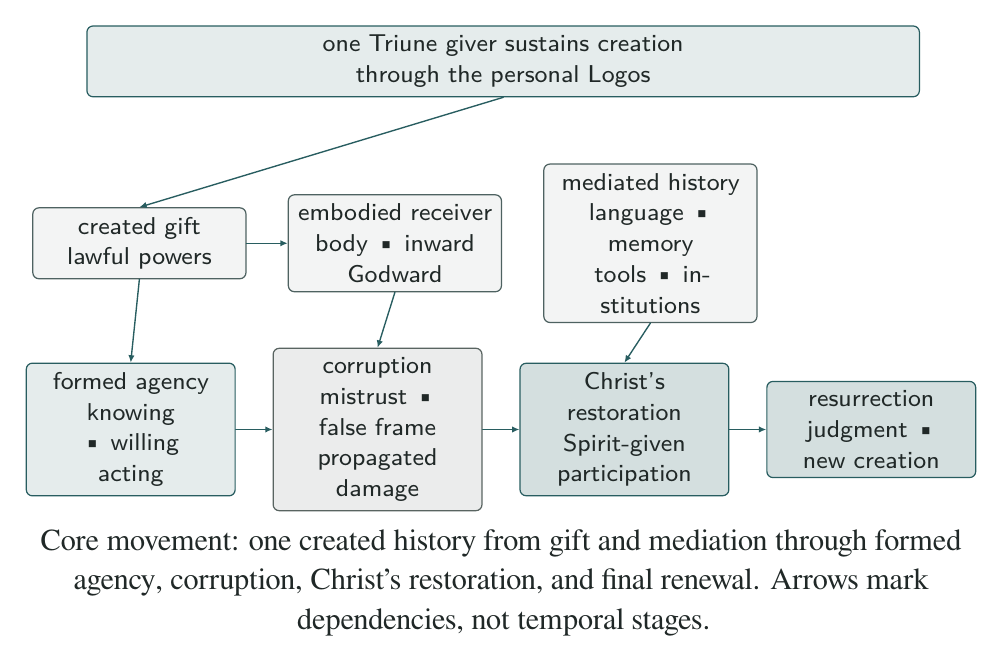
Framework names the relations that hold this history together and make further explanation possible. Its central movement is this: God gives and sustains an intelligible creation with real powers and goods; creatures receive and act within it, forming consequential histories; sin corrupts their life and relations; Christ restores communion through the Spirit and brings created life toward fulfillment. Joining these claims creates obligations. The account must explain real creaturely action under divine dependence, corruption without making creation evil, and restoration that answers the lives actually damaged.
How a created world develops
Begin with the reality the proposal describes. God creates from fullness: the world supplies no missing divine life, knowledge, or love. A distinct creature's good can be worth giving without making its giver more complete. God understands and freely actualizes that good; creatures do not first exist to demand creation, and no uniquely best possible world has to compel the gift. Creation begins in this knowing generosity: God brings distinct creatures into being and gives them goods that become their own. This knowing gift is the account's foundation.
Its recipients have lives of their own. A tree grows through its own activity; a child learns through attention and practice; friends make a shared history through what each gives and receives. God's sustaining action includes those real powers and their exercise. Discovering a natural cause therefore discovers something about how the gift works. Chapter 4 develops the account of this intentional act; the chapters on suffering ask whether the history actually given is consistent with its claimed goodness.
Created goodness includes development: capacity, acquired skill, and a particular act are different goods. Some goods, such as a promise kept over years, essentially include the history through which they are lived. Time therefore contributes to creation's fulfillment through care, teaching, work, and discovery.
In such a world, activity changes later conditions. Nourishment develops a body; practice develops a skill; trust makes truthful correction receivable; a decision can open or close another person's opportunity. Finite beings share conditions they cannot individually control. Their exposure to one another makes cooperation fruitful and injury transmissible. Explaining those dependencies requires the actual processes: disease and deception, for example, damage through different routes.
Corruption disorders received powers and goods. Intelligence can organize a deception, attachment can become possessive control, and authority can preserve a false account. The same channels that carry learning and care can then carry fear, exclusion, and injured trust. Sin concerns culpable action; suffering can reach someone who never consented to it.
Restoration follows those dependencies. Forgiveness answers guilt; truthful disclosure answers concealment; healing addresses damaged powers; renewed communion changes how people receive and give; resurrection concerns the beings whose embodied lives were interrupted. In Christ, the giver enters the conditions of the gift, lives their good faithfully, and acts against sin and death. The Spirit brings recipients into that restored life.
The same recipients
A person's powers, achievements, and losses belong to the embodied person who lives through them. Families and institutions can carry their effects into other lives without becoming one personal subject. This distinction gives care its object: the child who needs help remains someone whose good matters when a household, school, or nation appears to be flourishing.
Restoration has the same actual recipients as creation. Christ assumes the complete human nature needing healing, and the Spirit brings distinct people into His life through their own reception and action. Judgment concerns what those people did and suffered; communion fulfills their goods without declaring their injuries good.
A world that includes its knowers
Physical processes, living organization, conscious experience, rational judgment, and shared practices meet in a single embodied life. Explaining a person's observation requires an instrument's operation, their capacity to perceive, their learned interpretation, and the reasons that make the interpretation warranted. The explanation must hold these together without pretending that one level can do the work of all the others.
Their standards also differ. Predictive success does not settle whether someone understands a model. Survival does not establish justice. A false belief can cause real harm. An institution can achieve its stated goal while injuring people it has failed to count. These are not rival descriptions of one fact; they are different questions about one situation. A connected account must make the distinctions useful without separating the situation into unrelated worlds.
Scientific inquiry gives these questions concrete content. Discoveries about living organization, memory, or conscious access reveal which powers a being has and how they develop or fail. They can also change the categories through which we understand those powers. A connected account learns from the world it seeks to explain. Universal scope creates answerability wherever the account makes a claim. A failed empirical premise changes the conclusions that depend on it; a text that cannot bear an interpretation requires the interpretation to change; an institution's concealed injuries can expose a defective account of success. The world has authority to surprise the account.
Powers, relations, and history
An inventory of a circuit's components does not specify whether the circuit is complete. Its arrangement explains which electrical powers can act together; prior damage explains why the same switch now produces a different result. Composition, organization, and history contribute distinct information. The parts are real, but the powers belong to the arranged whole, and the whole carries a history that cannot be read from a parts list alone.
In development and learning, activity changes the organization through which later activity occurs. A skill becomes an acquired capacity; an institution preserves practices beyond their first participants. This is formation: a history becomes a condition of further activity. Its mechanisms differ across a growing body, a practiced skill, and a public institution.
This gives the book a continuous path. Physical arrangements enable particular activities. Living organization makes some activities matters of nourishment, injury, and repair for an organism. Experience gives some losses a felt bearer; rational agency makes truth, promises, and responsibility questions that bearer can face. Shared practices carry the consequences into other lives. Each step adds something that needs explanation. A functioning system is not yet a just institution, and a complete record of a life is not yet the person who lived it.
A rule that punishes reporting failure can make an institution appear more successful while depriving it of the information required for correction. Its persistence is real, but persistence is not a sufficient measure of its good. We must ask whose capacities the arrangement develops, whose life it damages, and who can answer for maintaining it. Organization becomes explanatory when it identifies these dependencies; moral judgment assesses the goods and obligations within them.
The Christian proposal
Human beings receive bodily life, language, memory, family, instruments, institutions, worship, and testimony before they can assess their sources. These channels form attention, desire, judgment, habit, allegiance, and love. Through them we encounter both care and inherited injury. Our responses enter conditions others will inherit.
The biblical account of restoration follows Israel's promises, covenants, worship, failures, judgments, and hope. The creating Word enters embodied human history. Christ's death and resurrection answer sin and defeat death; the Spirit brings people into His life. Grace is given participation in this saving reality, with consequences for worship, forgiveness, care, justice, and fidelity.
The promise concerns the people who lived this history. A future containing happy replacements would leave unanswered what became of those who suffered. Christian hope promises resurrection and differentiated judgment, the transformation of Christ's people still living at His appearing, and new creation. Healing and judgment reach actual victims, culpable agents, and the relationships in which their lives were formed.
What integration contributes
A footbridge may withstand its loads while its steps exclude residents and its funding omits maintenance. Structural knowledge, attention to users, and institutional provision meet in the requirements of one project. Connecting them changes what must be built and what must continue after construction. The bridge's good lies in the passage it actually makes possible.
Personal repair likewise joins distinct explanations. Exhaustion can help explain cruel speech; the hearer's injury identifies a damaged good; responsibility grounds apology and changed conduct. A causal explanation does not justify the act, and acknowledgment does not itself restore trust. Their connection determines what repair requires.
Such connections are available to competent engineers, clinicians, naturalists, and moral philosophers. This book asks about their common ground: why intelligible powers, finite knowers, and goods worth pursuing coexist in one world. A rational giver can intend a world capable of being known; a good giver can intend the good of the subjects who know and inhabit it. Creation then has a reason in what those distinct creatures receive, and their value precedes the approval of whoever currently controls their lives. Intelligibility, knowledge, and care have a common ground in knowing generosity.
The Christian claim identifies this giver in Christ. The relation between intelligible order and known good leads to the source argument of Chapter 3; the identification with Jesus leads to historical testimony and its interpretation. Both matter to the hope that the source of life also answers its wounds.
The order of explanation
The argument proceeds through standards of inquiry, God's identity, and creation; then matter, life, mind, and language; then persons, obligation, and the biblical history of restoration. Applied chapters test consequences in shared life. Resurrection, judgment, and fulfillment complete the proposed system; Chapter 42 assesses its comparative warrant. Each stage contributes a relation the next needs, while the final judgment depends on the strength of the whole chain.
Related research
Compare this chapter with source documents or study its biblical references.
Chapter comments