Living organisms inherit both capacities and the conditions through which those capacities develop. An altered transporter can make a new food available; a new partner can change the environment inherited by descendants. Across generations such changes produce lineages whose powers differ from their ancestors'. Their history also contains the creatures nourished, injured, and lost along the way. Reconstructing it means explaining how capacities arose and identifying what their exercise meant for the lives that bore them.
Descent and branching
Reproduction transmits material and developmental resources through an already living process. Population separation, variation, and restricted exchange can yield distinct lineages. A branching tree records descent, not increasing perfection: humans and living chimpanzees each have subsequent histories from shared ancestors.
Fossils, geographical distribution, anatomy, and molecular inheritance constrain reconstruction through different evidential routes. Nested changes across genomic regions test more than visible resemblance. Recombination, ancestral variation, gene flow, and horizontal transfer explain why gene histories need not coincide with species trees.
Stratigraphy and physical dating constrain when a proposed ancestor could have lived; the dated material and its association matter. Deep time supplies generations; the pathway is a separate reconstruction. Likewise, the last common ancestor of surviving organisms need not be the first organization capable of evolution.
Variation, selection, and constructed environments
Mutation has molecular biases while ordinarily remaining random with respect to future need. Recombination redistributes variation; duplication permits divergence; horizontal transfer supplies material from another lineage; migration changes population composition. Development determines which forms these changes can produce. Plasticity permits condition-dependent responses without automatically making every acquired response heritable.
Selection concerns heritable differences in reproductive contribution, not an interchangeable ranking of strength, longevity, or complexity. For a large haploid population with variant frequency p, relative output 1+s, and alternative output 1, the next frequency is the variant's weighted output divided by the population's mean output:
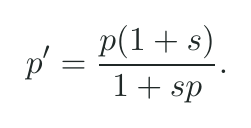
With p=s=0.1, the expected next frequency is about 0.1089, assuming constant conditions and no mutation, migration, or sampling noise.
Finite reproduction adds sampling drift. In an ideal haploid sample of N independent offspring,

At p=1/2, standard deviation is five percentage points for N=100 and half a point for N=10,000. A beneficial variant need not spread on each occasion.
Organisms also change inherited conditions through burrowing, vegetation, microbial chemistry, and other activity. Symbiosis supplies capacities and new dependencies. Laland and colleagues give development, plasticity, and constructed environments greater causal prominence; Futuyma shows how population genetics already incorporates many of their effects. A fuller explanation joins the feedbacks to variation, inheritance, and reproductive consequences. Active organisms change the conditions of selection, and population reasoning traces what follows. Additional predictions and their success in particular cases determine whether a proposed extension adds explanatory power.
Prior organization limits and enables later change. A useful alteration can disrupt another function; a retained structure can be recruited into a new role. Contingency and convergence reveal different aspects of these constraints. Novel functions and ecological relations are real achievements of a mechanism with no foresight of its own.
Experimentally recoverable novelty
In the long-term bacterial evolution experiment, twelve populations received limited glucose and citrate under oxygenated conditions. Citrate use appeared in one population by generation 31,500, initially weak and subsequently refined. Reviving frozen ancestors showed that later backgrounds more readily yielded citrate-using descendants. Genomic analysis identified a duplication that placed an existing transporter under an aerobically active promoter; subsequent changes improved use. Multiple backgrounds supported accessible routes, so contingency does not imply one uniquely necessary sequence.
Keefe and Szostak screened approximately 6×10^(12) proteins with eighty random amino-acid positions and isolated four unrelated ATP binders. Translation, display, selection, amplification, and later introduced variation supplied the experimental setting. The result shows that ATP binding is reachable by sampling random sequences.
Expression, recruitment, and retention
Expression makes a product available; interaction gives it consequences; selection can retain some consequences. Carvunis and colleagues identified about 1,900 yeast proto-gene candidates between unannotated sequences and established genes. Many lacked detectable purifying selection, while a subset showed retention against amino-acid changes. Translation varied by conditions, so expression alone did not establish function.
Lenski and colleagues' digital organisms acquired complex logical operations through rewarded simpler operations. Their inspectable histories show how cumulative acquisition works within specified computational rules.
Babina and colleagues recovered three hydrophobic proteins of at most fifty amino acids that restored growth in bacteria lacking serB. Increased hisB expression recruited an existing alternative phosphatase activity; Hdp1 binding to regulatory RNA supported one mechanism. A short new product can benefit a cell by changing an older capacity's availability.
In the bacterial long-term experiment, uz-Zaman and colleagues found insertion sequences and rearrangements recruiting existing promoters into previously quiet regions, more prominently than new-promoter creation in the examined cases. Iyengar and colleagues' models and yeast/fruit-fly comparisons found a favorable antisense reading frame for open-reading-frame acquisition and retention. Overlapping established coding constrains candidate availability; a resulting protein's fitness effect needs separate evidence.
Frumkin and colleagues recovered thousands of antiphage sequences from partly randomized expression libraries. Characterized products recruited stress-induced capsule production or reduced the phage receptor OmpC; some acted through RNA. The codon-biased libraries and living host supplied the conditions in which these sequences could be expressed and selected for protection.
A natural-population survey by uz-Zaman and Ochman supplied counterpressure: many unannotated proteins showed little evidence of progressing toward function, and only one proto-gene's de novo emergence was rigorously reconstructed in sampled bacterial history. Missing relatives and hard-to-recover origins cut both ways, leaving the rate of de novo gene birth an open measurement. Frequent expression and later functional recruitment remain distinguishable rates.
The coupled origin problem
Life's origin requires production, persistence, concentration, free-energy use, catalysis, heredity, and association of products with what inherits their effects. These operations constrain one another rather than forming a simple checklist. Stable template binding can prevent separation; a protective boundary can exclude substrates; synthesis can produce inhibitors.
A predecessor need not reproduce modern cellular division of labor. RNA can combine hereditary and catalytic roles; pores or surfaces can provide confinement; environmental cycles can alternate conditions before internal regulation develops. But the separations, replenishment, and cycling imposed in an experiment are themselves contributions whose counterparts must be explained in the proposed environment.
If a catalyst promotes a compartment's growth and remains with descendants, variation can alter its own reproductive continuation. If it diffuses freely and benefits all compartments, the inheritance relation changes. Origin experiments become more explanatory when precursor chemistry, copying, energy use, and spatial association connect under compatible or sequential conditions.
Precursors and chemical coupling
Powner, Gerland, and Sutherland demonstrated activated pyrimidine ribonucleotide synthesis through intermediates rather than direct assembly of finished base, sugar, and phosphate. Phosphate guided earlier reactions; a first intermediate exceeded eighty-percent yield, while later phosphorylation and ultraviolet treatment selected cytidine and uridine derivatives. The early yield was not an overall RNA yield. The staged conditions are part of what the experiment explains.
Patel and colleagues linked RNA, amino-acid, and lipid precursors through cyanosulfidic chemistry using ultraviolet light, reducing power, and copper-assisted pathways. An RNA-related intermediate connected to glycerol and amino-acid precursor routes; one interconversion yielded fifty-nine percent. Their streams-and-pools scenario assembles these supported reactions into a proposed geological sequence.
A membrane-building route connects this chemistry to compartments. Cho and colleagues showed that cysteine reacts spontaneously with two short-chain C8 thioesters in water to form diacyl-lipid vesicles. Silica catalysed the reaction, and the vesicles remained compatible with functional ribozymes.
Abil and colleagues then built a different bridge: liposomes containing a recombinant transcription--translation--replication system sustained a linear DNA template encoding the Φ29 DNA polymerase and terminal protein, with purified single- and double-stranded DNA-binding proteins and supplied nucleotides. Intermittent or semi-continuous rounds produced adaptive mutations within ten rounds. The result demonstrates compartmentalized Darwinian evolution under a highly engineered biochemical system, including purified machinery and freeze--thaw redistribution.
Singh and colleagues demonstrated thioester-mediated RNA aminoacylation near neutral pH. Single strands exposed internal attachment sites; duplex organization protected them and favored terminal attachment. Separate frozen-condition chemistry produced a relevant thioester at forty-eight-percent yield, while the downstream attachment tests used substantially higher reagent concentrations. Changing activation chemistry enabled peptidyl products, so aminoacylation and peptide formation remain distinct steps.
These results identify accessible selectivity and coupling, with supply, concentration, compatibility, and renewal still to be integrated. The aminoacylation and peptidyl-RNA reactions establish chemical operations used in translation. Establishing an inherited correspondence that directs peptide sequence is a further, distinct achievement.
Recurring copying and persistence
Sequence fidelity and recurring heredity are achievements distinct from polymer length. Duzdevich and colleagues sequenced extension products with their templates, locating mismatches and stopping points. One deliberate mismatch control recorded extension in 6.1 percent of read pairs, with over ninety-eight percent of mismatch observations at the first position. That was a control condition, not a universal prebiotic error rate.
Zhou and colleagues used short invader strands to displace a blocking complement and restore primer extension that was absent without the invader. The strongest extended synthesis used reactive analogues yielding 3'-NP-DNA on an RNA template. The supplied strands and substrates establish a displacement mechanism, not an autonomous RNA-only copying cycle.
Attwater and colleagues combined an engineered polymerase ribozyme with activated trinucleotide substrates. The triplets supported synthesis and limited immediate strand reannealing. Imposed acid/heat separation, neutralization, freezing, and replenishment let one cycle's products become later templates. Emergent shorter product classes reached up to 60,000-fold amplification after accounting for dilution; separate experiments copied a twenty-nine-nucleotide catalyst segment and enabled primer-free initiation. The result is recurring amplification and partial self-copying, not renewal of the complete catalyst and support chemistry.
Burger and Gerland's virtual-circular-genome model distributes a larger sequence across overlapping strands. Concentrations, length, and preferences for feedstock addition govern correct assembly versus error-prone joining. Longer informative strands at lower concentrations and preferential monomer addition define regimes for chemical testing.
A simple exact-sequence model shows why these requirements couple:
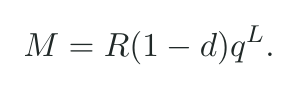
With R copies per replaced parent, length L, independent per-position fidelity q, and survival probability 1-d, M is expected surviving exact descendants. For R=2,d=0.1,L=100, changing q from 0.99 to 0.999 changes M from about 0.659 to 1.629. Real sequences tolerate some changes, errors correlate, and cooperating fragments can distribute requirements. The model identifies the dependency.
A route to Darwinian evolution must join heritable functional variation, differential propagation, and the organization that sustains both. RNA-centered, metabolic, and compartmental explanations contribute different operations to that problem. Their experimentally constrained integration is preferable to treating each as a complete rival origin: heredity needs energy and spatial association, while useful chemistry needs a route of inheritance. The present evidence supports substantial components without selecting one complete geochemical scenario, and a theological account cannot supply its missing concentrations, catalysts, or sequence of environments. Creation gives reason to receive the discovered powers as real causes; the comparative case for a Creator comes from the wider argument, not from those missing details.
Human ancestry in several senses
Jebel Irhoud's fossils combine faces, jaws, and teeth aligned with early or recent Homo sapiens with more ancestral cranial features. Associated heated flints yielded 315±34 thousand years by thermoluminescence, with a tooth-based comparison. Traits and population histories therefore need not change simultaneously.
Thomas Quarry I in Casablanca adds a deeper African comparison. Hublin and colleagues dated new hominins from the ThI-GH locality to about 773 thousand years and found a mixture of primitive features with traits resembling later Homo sapiens and Eurasian archaic groups. The fossils strengthen an African ancestral population before Jebel Irhoud, while their mosaic morphology cautions against imagining one clean, linear human stem.
Genetic coalescence traces region-specific ancestral copies. Recombination permits different dates across regions; effective population size describes an idealized genetic process, not a census. Gronau and colleagues inferred ancestral effective size near 9,000 under calibrated demographic assumptions.
Ragsdale and colleagues favored weakly differentiated African stems connected by recurrent gene flow. Cousins, Scally, and Durbin's different model inferred a deep split near 1.5 million years and joining near 300,000 years with contributions around eighty and twenty percent. Both support ancestral structure; different model spaces leave its architecture open. Their populations cannot simply be equated with named fossil groups.
Ancient DNA now also resolves part of the Holocene rather than the deep origin itself. Jakobsson and colleagues sequenced twenty-eight ancient southern African individuals dated between 10,200 and 150 calibrated years before present; genomes older than about 1,400 years fell outside the variation of living samples, while the region showed little spatial or temporal stratification across roughly 9,000 years. The study infers outward gene flow beginning more than 8,000 years ago and inward gene flow only after about 1,400 years ago. These data recover previously hidden diversity and continuity across the Holocene.
Genealogical ancestry is parentage, even when no identifiable DNA survives from an ancestor. A pedigree has 2^g positions g generations back, but repeated people and overlapping paths make those positions less than 2^g distinct individuals. Expected autosomal contribution along one unrepeated path is 2^(-g), not guaranteed surviving material. Mitochondrial and Y-lineage ancestors trace narrower paths and were not necessarily sole contemporaries or a couple.
Rohde, Olson, and Chang's structured models permit universal genealogical ancestors only a few millennia back under suitable migration and connectivity. Continued isolation defeats recent outside ancestry. A sole founding pair permits at most four initial autosomal copies at a location; a couple within a larger population permits other genetic contributions. Covenant appointment adds a different relation.
Ancient behavior and its evidential reach
Paige and Perreault measured stone-tool procedural complexity across 3.3 million years against primate, inexperienced-human, and random-flaking comparisons. Sustained increases around 600,000 years, and some technologies near twice the primate baseline around 300,000, support cumulative culture under that measure.
The Panga ya Saidi burial, dated 78.3±4.1 thousand years, contains remains of a child about two and a half to three years old. Pit sediments, articulated remains, and decomposition evidence support deliberate burial, although they do not recover the mourners' beliefs. Sima de los Huesos Cranium 17, about 430,000 years old, bears two similar perimortem depressed fractures with differing trajectories. That pattern supports repeated intentional lethal blows while leaving motives unknown.
Living capacities inform comparison without dating their first occurrence. Mobbs and colleagues found threat proximity shifted human activity toward the periaqueductal gray, especially with greater anticipated pain. Anderson and colleagues observed chimpanzee care, testing for life, attendance, cleaning, aggression, and later place avoidance around one death. These disclose defensive and social responses without assigning all behaviors one human emotion.
Planning, attachment, grief-like behavior, and violence all lie within evidential reach. The ancient creatures whose lives are being reconstructed had goods and vulnerabilities of their own. Any human persons among them bore the full standing described in Chapter 13, regardless of technology or the sparseness of their remains.
Adam within an embodied history
An actual covenantal beginning need not be a recent exclusive genetic pair. Under ordinary inheritance that simple bottleneck faces strong genetic evidence; a pair within a wider population leaves other genetic contributions intact. Genealogical and deeper historical placements require evidence of their own. Archetypal and corporate readings explain the story's universal significance without, by themselves, locating an initiating event.
The canonical reason for an actual beginning lies in the causal work of the trespass in Romans 5 and the ordered earthly-to-resurrection history of First Corinthians 15, read alongside Genesis's genealogies. Using a story as a type alone would not establish historicity. This judgment depends on the apostolic authority argued in Chapters 21 and 24; Chapter 17 develops the comparison with archetypal readings. Universal significance and an initiating act can belong to the same history without implying genetic monopoly.
Headship is a covenantal relation, not equivalent to exclusive genetic ancestry. Inherited deprivation and mortality also differ from later persons' own culpable acts. If persons preceded Adam, their dignity was full and their circumstances conferred no guilt. Evidence of responsible wrongdoing before a proposed first-defection date would require revising the date or Adam's role, rather than redefining those earlier wrongdoers as nonpersons.
Loss across deep time
Fossils document ancient attack and repair through digestive remains, drilling, and scars. Subsequent growth supports survival after damage; unrepaired breakage is more ambiguous. Recognition, transport, preservation, and sampling affect prevalence estimates; the cumulative predation record stands.
A Centrosaurus fibula from roughly 77.0--75.5 million years ago, once identified as a healed fracture, showed invasive abnormal growth consistent with osteosarcoma under imaging, thin sections, and comparisons. The specimen therefore identifies serious individual pathology long before humanity.
Green and colleagues linked flood-basalt timing and rates statistically with extinction, proposing volcanic environmental effects. Henehan and Witts disputed extension to later events, particularly the Cretaceous--Paleogene, given changed ocean and carbon-cycle conditions. Causes remain event-specific while the losses are independently recorded.
Nociception processes damaging stimulation; pain adds unpleasant experience. Crook's octopus experiments combined injury-associated place avoidance, protective behavior, neural activity, and responses to local anesthetic. Schnell and colleagues retained the converging evidence while noting a missing matched injured-saline control in the relief-conditioning comparison. Their 2026 assessment found strong evidence for octopuses and cuttlefish, substantial evidence for squid, and too little research to settle sentience in nautiluses. These are grades of evidence, not levels of experience or findings that poorly studied animals cannot feel.
The experienced condition of extinct creatures requires further anatomical and evolutionary inference. Where experience is warranted, evolutionary benefit elsewhere does not answer the affected subject's loss. A prey's death feeds a predator without restoring the prey; extinction can open niches while ending actual lives. The scale matters: in most lineages most offspring die before reproducing, and mass extinctions removed large fractions of the species then living, so the losses in question are the rule of this history rather than its exceptions.
Purpose in histories that could have differed
Evolutionary contingency changes which creatures and powers become actual. It does not make their powers unreal or leave their good to an observer's preference. Once an organized life exists, nourishment, development, injury, and repair have consequences for that life. The inherited organization and its surroundings determine what activities are available; whether those activities sustain or damage the bearer is then open to causal investigation. A power can have a contingent origin and a determinate contribution.
An observed case makes the standard concrete. Saad and colleagues found that cave planarians retained small functional eyes while producing fewer eye-directed progenitors and regenerating eyes more slowly than surface comparisons. The evolutionary explanation remains open between selection and relaxed purifying selection. A larger, more ancestral-looking eye would not thereby be a cure, and the existing eye is not certified optimal by its persistence. The relevant question concerns what a change would enable or impair in these animals under their conditions. Evolution explains how their powers became actual; their contribution to the bearer's activity remains open to investigation.
The citrate experiments provide a narrower observed case. Earlier inherited backgrounds changed which innovations were accessible, while the eventual transport arrangement made a new resource usable. Its contribution is assessable even though that arrangement need not have evolved. Had another history produced another metabolic route, the relevant good would belong to the resulting organisms and their actual dependencies. This comparison does not presume that the same individuals would exist under different ancestries, or that every possible lineage must appear. It applies the same question to the bearers that each history contains: what can this life receive and do, and what enables or injures it? A better life belonging to another creature in an alternative history would not thereby repair an actual creature's injury.
A good giver can intend these living recipients and their own participation in creaturely goods. Organisms develop through inherited resources, alter habitats, provide for young, and sometimes repair themselves. Their activity helps produce what they receive and pass on. Such participation gives a positive reason for creation through history without requiring a fixed inventory of species or an evolutionary tendency toward maximum complexity.
God's regard then concerns actual creatures, their powers, and what happens through them. A feeding capacity serves a predator's life; its exercise can gravely damage a prey's life. Neither ecological success nor the later appearance of humans makes the prey an intermediate design whose suffering can be omitted. Randomness relative to future need describes variation, not its ultimate purpose. Equally, a purpose for living recipients gives no warrant to assign a good end to each harmful event.
Sentience adds a further relation: a creature can experience the good it receives. Nourishment, movement, and attachment can matter both to the continuation of its life and to how that life is lived. The connection is experimentally accessible. In Aizawa and colleagues' sixteen-participant study, the same local warmth was judged similarly hot while whole-body warming and cooling changed whether it felt pleasant. Bodily condition and felt value are connected without being the same measurement.
An animal's own pursuit and enjoyment of nourishment, movement, or companionship gives a good-giver account reason for some feeling--function coupling before moral agency. This gives theism a reason to expect some connection between feeling and function; it establishes neither a comparative likelihood advantage nor the necessity of aversive experience. Draper's hardest cases persist: agony after protective responses have become impossible can be biologically explained while remaining evidence against benevolent governance. Chapter 26 compares that pattern with his hypothesis of indifference.
A naturalist can explain these mechanisms and acknowledge the same goods. The further Christian claim is that the giver's regard persists when useful mechanisms fail. The arguments for a good giver and for Christ's history and identity supply the warrant: the claimed bodily renewal in Christ is fulfillment received by an actual embodied life. Chapter 35 extends the inquiry to injured animals through creation's promised liberation and God's particular care. That expectation depends on the independently assessed promisor. Healthier successors would not themselves give good to the creature that suffered.
Why, then, permit this route and distribution of severe losses when other histories appear possible? Creaturely participation identifies a good of history without showing that every cost was necessary to give it. Finitude and dependence can be good before consummation; unhealed injury is a deprivation within that good. Their distinction prevents both the dismissal of evolving life as a failed creation and the dismissal of its sufferers as its acceptable price. Chapters 26 and 35 pursue the hoped-for answer to those actual losses.
The theological scope of this history
Genesis 1 gives vegetation as food within its creation portrait; Psalm 104 and Job include wild predators under present provision; Isaiah 11 promises animal peace within the coming reign. Gift, governance, and healed horizon belong to the canon's account of one creation.
Early readers understood that history differently. Theophilus linked animal ferocity to transgression; Basil discussed carnivores within divine provision; Irenaeus expected Isaiah's peace to include renewed animals and original food. Theophilus's chronology conflicts with the predation recorded long before humans, while Basil was not describing modern evolution. The continuity lies in good creation and embodied renewal, with the intervening history now more fully known.
Romans 5 traces sin and death through one human to human beings; First Corinthians 15 answers dying in Adam with embodied life in Christ. Genesis 3 joins exile from life to return to dust, while Hebrews 2 distinguishes death's power from enslaving fear. Adamic death therefore names bodily death within Sin's personal and covenantal reign. The same embodied loss acquires a relation to alienation, accusation, and judgment; the distinction concerns its historical condition and final horizon.
The distinction prevents prehistoric predation from becoming evidence of an earlier human transgression. Chapter 17 explains the additional relation in which mortality becomes an instrument of concealment, coercion, and distrust; Chapter 22 develops liberation from that reign. Biological death, fear of loss, and culpable use of fear require different explanations.
Resurrection makes bodily death provisional. Revelation's second death belongs after resurrection and judgment; it names a different relation from ordinary prehistoric mortality.
Romans 8's unwillingly subjected creation groans toward liberation with redeemed human bodies. Its suffering is subjection to futility, not moral rebellion. Human wrong additionally propagates into land and shared life, as Genesis, Leviticus, Hosea, and Isaiah describe. The canon describes no comparable route by which an angelic fall would shape the fossil history.
Descent and novelty describe the formation of powers; benefit and injury describe what their exercise means for their bearers. The promised liberation concerns this actual creation, including its sufferers, rather than the productivity of surviving populations alone. The next chapter follows one further power within that history: a creature's capacity to experience its world, learn from it, and act on what it comes to know.
Related research
Compare this chapter with source documents or study its biblical references.
Chapter comments