One world, a connected explanation
What is observed, the instruments that extend observation, and the knowers who use them belong to one world. A personal giver creates real powers; those powers become active through material conditions and history; living subjects receive, act, and alter what others inherit. Corruption damages their goods, and Christ restores the same embodied creation. The Axiom of Purpose grounds the account of created order: whatever is created receives its existence, intelligibility, goodness, and end from one knowing source. The further Christian claim identifies that source with the one who has acted in Christ to restore what was damaged. Its strongest rivals can preserve much of the same science and moral care. The comparison asks whether the relations explained by this act of giving earn a preference over the strongest alternatives, and what the account requires of its source. One commitment here means one explanatory act, not one cheap posit; what that act requires of its source is priced below.
Three judgments remain independent. Confessional adequacy asks whether the account faithfully interprets its Christian sources. Public explanatory fit asks whether its premises and connections explain shared evidence better than alternatives. Embodied fruit asks what particular practices actually do to affected people. They inform each other and are never averaged: a secular service may protect someone whom a doctrinally accurate church neglects, and doctrine never offsets the harm.
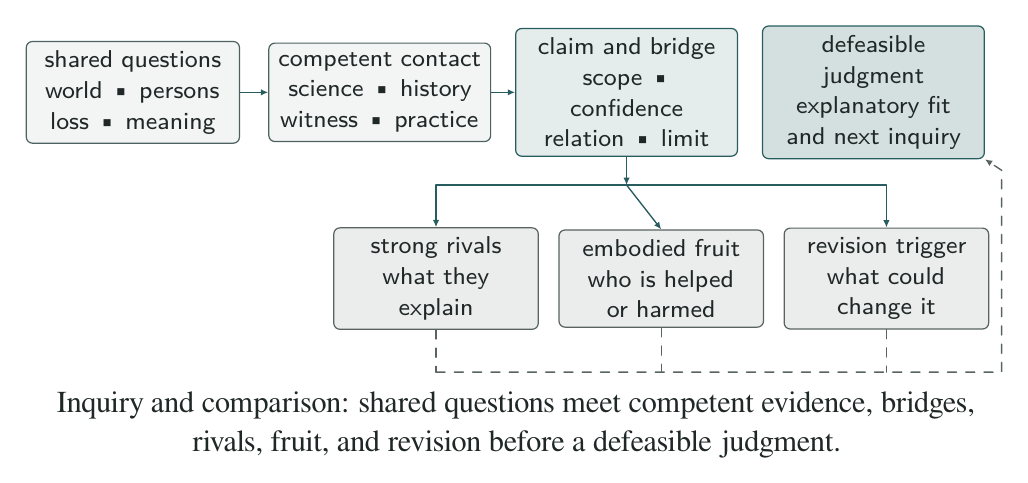
Suffering, conscious experience, intelligibility, social power and moral claims are shared questions. Resurrection and final repair are further Christian commitments. A rival need not fulfill a promise it never makes, though it must account for the goods and losses to which that promise responds. The families below separate arguments, not people; real lives overlap them.
How the supports accumulate
The earlier arguments carry forward through dependencies. A conclusion about what a human is constrains what formation can change; the account of corruption determines what healing must remove; the account of standing determines whose good restoration must reach. These connections give the framework its explanatory unity. Later conclusions inherit the support already earned by those premises, and their success in explaining further parts of the same world can strengthen the connected account. These are cumulative relations of support, with dependent conclusions counted in relation to their grounds rather than as several independent observations.
Christ connects the source, the injury, and the remedy: the creating Logos assumes the nature that needs healing, lives its faithful human response, and gives its restored life to distinct receivers through the Spirit. This identifies what the Christian claim adds to general benevolent design. Its warrant comes from the source and historical arguments, whose respective strengths the comparison must now assess.
Personhood supplies a decisive constraint. A human exists before acquiring the competence later exercised, and can lose competence without becoming a different bearer. Restoration can therefore end corrupt formation while preserving the person; resurrection must restore that same bearer across death. The conclusions inherit the anthropology of Chapter 13 and the persistence argument of Chapter 38.
Each connection has its own grounds. The encountered world supplies evidence about powers, living organization, knowing, and transmitted consequences. Philosophical arguments assess why these realities exist and what grounds their truth and good. Historical inquiry tests the claims about Jesus; canonical and received confession identify their proposed divine meaning. Those inquiries can use some of the same texts, so their source dependence must remain visible. A well-supported mechanism supports part of the account, and its ultimate ground is argued separately.
Mathematics and physics make the first connections determinate. Chapter 5 distinguishes objective relations from finite access through permitted operations. Chapters 6 and 7 show how collective powers depend on actual states, interactions, and history. Together they explain how access can develop while the truth it encounters remains independent of that development.
A learned machine can likewise develop a construction and expose relations its designers did not already know. Chapter 11 credits these achievements as real exercises of received powers. Human standing therefore cannot depend on retaining the best performance in every task. The further claims concern an actual subject's experience and good. Chapter 10 shows why a living need, the signal representing it, and a learned response can come apart; repair must reach the failed relation in that life.
The practical chapters test a related distinction: a corrected description must change the conditions through which its intended good is received. Establishing a benefit entitlement, authorizing payment, delivering it, and enabling its use are different achievements. Their mechanisms differ while their success concerns the same recipient.
The moral argument adds something observation alone cannot supply. On the standing and non-domination premises of Chapter 14, the good giver regards recipients as distinct bearers of good, and powers over them are entrusted for fitting service. Changing institutional recognition or aggregate success cannot remove the affected person's claim. A naturalist moral realist can defend the same remedy through flourishing, rights, or reasons. The comparison concerns why these obligations belong with the world's powers and actual persons. The answer given here joins their source, good, and answerability in one relation of giving.
The comparison asks about scope, supported connections, evidential constraint, discrimination between rivals, and the cost of added commitments. A connection earns weight when it identifies a real dependence, explains it, and changes what further inquiry should investigate. Shared achievements receive shared credit; Christianity's additional claims must explain something further.
Naturalistic explanation
Naturalism's strongest pressure is the continuing success of investigating nature: why add another kind of being when material, evolutionary and social explanations keep yielding knowledge? Methodological discipline can expose fraudulent miracles, fabricated citations and harmful treatments. Its success supports a comprehensive naturalist case without making the local method identical with the thesis that nature exhausts reality.
Structural realism, emergent naturalism, organizational function and enactivism already recognize relations, higher-level powers and historical dependence. A biological capacity can serve the organism while another organized process damages it; norm-sensitive behavior need not establish moral truth. These distinctions constrain every account.
Chapter 7 gives naturalism a genuine economy advantage within the explanation of cosmic order. Measured sensitivity and the conditions for generative history constrain any adequate account, but do not supply a calibrated probability that selects a divine intention. A deeper physical explanation would earn further credit; an unexplained boundary condition remains a cost. Theism adds a source with knowing and willing powers, so it must earn that addition through more than the world's successful scientific description.
For measurable mechanisms, scientific explanation supplies what the task needs more precisely than a metaphysical description, and comprehensive naturalism remains a strong competitor; one finding redescribed as organization, emergence and formation remains one finding.
The strongest impersonal comparison can grant considerably more. Suppose a concrete natural ground exists necessarily, has real causal powers, and generates a contingent history, perhaps through objective chance. Add objective truths about value and reasons, with embodied minds capable of fallible knowledge of them. Necessity at the source need not make every subsequent event necessary. Nor need objective morality await a divine command. Oppy's causal alternatives and Wielenberg's non-theistic moral realism supply resources for this comparison, although the combined position here is a constructed rival, not a doctrine attributed wholesale to either author.
Knowing agency explains the conjunction through a reason operative in giving: the source understands the finite good that its recipients can receive and gives the powers through which it can become theirs. That relation has definite content. Truthful participation requires access that answers to its object; a beneficiary's repair requires good received by that bearer. A strong impersonal account can also connect causation and value within one necessary ground, including powers directed toward real goods. The comparison therefore concerns two forms of dependence, good understood in the act of giving and value intrinsic to a productive order. Neither gains an advantage merely by being called one source.
The source argument in Chapter 3 defends this personal proposal, and Chapter 4 relates free giving to fidelity toward the actual recipient. Several gifts can be fitting without one uniquely best world compelling the result. Truthful access and received repair give the intention definite success conditions. Knowing intention is nevertheless the proposed explanation of the evidence, not another independently observed fact to place beside it. The conjunction of order, minds, and value motivates the proposal without settling its truth.
The philosophical and historical arguments assess this relation together. The source need not be established before the testimony can bear on its identity, and a proposed divine meaning is not an extra witness to the event. The question is whether a knowing giver acting from continuing concern better explains the reported restoration, its subject, and its mission than an impersonal ground with ordinary history or a derived personal restorer. The latter can preserve much of the same good and even personal action. What needs warrant is the further identification of that action with the ultimate source. The comparison retains the costs of underived knowing and free willing, together with the suffering and unequal access that press against the care it proposes.
Paul gives that claimed relation an early expression. The God who commanded light is the one whose glory is disclosed in Jesus' face; the messengers serve their hearers for Jesus' sake; and the God who raised Jesus will raise and present them together with those hearers. Creation, disclosure, service, and bodily hope concern one giver and actual people. This is part of the testimony being assessed, rather than another independent observation of resurrection. It identifies what the Christian explanation proposes: the source makes Himself known through action directed toward the lives He gives.
The connection also reaches judgment's entrusted form. First Corinthians joins the received covenant meal and resurrection proclamation to exclusion of a harmful insider, care for humiliated members, and the Lord's discipline directed against condemnation. Chapters 24 and 39 establish those operations. The historical gain is that restorative purpose and differentiated authority already belong to the early testimony under assessment. They specify what this claimed act of God continues and authorizes, instead of being later repairs attached to a bare miracle. The argument for the event still depends on the testimony's credibility and body history.
Experience and bodily causation
Chapter 10 favors taking experience as an actual occurrence in an embodied subject while leaving neural identity, functional realization, and hylomorphic constitution in contention. Strong illusionism disputes phenomenal occurrence itself. The comparison turns on whether its physical and functional explanation preserves the hurt encountered by the subject, alongside correction of mistaken beliefs about its cause.
Berkeley is a precise alternative to bodily causal realism. His stable, involuntary sensory order distinguishes real bodies and injuries from private imagination. He locates activity in spirit and treats perceived ideas as passive. His law-governed divine action can preserve the experimental relations that this book attributes to created bodies, so bodily resistance alone does not decide between them.
I prefer real bodily powers because selective intervention gives reason to attribute the resulting activity to the organized being whose condition makes the difference. A causal power need not appear as an isolated sensation to be warranted by its effects; Berkeley likewise knows spirit through its activity. His further restriction of agency to spirit therefore needs its own argument. Within the creation account, giving bodies actual efficacy also explains their contribution to life, learning, injury, and repair as one continuing embodied subject's activity.
Construction, power and moral reason
Fricker distinguishes prejudicial loss of testimonial credibility from unfair disadvantage in interpreting experience through shared resources. She also resists reducing reason to power, since that would obscure justified rejection of testimony as distinct from prejudice. Haslanger distinguishes a concept's social history, socially caused features and socially constituted roles. A landlord's status can be constituted by relations without every belief about landlords thereby becoming false.
A school record classifying a child as unreliable can close access to help; its social production leaves the original injury real. An institution can cause a disadvantage and then mistake it for the child's inherent defect. Christian authorities are answerable for that same failure. The child's standing precedes institutional recognition: Chapter 14 grounds it in the good giver's regard for each person. The social diagnosis identifies the mechanism; the source and moral arguments explain the standing it violates.
Humanism's practical achievement is responsible common action without prior religious agreement. It has also corrected Christian failures. The disagreement with moral naturalism meets its strongest arguments: Railton can affirm obligation while declining universally desire-independent rational requirements; Foot gives costly justice a place in practical reason. Neither makes ethics whatever happens to be preferred.
The neighbor's created standing gives a capable responsible agent a reason even when the agent's ends exclude that neighbor. Chapter 14 grounds this claim in the good giver's relation to distinct recipients: power is entrusted to serve their fitting goods, and dependence gives no proprietary title over them. Chapter 13 adds a concrete advantage over views that rank basic human standing by developed capacities: childhood, dementia, and unequal performance never turn one person into another's expendable resource. The qualifier matters. A two-tiered account such as McMahan's does not license treating the impaired as resources; what it cannot supply is a standing that does not vary with the capacities present. The advantage must also be held against the account's own hardest case, the command examined in Chapter 19, where that same standing requires an account of why the children's commanded deaths were fitting. The question concerns the act entrusted, while the children's equal worth remains the standard of judgment. Robust moral realists can defend the same equal standing and desire-independent reasons. The comparative gain claimed here is the connection of actual persons, their good, and responsibility through one knowing source, supported by the further Christ argument. Humane secular practice likewise supplies a standard by which Christian practice can fail.
Care and institutional religion
Competent therapy can deliberately leave metaphysics undecided. Its task is to provide warranted care, and comparison favors care where it actually meets need, irrespective of its label. Private spirituality likewise includes varied histories of trust, prayer and institutional injury. Present relief becomes an inadequate truth criterion only when made the final measure: comfort can accompany falsehood; distress can accompany necessary acknowledgment. This book situates care within truthful communion and durable obligations; those ends require consent, clinical responsibility, and protection from renewed abuse.
Institutional criticism presents a related challenge to the theology of mediation in Chapter 24. Durkheim's moral community, Weber's relation between belief and conduct, institutional-betrayal analysis and reports of nonaffiliation answer different questions. A particular allegation needs its own testimony and records, protection and fair investigation.
A corrupt office is a theological failure where the office claims to mediate Christ. Evidence of recurrent domination must reach doctrine's interpretation and use, not merely one offender's reputation. The local verdict favors competent care and accountable institutions over religious protection of reputation. Christianity's further case rests on the living Christ's appointment of communal witness and participation, examined in Chapters 23 to 25; a social explanation of cohesion neither supplies nor defeats that historical warrant. I therefore retain durable Christian forms where they serve their appointed goods, with real correction when their teaching or action betrays those goods.
Information and becoming
Information theories explain transmission, recovery, and finite access under definite conditions. This book incorporates these results while asking how the represented structure is realized and which actual bearer knows, acts, or receives repair. A successful information ontology must answer those concrete questions.
Bostrom's simulation argument assumes suitable computation can support consciousness and considers civilizations running ancestor simulations. Either such civilizations rarely arise, rarely run the relevant simulations, or simulated observers dominate the relevant class. Turning that fraction into one's credence requires an indifference principle.
The argument establishes a consequential disjunction, not the population fractions needed to choose its third branch. I retain ordinary embodied realism as the warranted working account because the available evidence establishes bodies, operations, and records without establishing the additional simulator. Evidence for simulation would change that account of the immediate world. It would leave the ultimate-source comparison open: a simulator has conditions and powers, whereas the proposed Creator grounds the entire field, including its medium. An information-based realization could therefore enter the creation account defended here.
Process theism gives a stronger answer to nonintervention than a claim that God always chooses restraint. Griffin holds that God necessarily acts amid realities with their own power; unilateral determination is metaphysically unavailable. This directly answers why God does not sometimes use that power to prevent a horror. He also rightly distinguishes occasional protection from canceling all consequential freedom: preventing one child's murder need not turn every life into a world without difficult action.
The objection survives the preference for created powers dependent on a source whose life is not received from them. Giving a power need not make it immune to every changed condition; protecting a victim can preserve agency while blocking a harmful outcome. The creator-and-restorer identification in Chapters 21 and 22 supplies a positive reason for the stronger account of divine power, beyond what resurrection considered alone would show. That power also deepens the question about preventable suffering. Griffin's argument strengthens this cost of the preferred account.
Religious diversity and historical identity
Hick's pluralism answers a real problem for appeals to religious experience. Comparable sincerity and transforming fruit occur within incompatible traditions, and upbringing strongly shapes which experience becomes available. His proposal distinguishes the Real in itself from culturally conditioned manifestations, treating personal and nonpersonal traditions as responses to what exceeds those categories. Transformation away from self-centeredness supplies a common criterion. This avoids direct contradiction by reinterpreting the claims as different manifestations, while adding a hypothesis about their common referent.
I accept Hick's correction of any inference from privileged upbringing or transforming experience alone to Christianity's unique truth. I nevertheless prefer particular revelation because the case developed here also concerns publicly examinable claims about an embodied person's history and identity. A well-supported judgment about who acted gives a reason to preserve that reference rather than translate it into a manifestation of an otherwise unidentified Real. Chapters 21 to 24 defend those warrants. Universal relation to the Logos then permits wisdom and divine care beyond explicit Christian recognition while preserving the particular claim; unequal encounter remains a difficulty the account must answer.
Demographic growth, decline and switching explain transmission without settling a doctrine's referent. Measured generosity concerns particular recipients and designs, not a population's complete character. Cross-cultural comparison requires participants' meanings and evidence that measurements support the intended comparison.
Christian particularity depends on the event and identity arguments of Chapter 21. The resurrection preference rests chiefly on early encounter testimony in its bodily context and a qualified judgment that Mark preserves a remembered vacancy. Resurrection explains bodily absence and renewed presence through the restoration and self-disclosure of the same person. The strongest experiential rival connects sincere experience, interpretation, and transmission with ordinary body history. Later material scenes add supporting weight where their provenance warrants it. If the vacancy is chiefly narrative construction, the combined body-and-encounter explanation loses an important part of its support.
The deity judgment adds a further step. Divine vindication supports Jesus' mission without by itself establishing deity. Creation through Him, saving invocation, and common allegiance within Paul's argument against idolatry give the identification a broader basis; Hebrews and John articulate the comprehensive creator relation. I receive the identification of Jesus as creator as the church's faithful clarification of what His mission already implied. Its further claim to numerically one divine life with the Father depends on the argument of Chapter 3, beyond the contrast between creator and creature alone.
Theism, event, and identity thus contribute distinct steps. The sources can be assessed before their divine authority is accepted; the event and its central interpretation can then support trust in their witness. Canonical reception preserves and identifies that witness without supplying another observer of the event. Other personal theisms share the argument's first stage, and Christian traditions share much of its historical center. The more particular judgments made here about authority and final destiny must earn their own preference within that common Christian field.
Expectations that can distinguish accounts
The axiom gives the account definite conditions of success. Truthful participation requires genuine contact and avenues for correction; the recipient's good excludes treating her as disposable material; promised restoration must reach its actual bearer. These constraints make the account assessable, while comparison still asks which rivals can explain them. An intention explains only by making some relations fitting and others contrary to its end. Intended finite knowing gives reason to expect an order that can be encountered, represented, checked, and sometimes misunderstood. The formal and empirical chapters establish actual examples of those relations, which a strong naturalist also accepts. Deception built into the very powers alleged to give truthful access, with no available correction, would weigh against the good giver's intended relation to knowers. Particular lies and corrigible errors require a different judgment about how good powers have been used.
The historical comparison can distinguish accounts more sharply than shared scientific success. Resurrection and the coupled experiential account offer different histories behind the early bodily proclamation and the possible remembered vacancy. Their relative strength depends on the testimony and body history assessed in Chapter 21.
The same constraint reaches moral explanation. Created standing means that a powerless person's real good continues to bind those who can injure or help her. Chapter 14 argues for that standing, while objective moral realists can also defend it. The additional Christian claim is personal: the source of these powers knowingly concerns Himself with their recipients and acts to restore them. A loss concealed by an institution's success therefore contradicts the intended good; calling it formation cannot make it a success. A promised final answer must restore the actual bearer and answer the whole history. A replacement, a better record, or someone else's happiness would fail that promise, however well they fitted a larger pattern.
Integration and its costs
The account's unity has a definite content. Truthful participation requires objects that can be encountered, powers through which the creature encounters them, and conditions for correcting error. Restoration requires good received by the injured bearer. These are connected requirements of the proposed end, and the book's mathematical, biological, and moral investigations make them more precise. A useful remedy can sometimes survive uncertainty about its cause; a copied result in another bearer cannot fulfill the promise to this one. Their explanatory value lies in what they require of a successful account.
The connection becomes more demanding when creation needs repair. The good for which a creature is given also supplies a reason to care for it when that good is damaged. Under the normative premises of Chapter 14, injury changes what the giver's original regard calls for: truthful teaching, reconciliation of culpable estrangement, or healing of damaged powers. Christ is proposed as the enactment of that continuing regard. A promise specifies its intended fulfillment more fully; it is not the first reason why the creature matters.
The restoration chapters give this commitment concrete content. Bodily healing, vindication, usable agency, particular loves, and communion answer distinct injuries. Their fulfillment can defeat a horror's power over the same person's life while preserving the judgment that it should never have occurred. The promise concerns actual receipt by that bearer, whose continuity through transformation is the requirement developed in Chapter 38. Reason to trust its accomplishment comes from the giver's action in Christ; the coherence of the promised answer adds no historical witness.
A good also determines its conditions of completion. A withdrawn accusation establishes a truthful verdict; restored agency and communion include continuing opportunities to act and relate. Chapter 39 derives this difference from the goods themselves. It gives final-destiny comparisons a substantive standard: the whole outcome must answer the actual person's loss, including goods whose fulfillment requires a continuing life.
Unification earns credit through independently warranted connections rather than new names for the same result. Corruption cannot immunize every failure: if success confirms purpose and every failure confirms corruption, nothing discriminates.
Two foundational commitments must be priced at their full strength. First, the source knows without a body, sensory acquisition, or the learning history through which every directly investigated human knower develops. Chapter 3 argues that underived knowledge need not use those means; it does not supply another observed example of such knowing. Second, this necessary source freely settles determinate contingent content without needing the result for its own completion. Chapters 3 and 4 defend a knowing act for the recipient's good, while leaving its ultimate exercise basic. Exempting personal choice from a demand for a further determining cause requires granting comparable stopping points to impersonal powers and objective chance. Calling God one being does not by itself make these commitments cheaper than the rival's. Swinburne argues that one person of unlimited power and knowledge is the simplest possible ultimate explanation; Oppy replies that a necessary natural ground without knowing powers is simpler still, since it posits no mind. I accept neither claim as settling the comparison. Simplicity breaks ties at best; the work is done by what each ground explains and what each must leave brute.
The strongest adverse evidence concerns the goodness of this personal source. A causally indifferent order carries no antecedent commitment to prevent horror. A value-sensitive impersonal ground faces a goodness question in the measure that its powers favor good outcomes; the account defended here adds the stronger commitments of care for each creature and possible personal reciprocity. Horrendous losses before ordinary agency, evolutionary suffering, and a willing person's deprivation of that reciprocity therefore press especially heavily against it. Created generativity, transmitted injury, and contact preceding correct identification explain important parts of these histories; they do not make every quantity or distribution of loss fitting. Secure fulfilled freedom also defeats the unrestricted claim that freedom always requires exposure to horror.
The infant-inclusive command examined in Chapter 19 creates a further pressure: the goodness of judgment does not establish the fittingness of that human instrument. Neither a future resurrection nor confidence in Christ independently corroborates the command or supplies its missing rationale. These cases must affect the comparative judgment because the same recipient-directed goodness that explains creation makes them difficult. Trust in Christ answers them by committing to truthful and effective redress; it does not convert their painful features into fresh evidence for the account. Two further costs are entered on the same terms. Chapter 28 asks embodied fidelity of people whose desires its conclusion does not fulfill, and the book does not pretend that the argument imposing this cost also pays it. Chapter 40 argues that judgment can painfully end a corrupt organization of life while restoring its actual bearer. Its restorative conclusion must account for the canonical passages that appear to make exclusion terminal. These questions retain their weight in the comparison, including where the defended interpretation is less secure than the central claim of restoration.
Chapter 40 applies that standard by distinguishing personal identity from experienced continuity. Its preferred conclusion preserves the person through judgment while allowing a corrupt acquired way of life to end painfully. The proposed developmental sequence explains how that transition could occur; the canonical case grounds the preferred scope. Its Revelation argument interprets the final torment picture as irrevocable judicial defeat and joins that defeat to the same creature's healing through comprehensive reconciliation and effective grace. This further extension to the adversary has less support than the human Adam--Christ argument, while preserving the same recipient-directed account of good.
Restoration and reward also have different objects within that account. Saving completion reaches the person; recognition answers the work actually done, and a particular entrustment can remain forfeited without making the healed person less human or incapable of further good. This explains how judgment and lasting loss can coexist with fulfillment. Its application to each finality passage still depends on what that passage asserts.
The whole-account judgment
The comparison gives shared science its full authority and its limited discriminating role. The strongest impersonal account shares those achievements and can unite causation with objective value. The personal account adds a reason for their connection: the source knowingly gives actual creatures the powers through which they receive good. Historical inquiry then asks whether that source has acted to restore a creature. The table carries both this proposed gain and the costs of knowing agency, suffering, unequal encounter, and disputed authority. No calibrated numerical scale is available for adding them.
- Datum or judgment | Christian explanatory reason | Comparative judgment
- Lawful order and finite knowers | Knowing agency offers one reason for powers, intelligibility, and finite access to exist together. | Nature's economy is an initial advantage. The personal explanation adds bodiless knowledge and free contingent intention; shared scientific results do not repay those costs alone.
- Equal basic standing | A good giver's relation to each person grounds care across unequal capacities. | This opposes capacity-based ranking. Robust moral realism can preserve the same standing; unity of source and concern is the further proposal.
- Early encounter testimony and possible remembered vacancy | Resurrection connects bodily absence, renewed presence, and continuing mission through the restoration of the same person. | This adds historical support beyond shared science. Its force depends chiefly on the early testimony and qualified vacancy judgment; later material scenes have secondary weight. Creator identification requires a further argument.
- Suffering and nonresistant nonbelief | Created dependence explains real vulnerabilities; the Christian agent promises to answer their injuries. | Their extent and distribution count against recipient-directed goodness. A credited act of restoration supports trust without establishing every permission's reason.
- Received command and carried costs | The command of Chapter 19, the fidelity asked in Chapter 28, and the finality warnings examined in Chapter 40 require their own justification. Restorative judgment must account for the force and scope of the warnings. | Their particular source, meaning, and application require justification. Resurrection does not settle these questions; the promise of restoration must be read with the strongest finality passages.
- Promised personal repair | The promised good reaches the actual sufferer and answers the whole life. | This is a consequence to be fulfilled, not another observed success. Terminal interpretations receive no independent evidential credit from the promise.
I judge the central Christian account a superior fit on the scale of Appendix A because the source and historical arguments converge on one act of concern. The source argument makes a recipient's good intelligible as a reason for giving life and remaining faithful to it. Jesus' mission gives bodily restoration a particular context: God's reign is proclaimed through healing, forgiveness, and renewed human life. I favor resurrection when those independently assessed source reasons are joined to the early encounter testimony and the qualified judgment of a remembered vacancy developed in Chapter 21. Divine ability makes such an act possible; the mission gives a reason to expect its purpose, and the testimony supplies the historical grounds for crediting it. The claimed act would enact the concern proposed by the source argument and make the promised answer to death the continuation of an accomplished restoration. An experiential account remains competitive where those source reasons or body-history judgments receive less weight. The preference concerns the joined account; its related explanatory gains do not become additional independent witnesses. The historical uncertainty and adverse evidence entered in the table retain their weight.
General theism can credit that act. The specifically Christian identification joins Paul's creative and saving predicates to their comprehensive expression in Hebrews and John, under the argued continuity of the received mission. Chapter 3 then explains their unity in one divine life. These steps identify the giver as the Son who enters the condition He restores. The gain is precise: the source of a person's being, the agent answering that person's death, and the fulfillment offered to that person belong to one purposeful relation. Neither a replacement beneficiary nor an unrelated future happiness would answer it.
This is a qualitative judgment with identifiable points of revision. The shared grounds of the account legitimately inform its particular readings, as Chapter 2 explains. An argued preference can remain warranted while some ancient circumstances are inaccessible. A stronger experiential account of the early testimony or a chiefly constructed vacancy would weaken the resurrection preference. A divine restoration without faithful creator identification would support general theism. Other Christian accounts share the central case; this book's judgments about authority and final destiny combine that support with the particular arguments developed in Chapters 24 and 40. Promised repair remains a good to be fulfilled, not another observed success. The strongest impersonal rival is competitive where those historical judgments or the costs of underived knowing and free willing receive a different weight.
What could change the verdict
Practical superiority needs actual comparison. Did independent complaint review, corrected records and protection give the child access to help without retaliation? Did a practice work when correction became costly? Equivalent resources and conditions matter. Improvement may derive from oversight rather than distinctive theology; increased reporting may conceal harder access to support. That comparison is the next work to be done.
Revision must follow dependence. A corrected experimental premise changes arguments relying on it. A failed analogy withdraws a bridge without erasing both local findings. A failed normative argument cannot be replaced by biological function. Defeat of the historical pair of Chapter 17, the first humans whose culpable defection inaugurated the fallen order, would change the proposed history of headship, not abolish population biology or human dignity. Defeat of actual resurrection would have the wider consequences Paul states; metaphorical communal renewal would not preserve that historical conclusion.
Several questions remain open within the account, and the verdict depends on how they are answered. The causal route by which the same individual's life continues or resumes across death still needs substantiation (Chapter 38). The model of free creation must earn its cost against the strongest necessary impersonal source (Chapter 3 and this chapter). The preferred resurrection account remains a judgment from joined evidence, with no independent Easter observation added (Chapter 21). The particular circumstances of the infant-inclusive command and of hereditary ownership of foreign persons are not recovered, so whether the wider grounds warrant trust at those scopes remains a comparative question (Chapters 19 and 31). The continuing exclusive sexual norm rests on normative premises that others dispute (Chapter 28). Exact canon boundaries and the scope of protected teaching remain open (Chapter 24). The practical advantage of the working forms awaits independent tests (Chapter 43 and Appendix D). A defended comparison is not an omitted answer, and a proposed experiment is not a completed demonstration.
Faith takes this judgment personally: dependence becomes received participation, and trust in the giver becomes responsibility for the gift. That responsibility includes testing whether the way of inquiry developed here helps anyone diagnose and repair a real failure. The next chapter puts that practical claim to work.
Related research
Compare this chapter with source documents or study its biblical references.
Chapter comments