A law describes how a ball can fall; its height, speed, surroundings, and actual release determine this flight. Physical powers become effective in particular states and histories. Relations among parts shape what the whole can do, while instruments and records make what happened recoverable. These are the concrete conditions through which an intelligible world becomes available to finite knowers.
Dynamics and particular histories
A physical law is a rule over possibilities, not a history. States and boundary conditions select a particular application. Take a ball leaving a ledge horizontally at speed v_0 from height h. Under the point-particle, constant-gravity approximation and ignoring air resistance, its path is

The first two expressions give the horizontal and vertical coordinates; the third identifies when the vertical coordinate reaches the ground. With h=1.25 meters, v_0=2.00 meters per second, and g=9.81 meters per second squared, impact occurs after about 0.505 seconds at x=1.01 meters. The measured height and speed enter the prediction with uncertainties, because an instrument reaches such quantities through a calibrated physical interaction checked over the range in which it is used. If a measurement disagrees, the cause might lie in the departure conditions, a neglected force, or measurement error. The calculated digits cannot exceed the precision warranted by the inputs.
Physical description also includes fields, whose local quantities and propagation relate separated interactions. In the ideal flight, energy tracks the state and its exchanges rather than acting as a substance from which everything is made:

Drag would decrease this subsystem's mechanical energy while transferring energy to the surroundings. The conservation statement applies to the enlarged accounting, not automatically to the selected subsystem.
The same motion can be expressed through an action, a quantity assigned to an entire path:
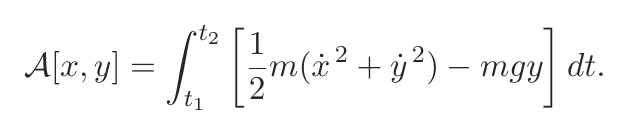
Stationarity under admissible fixed-endpoint variations yields the same equations of motion. “Stationary” need not mean “minimum,” and describing the whole path adds no process of foresight to the particle.
Noether connects suitable continuous variational symmetries to conservation: time translations to energy, spatial translations to momentum, rotations to angular momentum. Conditions matter; a time-dependent external influence need not conserve subsystem energy, and general relativity does not automatically supply one conserved global cosmic energy.
Clocks and dynamical geometry
Relativity distinguishes the duration measured along a clock's history from coordinates assigned to distant events. For inertial frames in relative motion,

The cross term makes distant simultaneity frame-dependent: at a separation of 300 meters and v=0.6c, events simultaneous in one frame differ by about -0.75 microseconds in the other, for the stated orientation. Causal order remains invariant for events connectable by signals at or below c; spacelike events can reverse coordinate order without reversing any possible ordinary causal influence.
Proper time follows the clock's actual path. At constant speed in flat spacetime,
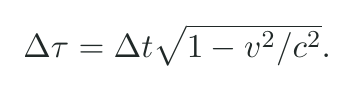
A clock moving at 0.6c accumulates eight seconds during ten coordinate seconds. Comparing reunited clocks requires their whole paths, including changes of motion.
General relativity makes geometry dynamical: matter's energy, momentum, and stresses relate to curvature, which determines intervals, light propagation, and free-fall paths. Initial or boundary data and matter descriptions remain necessary for a particular solution.
Chou and colleagues raised an aluminum-ion optical clock by 33 centimeters and measured a fractional frequency increase of (4.1±1.6)×10^(-17). The weak-field estimate gh/c^2 gives about 3.6×10^(-17). A laboratory intervention therefore tests geometry's relation to clock rate. Physical succession has situated durations and invariant causal structure.
Quantum states and alternatives
Quantum theory does not begin with a general inventory of classical trajectories. Quantum states provide amplitudes and measurement probabilities; an isolated pure state evolves through the Schrödinger equation, while mixtures require a statistical state description. A qubit has a two-dimensional state space with normalized complex amplitudes, whose relative phase affects possible operations and measurements.
When alternatives remain coherent, their amplitudes add before probabilities are calculated:

For a=b=1/4, the displayed outcome has probability 1/4; changing to b=-1/4 makes it zero even though the squared magnitudes are unchanged. An ordinary mixture lacks the phase term and therefore cannot generally reproduce the coherent distribution.
Bach and colleagues controlled double-slit transmission with a movable mask, then accumulated localized electron impacts at about one detection per second. Their mean separation greatly exceeded the apparatus's length; the interference pattern therefore did not require collisions between neighboring electrons. The configuration constrained a distribution built from individual detections.
Path integrals construct transition amplitudes through contributions with phases exp(iA/ℏ), requiring a measure, normalization, and endpoint or state specification. Rapid phase variation produces cancellation; contributions near stationary action can dominate in suitable classical regimes. The alternative paths are a calculational device whose contributions combine into one transition amplitude.
Noncommuting observables resist simultaneously sharp values. For similarly prepared systems,
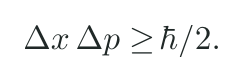
This constrains state distributions, not merely observational disturbance. An intervening perpendicular spin measurement can destroy certainty about a previously definite spin component.
Linearity also excludes a universal perfect copier of arbitrary unknown quantum states: a device copying two orthogonal states would not thereby copy their superpositions. Quantum amplitudes therefore do not provide arbitrarily readable classical storage.
Entanglement and Bell locality
A pure joint state is entangled when it cannot factor into pure states of its parts. For example,
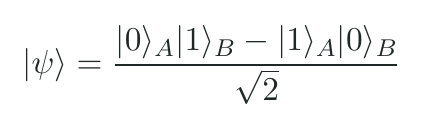
gives opposite outcomes along the specified axis while each local outcome is unpredictable. Local states do not exhaust joint correlations. For mixed states, separability instead permits probability-weighted mixtures of products.
Opposite outcomes alone could arise from paired classical instructions, so Bell tests compare correlations across different measurement settings. Bell-local factorization requires

where λ specifies relevant common causes. The usual test also assumes its distribution is independent of settings.
For local signs A_0,A_1,B_0,B_1, the combination

is always +2 or -2. Averaging gives the CHSH bound

Local stochastic responses obey it too. Suitable quantum states and settings permit 2√(2).
Hensen and colleagues used electron spins separated by 1.3 kilometers, heralded successful entanglement before choosing settings, and arranged spacelike measurement events with efficient readout. Their 245 trials yielded B=2.42±0.20 and a probability no greater than 0.039 for a local-realist model to produce so large a violation under the stated test assumptions.
Storz and colleagues extended the same test to superconducting circuits: two qubits connected by a 30-meter cryogenic link produced more than one million trials with S=2.0747±0.0033 and a reported p<10^(-108). Their timing closed locality, fair-sampling, and memory loopholes under the experiment's spacetime and random-input assumptions. The result is an independent implementation on a different physical platform; measurement independence and the physical identification of the relevant events remain part of the inference.
Bell locality and no-signaling differ: changing the remote setting does not controllably change unconditioned local outcome distributions, and comparing the exceptional correlations requires ordinary communication. The result constrains a conjunction of assumptions, not every account containing hidden variables.
Measurement context
Contextuality asks whether a sharp observable's value can remain independent of the compatible observables measured with it. For two spin systems, each row and each column in the following array contains mutually compatible observables:
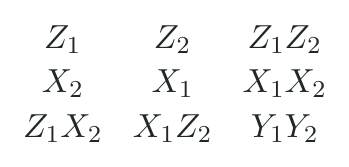
Quantum theory gives product +1 for all rows and the first two columns, but -1 for the last column, independently of the state. A context-independent sign assignment would use each entry twice in the total product and yield +1, contradicting the quantum -1. The corresponding row-and-column expression is bounded by 4 noncontextually and equals 6 quantum mechanically.
Kirchmair and colleagues obtained 5.46±0.04 for a singlet using two trapped calcium ions and exceeded 4 for nine further states. Repeatability and disturbance tests assessed how closely sequential measurements realized compatibility. The exact mathematical contradiction and the apparatus's operational fidelity are different parts of the result.
Records and the outcome problem
Measurement physically correlates alternatives with an apparatus and its environment:

If we inspect only the system and record, the interference terms carry the environmental overlap ⟨ E_1|E_0⟩. Ordinary interactions make that overlap extremely small, so locally accessible behavior approximates a mixture even though coherence remains in the complete joint description.
Decoherence explains suppressed accessible interference and favors dynamically robust pointer states. Quantum Darwinism investigates redundant encoding of selected observables in independently accessible environmental fragments, such as scattered photons. Such redundant access takes more than bare entanglement. The fragments carry information about those selected observables, not a copy of the entire system.
The remaining questions concern definite outcomes and probability. Bohmian configurations give definite results through nonlocal guidance and reproduce ordinary probabilities in quantum equilibrium. This supplies a definite trajectory while introducing a configuration whose relation to relativistic physics needs further treatment.
Everettian accounts retain universal evolution and locate outcomes relative to branches. Decoherence explains their approximate autonomy; explaining branch emergence and probability is the further task of this account. Were it true, the nonbranching continuity of a person used in Chapter 38 would have to be stated relative to a branch; the arguments of this book do not depend on choosing among these interpretations.
Objective-collapse theories instead change the dynamics to produce localization. Their parameters allow empirical tests of departures from ordinary quantum evolution while preserving microscopic success within bounds.
Relational quantum mechanics locates states and values relative to interacting physical systems. An observer is such a system, whether conscious or not; comparison of records brings the consistency of their accounts into question. These interpretations agree across much of the experimental field described here; collapse theories add distinct tests. Each gives physical records a place in its account of outcomes. Reading those records introduces a further relation: a mark can persist perfectly while its interpretation is false.
Recent manuscripts on gapped quantum matter ask when a joint state admits a controlled representation. The two-dimensional area-law manuscript claims that, for a finite induced square-lattice domain with fixed finite local dimension, finite-range bounded interactions, a unique ground vector, and a fixed positive full-system spectral gap, every region's ground-state entropy is bounded by a constant times the number of lattice edges crossing its boundary. No gap for each restricted subregion is assumed. Its PEPS companion claims that an open L× L square with bounded on-site and nearest-neighbor interactions and the same global gap admits a projected entangled-pair state: local tensors joined along the original lattice edges, with bond dimension at most CL^c and normalized global-vector error at most L^(-1), up to phase. The constants depend on the fixed local dimension, interaction bound, and gap. These are manuscript claims at the cited revision. The PEPS conclusion concerns existence of the representation, with no guarantee that its tensors can be found or contracted efficiently.
The substantive question is how local interactions and a global condition constrain the correlations of an entire state. An entropy bound at each cut alone does not supply the claimed global approximation: the descriptions at different cuts must fit together, accumulated error must remain controlled, and the network must respect the original geometry. This is a precise problem about the relations a representation preserves. Entanglement already shows why separate local states can leave the joint state underdetermined. The proposed area law and PEPS theorem concern how economically a restricted class of such joint states can be described. Representation cost is one fact about our access to organized matter; physical powers depend on the actual state and its dynamics.
Entropy and historical direction
System boundaries determine thermodynamic accounting. A closed system exchanges energy without matter; an isolated one exchanges neither; an open one can exchange both. For a closed system without changes in bulk kinetic or external potential energy,
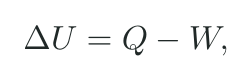
with heat into the system positive and work done by it positive. Heat and work name transfers, not stored substances.
Entropy is a state quantity. Between equilibrium states its change can be computed using a reversible path, dS=δ Q_( rev)/T, even when the actual process is irreversible. An ideal gas freely expanding from V to 2V in an insulated vessel receives no heat and performs no external-pressure work. Its entropy nevertheless increases by
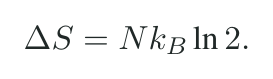
The statistical expression S=k_BlnΩ gives the same result because positional possibilities multiply by 2^N. Under the corresponding equilibrium counting, occupation of one specified half has snapshot probability 2^(-N), not a recurrence-time formula.
Microscopic reversible trajectories need not yield routine macroscopic reversal. Fine-grained Gibbs entropy can remain constant under Hamiltonian evolution while Boltzmann macrostate entropy rises. Macroscopic second-law behavior depends on the relevant variables and statistical conditions. Small stochastic systems admit negative-production trajectories; fluctuation relations constrain their probabilities while maintaining nonnegative mean total production.
Local organization can persist through exchanges that preserve the total accounting. A refrigerator exports more heat than it removes by receiving work; organisms exchange matter and energy. Exchanges alone are insufficient: a broken refrigerator also dissipates energy. Specific gradients, pathways, and rates determine what organization can be maintained.
Quantum entropy supplies a related example in which the full joint state matters. Here S(ρ)=-Tr(ρlogρ) uses natural logarithms and is dimensionless. Correlated modes need not have a total entropy equal to the sum of their separate entropies. For two independent finite-energy inputs on any finite positive number n of bosonic modes, passive beam-splitter mixing with transmissivity η obeys
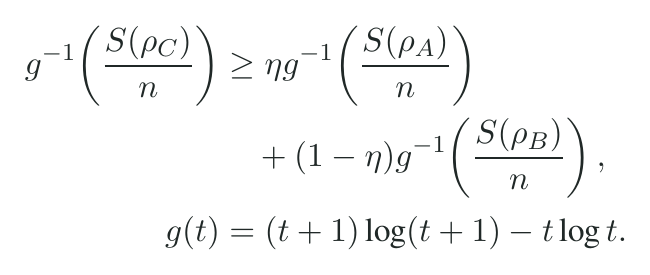
Arbitrary multimode entanglement within either input is allowed; the independence condition concerns the two input ports. Product thermal inputs with a common mean inside each port attain equality, even when the two port means differ. The quantity g^(-1)(S/n) is the mean photon number per mode of a product thermal state with that same entropy, an effective thermal coordinate rather than the input's actual mean photon number.
The proof keeps each input's joint quantum state intact. It first controls a minimization problem by adding small thermal and energy penalties, so that candidate states cannot escape the estimates through uncontrolled high-energy tails. It then compares how entropy changes under mixing and thermal relaxation. Exact transformation and entropy-production identities cancel the obstructing terms. As the fourth-moment penalty tends to zero, the remaining regularizations supply the control needed to force the limiting minimizers to have thermal form. Internal correlations are allowed throughout the argument, rather than removed by assuming independent modes at the start. The gain is a sharp collective bound whose extremal states can be identified within the same account of the whole. This illustrates how one precisely defined state quantity can constrain many microscopic organizations without exhausting their other properties.
The thermodynamic arrow of time also requires suitable past conditions. Laws invariant under time reversal do not entail our much lower-entropy past. Typicality applied to a present macrostate cannot simply recover it; statistical explanation must include the past boundary. In a gravitating universe, gas-box intuitions about uniformity require further revision.
Physical memory and reset
A two-well particle memory represents 0 and 1 through stable occupation, with a barrier limiting transitions. Reset maps both initial values to one designated value; the output loses the input distinction.
For equally probable initial values, symmetric wells, no usable correlated side information, and a thermal bath at T, restoring the landscape after an error-free reset gives the entropy balance

so
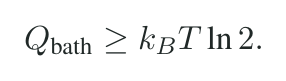
At 300 kelvins this is about 2.87×10^(-21) joules. With unchanged internal energy, minimum mean work has the same value. Quasistatic operation approaches the bound; finite speed and dissipation add costs.
Bias, unequal state energies or entropies, and usable correlations require different free-energy accounting. An uncounted controller can conceal where information went. Reset error ε leaves binary uncertainty

giving the corresponding simple-case heat bound k_BTln2[1-H_2(ε)]. At ε=1/2, unchanged uncertainty need not constitute any reset; at zero it recovers the ideal result.
Bérut and colleagues implemented two wells with optical trapping of a colloidal particle in water. Lowering the barrier, favoring one well, and restoring the landscape enabled repeated heat estimates. Longer protocols approached the benchmark; sufficiently strong tilts gave erasure success near 95 percent, with analysis of residual uncertainty. Individual trajectories fluctuated around the statistical result.
A one-to-one operation, such as exchanging 0 and 1, preserves recoverability and is not this reset task. Reversible computation therefore need not pay the reset bound at every gate, though practical speed, reliability, control, and eventual record handling still cost resources. The heat formula counts physical distinctions, whatever a stored report means.
An interaction produces a usable record when a fixed readout continues to report the relevant event across varied histories. In Mlodinow and Brun's reversible model, particles crossing between two chambers advance or reverse a counter. Changing their detailed paths while preserving the initial macroscopic imbalance changes the coupled counter with the net crossings. An independently preset display continues its old sequence.
The reading can also be reinterpreted using a reference chosen at a later endpoint. That apparent reverse record depends on a special history: generic microscopic perturbations at that later endpoint break the entropy-decreasing reconstruction. The authors' generality and robustness conditions connect recording direction to an existing thermodynamic arrow, even with nondissipative memory. Preparation, interaction, readout, and boundary conditions work together. A forecast instead extends a model beyond the registered events. Records and predictions can both inform action, through different relations to what happened. Reset cost and recording direction therefore require distinct explanations.
Powers in their conditions
Situated durations, joint quantum states, measurement contexts, and historical boundary conditions give physical powers their concrete form. What a thing can do depends on its organized conditions. A joint state can determine relations that no inventory of separate local states captures; a stable record can carry an event's consequences beyond the interaction that produced it. Classical descriptions remain useful where their approximations fit this more detailed reality.
Lewis's Humean account locates laws in the true system that best balances simplicity, strength, and fit. Bird grounds them in the dispositional essences of properties. Ontic structural realism treats relational organization as concrete reality, rather than merely a preserved description. Each offers an account of lawful order compatible with the tested findings.
Sustained agency in a lawful world
A world in which embodied creatures learn must let them persist while changing. An encounter has to leave a difference that remains available when it can guide further action. The bearer needs enough stability to retain that difference and enough responsiveness to use it before the relevant opportunity passes. Laws, resources, records and acting powers therefore do different work within one continuing activity. Their connection gives physical history its importance for formation.
The relation has a measurable temporal structure. In a model of cellular sensing, receptors respond to a changing chemical concentration and downstream molecules retain information about their recent states. Averaging reduces sampling noise, but older measurements can cease to represent the present concentration. Malaguti and ten Wolde show how the best integration time depends on the resources and dynamics of the specified system. A longer-lasting trace is therefore not automatically a better instrument of response. What must endure, and for how long, depends on the activity it serves.
A protective sensor illustrates three independent conditions: accuracy about the danger, a response before the opportunity passes, and an effective action following the alarm. Improving one does not supply the others. Different mechanisms can satisfy their coordination, so a recipient's good constrains an arrangement without selecting one unique implementation. The mathematical question about preserved distinctions becomes a physical question about whether information remains usable in time.
These relations give the creative purpose in Chapters 3 and 4 physical content: encounter, retention, response, and development enable creatures to become consequential participants. Their ordinary powers do the causal work. Dependable order provides that opportunity, while the possibility of protective action shows why lawfulness alone cannot explain every permitted destructive outcome.
Resurrection develops the relation between source and recipient already argued in Chapters 3 and 4. The giver of the creature's whole actuality can restore embodied life when ordinary powers fail; His fidelity directs that restoration toward the actual bearer of the interrupted good. The Christian promise concerns this creature and the renewed conditions of its embodied life. The physics considered here describes ordinary powers and constrains proposals about their operation; it supplies no mechanism that predicts this renewal. Chapters 38 and 41 develop its account of numerical identity and fulfilled creaturely life. We now turn to the realized cosmic history that supplied the material, gradients and structures through which the embodied powers familiar to us became possible.
Related research
Compare this chapter with source documents or study its biblical references.
Chapter comments