Israel's covenant connects deliverance to a durable organization of common life. Exodus 12 makes the connection explicit: the Passover joins protection and departure to lamb or goat shared by households, blood at the doorway, roasted meat, unleavened bread, bitter herbs, a calendar, and a child's future question. A received event becomes available to later generations through testimony and repeated practice.
The institutions that follow perform distinct formative work. Worship identifies the giver; instruction preserves the terms of belonging; rest and provision give dependents actual goods; public judgment makes power answerable. Their unity lies in a rescued people's responsibility to communicate what it has received.
A gift that creates obligations
Deliverance precedes Sinai. The commandments identify their giver through the rescue already accomplished; obedience cannot purchase it. Yet remembered release creates duties toward workers and strangers now dependent on the rescued people. Freedom forms people able to rest, judge, repair, and remember.
Rescue and maturity differ: Israel can leave slavery while retaining fear, appetite, and dependence on visible power. Torah gives instruction within the received relation, joining worship to bodily, household, economic, and public conduct.
The relation has a reason beyond national advantage. Deuteronomy joins the Lord's love and remembered oath to election, denies that Israel's greatness explains it, and identifies the universal Lord as an impartial judge who loves the stranger and provides food and clothing. Israel must love the stranger in turn. The particular gift therefore creates responsibility toward people outside its first recipients. Creation, deliverance, and commanded imitation supply that inference together; election alone would not establish it.
Promise, deliverance, and formation
Promise before possession
Abraham receives offspring, land, and blessing directed toward the earth's families before settled possession. Genesis 15 places his question about an heir, reckoned righteousness, future affliction, and the divine covenant undertaking together. The ceremony does not describe bargaining between equals.
Genesis 17 gives circumcision bodily, household, and generational force, includes those born or acquired there, names Sarah, and specifies Isaac. Promise precedes land, temple, and king. Election has a particular bearer for others' blessing (Genesis 12; 15; 17).
Deliverance, covenant and a broken promise
Exodus begins with political forgetting, forced labor, and threatened children, but also differentiated resistance by midwives and Pharaoh's daughter. God hears and remembers, commissions a reluctant Moses, and confronts public domination. Rescue must become a way of life; bondage can outlast its chains.
Passover's protection cannot conceal the firstborn deaths across households, including a captive's. Firstborn is a household relation, not a synonym for infant, and the narrative does not assign Pharaoh's culpable intention to everyone who dies. This is a temporal judgment within a shared history: Israel's deliverance and each sufferer's good remain distinct claims upon the same Creator. His care for those who die continues beyond this mortal phase and reaches their own restored embodied lives, as Chapters 38--41 argue. The remaining question concerns the fittingness of these deaths within deliverance. Chapter 19 examines the additional question raised when human agents receive a lethal commission.
Sinai joins priestly and holy vocation to words, assent, covenant blood, and the elders' meal (Exodus 19–24). The calf then misuses gold, skill, office, altar, festival, and even the divine name. Aaron's excuse conflicts with the narrator's account of his making. Intercession recalls promise; severe judgment, including killing and plague, is followed by renewed covenant and declared mercy. Severity and continued relation belong together (Exodus 32–34).
The wilderness and the learning of freedom
Manna meets hunger while teaching daily reception and Sabbath preparation. Failed hoarding and sanctioned preparation have different relations to the instruction (Exodus 16).
Numbers 11 contrasts nostalgia that minimizes Egyptian bondage with Moses's acknowledgment of an unbearable leadership burden. Quail ends in plague; Moses receives elders' assistance and welcomes the Spirit's activity beyond his own position. Not every troubled appeal is faithlessness.
Numbers 14 joins fearful refusal, threatened dissenters, intercession, forgiveness, and lasting consequences. The subsequent unauthorized advance shows that opposite behavior is not automatically correction: boldness can become presumption. At Meribah, water is provided while its leaders are judged, so effectiveness cannot certify faithfulness. The bronze serpent joins admitted wrong, intercession, and instructed healing without making the sign an independent source of life (Numbers 20–21).
Freedom is learned through this sequence of reception and response. The same people can fearfully refuse a gift and then presumptuously seize it. Manna, Sabbath, shared leadership, and correction teach them to receive provision and act within the relation that gives it meaning.
Balaam and the price of truthful speech
Balak hires religious speech for political control. Conditional permission, anger on the journey, and renewed restriction resist reduction to one uncomplicated command. Balaam's donkey perceives danger before the seer and is struck for preserving him. Changed locations, sacrifices, and payment cannot compel the promised curse: it becomes blessing.
Later texts identify counsel toward Peor, wrongful payment, and idolatrous compromise, supplying accusations not all narrated in the blessing oracles themselves. True words can coexist with false love.
Hear, love and remember
The Shema's compact syntax admits “one” or “alone” emphases, while Deuteronomy 6 explicitly requires exclusive allegiance. Its household practices receive their significance from that obligation.
Deuteronomy 8 adds prosperity's distinctive temptation: attributing wealth solely to one's power while forgetting received capacities and provision. Instruction must remain answerable to its giver when dependence becomes less obvious.
Institutions and the goods they protect
Holiness in the household and at the table
Leviticus 19 places parent reverence, Sabbath, offerings, harvest provision, truthful exchange, wages, impartial judgment, sexual conduct, and care for aged, disabled, and foreign neighbors within consecrated belonging. Holiness reaches the whole of common life, and a moral prohibition keeps its lasting force whatever ritual rule stands beside it.
Food rules identify a particular people's consecration rather than merely hygiene. Deuteronomy 12 distinguishes ordinary slaughter and eating away from the sanctuary, available to clean and unclean alike, from sacred meals. Blood's relation to life governs its prohibition; Leviticus 17 links blood given on the altar to atonement. Their differing settings matter. Rejoicing and provision include dependents, Levites, strangers, widows, and orphans.
Rest that reaches the servant
The householder who directs labor must share rest with servants, children, resident strangers, and working animals. Exodus grounds the command in creation; Deuteronomy in remembered deliverance. This costs actual productive use and makes rest durable rather than dependent on the master's mood. The command requires actual relief from enforced demand.
Debt, land and a family's future
Deuteronomy 15 anticipates refusing a needy borrower as release approaches and forbids that calculation's closed hand. Its debt rule distinguishes fellow Israelites from foreigners. Six-year service ends with material provision, while elected permanent service remains a regulated dependency rather than ordinary employment.
Leviticus 25 connects Jubilee to seven seven-year cycles, release, family return, and God's ownership of land. Transfer prices track remaining harvests; kin redemption and recovery have defined calculations. Walled-city houses, village houses, and Levitical property receive different rules. Jubilee is not universal cancellation of every possession.
Impoverished Israelites return with their children; foreign slaves can instead be acquired and inherited. The same laws show both a norm and a hierarchy.
The edge of the field
Field edges, forgotten sheaves, and remaining olives and grapes give vulnerable people claims on produce the owner could otherwise gather (Leviticus 19; Deuteronomy 24).
Ruth 2 adds operational requirements: protected access, water, a meal, prohibition of harassment, and deliberately left grain. Ruth's work supports Naomi and expresses her own agency. Its success displays one of the law's several modes of provision.
Deuteronomy 26 joins the firstfruits testimony of affliction and rescue to shared rejoicing, and the distinct third-year tithe declaration to actual food distribution. Thanksgiving incurs a public obligation.
Truth at the scales and the gate
False weights enact deceit materially. Creditor limits protect means of life and privacy: no millstone pledge, no entering the debtor's house to seize a pledge, return of the poor person's garment for the night, and wages paid before sunset.
Judicial instruction excludes bribery, false reports, crowd pressure, and partiality toward either poor or powerful. Multiple witnesses and diligent inquiry address charges; false witnesses answer for intended harm. Deuteronomy 24:16 forbids transferring executions between parents and children, despite wider inherited consequences.
Royal power likewise faces limits on horses, wives, silver, and gold, with law-reading directed against a heart lifted above others (Deuteronomy 17). Office remains under the instruction it administers.
Approaching the presence
The tabernacle's court, altar, basin, holy place, veil, ark, and kapporet, the atonement cover, express given nearness and restricted approach. The priest represents others while needing cleansing himself. Terms such as mishkan, dwelling; miqdash, sanctuary; kohen, priest; and mizbeach, altar, name concrete places and service (Exodus 25–30).
Solomon's prayer denies that heaven or the building contains God while asking hearing, judgment, and forgiveness, including for the foreigner (1 Kings 8:27–43). The prayer locates a place of approach without confining God there.
Impurity is not simply guilt
Tame and tahor name ritual states. Childbirth, emissions, and intercourse can require washing, waiting, or offering without constituting moral offenses. Interpreting every purification as punishment would invent guilt.
Impurity nonetheless affects contact and access, with sanctuary defilement a stated concern. Moral acts can additionally defile land and dwelling (Leviticus 15–18).
Five ways of bringing an offering
Qorban concerns bringing near. Five forms differ in occasion, distribution, and action.
The olah ascends through burning: herd or flock involves an unblemished animal, hand-laying, slaughter, priestly blood action, and washing. The hide goes to the priest; bird procedure differs. Whole-offering character coexists with acceptance and atonement.
The minchah brings cultivated produce, preparation, oil, incense, and covenant salt. A memorial portion burns and the remainder ordinarily feeds priests; a priest's own grain offering is wholly burned.
The shelamim joins altar portions, priestly portions, and an offerer's meal. Thanksgiving meat is eaten that day; vow and freewill provisions differ in timing. Fellowship retains restrictions on cleanness.
The chattaat, sin or purification offering, differentiates priest, congregation, leader, and ordinary member. Blood for priestly and communal cases reaches the tent, veil, and incense altar; other cases concern the outer altar. Confession and means-adjusted provision permit birds or, for the poorest, flour without ordinary oil and incense. Its use after childbirth prevents assigning moral guilt to every occasion.
The asham, guilt or reparation offering, concerns holy things, uncertain liability, and deceitful injury to a neighbor. Required restitution adds a fifth; offering cannot legitimate retaining another's property.
The offerings share appointed approach but differ in what they accomplish: dedication, provision, fellowship, purification, and reparation. Their distribution of food and their treatment of impurity or debt identify the differences. Overlap does not make one offering interchangeable with another.
Hebrews later receives this differentiated grammar in Christ. Its once-for-all offering gathers priesthood, cleansing, access, and service without making Israel's earlier practices empty. The comparison depends on their particular operations, not merely on a shared use of sacrificial language.
The cleansing of the common dwelling
Leviticus 16 begins after Aaron's sons' deaths and restricts entry beyond the veil. Washing and linen garments accompany offerings for the mediator and congregation. Lots distinguish a killed goat for the Lord from a live removal goat; Azazel's interpretation remains disputed.
Aaron first offers his bull, enters with coals and protective incense, and applies blood on and before the cover. The people's goat's blood follows. The holy place, tent, and altar are cleansed from impurities, transgressions, and sins. No other person enters the tent during this action; altar blood and seven sprinklings cleanse and consecrate.
Afterward Aaron lays both hands on the live goat, confesses Israel's wrongs, and sends it away through an appointed person. Cleansing and removal are complementary, not identical killings. Aaron changes garments, washes, and offers burnt offerings; fat burns on the altar and the bull and goat remains outside the camp. Removal and burning participants wash before return. Work ceases and the people, including the stranger, humble themselves annually.
Here “the holy place” can mean the innermost space; Exodus 26 distinguishes it as the most holy place. Hebrews 9:5 uses hilasterion for the cover. These particulars give later interpretation its material ground.
What kind of direction does a text give?
Typed directive force distinguishes seven kinds of direction: creation-rooted norms specifying a relation's good; direct moral commands; permissions regulating practices below that good; covenantal and ritual instruction received through fulfillment; civil restraint and temporal judgment within a historical jurisdiction; narrative, lament, wisdom, and prophetic exposure with their different assertions; and unique commissions limited to named agents and circumstances.
They can overlap. A rite can teach enduring goodness without perpetual repetition, a reported excuse is not an endorsed one, and a wisdom pattern is not a guarantee. Classification follows exegesis.
Instruction within an unfinished history
An instruction is understood through its actual command or permission, the good it serves, its covenantal setting, and the wider canonical judgment culminating in Christ. Its reception also becomes visible in what happens to those governed.
God addresses real people acting through an inherited order. Law can bind power, secure a needed good, and teach a response whose fuller exercise requires changed habits and common arrangements. Formation therefore has a historical object: these recipients learn to live the good through powers and relations they actually possess. A provisional permission regulates an existing practice below its fulfilled good; a rite truthfully anticipates a fuller gift; an endorsed command entrusts the act it actually requires. These are different ways of governing an unfinished history.
Irenaeus distinguishes hard-hearted concessions while recognizing adapted instruction within the New Testament too. Gregory's staged disclosure supplies an analogy: reception can be truthful while growing into fuller clarity.
Divorce and the good of the union
Deuteronomy 24:1–4's conditional sequence prohibits a first husband's renewed marriage after an intervening union; it does not command divorce. Matthew 19 expressly distinguishes Moses's permission under hard hearts from creation's union. The passage establishes accommodation's possibility.
Matthew's exception, separation for protection, and remarriage are distinct questions, and seeking safety from violence is never infidelity.
Slavery as a harder test
Exodus 21 regulates beating and speaks of the master's money; Leviticus 25 permits inherited foreign ownership. Restraints and release provisions regulate an institution that remains slavery.
Canonical counterpressure includes common creation, an escaped slave's protection from forced return, a servant's grievance before the shared Maker, and deliverance itself (Deuteronomy 23:15–16; Job 31:13–15). Philemon requires receiving Onesimus as beloved brother and as Paul, with Paul bearing debt; it leaves manumission unnamed and the outcome unreported.
Gregory of Nyssa's fourth Ecclesiastes homily attacks pricing God's image. Abolition fulfills the created standing and Christian kinship already named. The provisional reading developed in Chapter 31 understands inherited ownership as a recognized civil relation within an entrenched order whose governing good requires its transformation. The decisive change is the ending of personal title with provision for a free life: work, material care, and belonging can continue through relations that leave the person free. Christian slaveholding shows how strongly the earlier arrangement could resist that end. Chapter 31 develops the legal and canonical argument and retains the particular question of why foreign ownership received this durable form.
Truthful Scripture and disputed readings
A narrator can report a character's false claim without endorsing it. An endorsed divine attribution makes a different assertion; reading it as mistaken changes the account of the witness's truthfulness.
Westminster grounds Scripture's authority in God as its author, affirms its truth, and directs readers to interpret less clear passages through clearer ones. Dei Verbum explicitly develops human authorship, literary forms, and the writers' historical circumstances while affirming divine inspiration and truthful assertion. Reformed reception also recognizes human mediation, but Westminster I.4--10 does not itself set out this literary program. The shared commitment to truthful Scripture leaves substantial differences over Scripture, Tradition, and teaching authority.
Harmed people's testimony can expose omitted facts and authority the text never grants. Receiving it can correct interpretation in obedience to Scripture.
The world in which this history is told
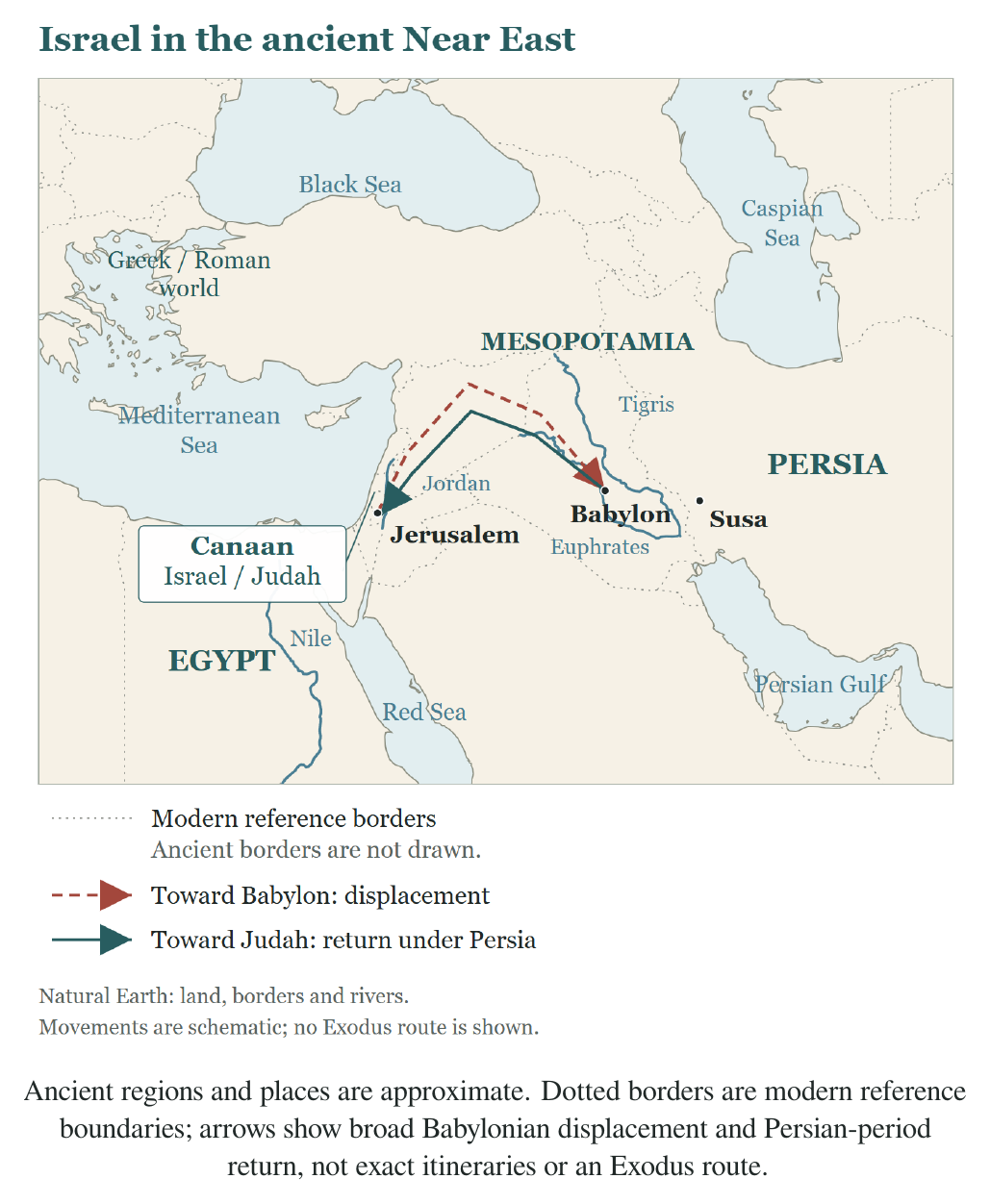
Egypt's Nile valley, Mesopotamia's river systems, and Canaan's eastern Mediterranean corridor connect cultivation, commerce, migration, and imperial pressure. Israel's covenant was particular within a connected world.
Narrative sequence, historical reconstruction, and theological interpretation require distinct evidence. The canon orders promise, Exodus, Sinai, settlement, monarchy, and temple; that order is not identical to a reconstruction of textual composition. Patriarchal dates and the Exodus's scale, route, and dating remain disputed.
Merneptah's victory inscription, conventionally dated around 1208/1207 BCE, independently names Israel as a people in the southern Levant. The Ketef Hinnom silver amulets preserve blessing language corresponding to Numbers 6:24--26; their editors argue from the artifacts and writing for a late preexilic date. These anchors attest a known people and the use of divine blessing in Judah. They do not establish Israel's complete origins or Exodus route, date the completed book of Numbers, or demonstrate general observance of its laws.
The testimony concerns a real deliverance received and remembered by this people. Its route, population, and date require historical judgment. No Egyptian record of the departure is known, and Merneptah supplies the earliest external mention of Israel. Archaeological evidence weighs against a migration on the mass scale suggested by a literal reading of the narrative's population totals. It does not settle whether a smaller movement from Egypt contributed to Israel's formation. The deliverance can be real and its scale modest. An invented founding act would contradict a different and more basic claim than an incorrect reconstruction of its itinerary.
Egypt's creators and the order of life
Egyptian traditions joined solar renewal, fertility, death, restoration, kingship, and divine order. Ra, Osiris, and Isis exceeded labels for physical mechanisms. Atum's creator role and combinations such as Ra-Atum and Amun-Ra sought unity without necessarily abolishing differentiated gods. Amun's hiddenness and a plurality of names belong to that same search.
The Great Hymn to the Aten extends life-giving provision to humans, animals, womb, egg, and peoples beyond Egypt with differing languages and appearances. Akhenaten's reform nevertheless concentrated authority in the royal family; household practices did not uniformly abandon other protective deities. Universal provision, exclusive devotion, and a doctrine excluding every other deity are three different things, and the Hymn most clearly attests the first.
Ma'at joined truth, justice, and cosmic order; heart-weighing placed a life under judgment. Israel's neighbors had a moral theology of their own.
Babylon's god and the king's justice
Mesopotamian accounts placed Anu, Enlil, and Ea in differentiated relations of heaven, authority, wisdom, and creation. The Enuma Elish elevates Marduk through victory over Tiamat, cosmic ordering, and fifty names; identification with Asalluhi joins inherited ritual wisdom. This is expansive integration within relations among gods, rather than dependence on one uncreated Creator.
Hammurabi's prologue and epilogue claim divine authorization to restrain the strong and defend the weak, widow, and orphan. They establish a professed norm, not its consistent realization. The same distinction governs Israel: laws against oppression do not describe an oppression-free society.
Confession through defeat and displacement
The texts accuse Israel and Judah of rival worship, preserving contested allegiance rather than uniform practice. Exilic claims that no other God exists place catastrophe and foreign rule under the Lord's sovereignty instead of treating defeat as His defeat (Isaiah 40; 44–45).
A Kuntillet Ajrud inscription dated to the late ninth or early eighth century BCE invokes YHWH of Teman and his asherah. The object named is disputed: the goddess Asherah or a sacred pole or tree associated with worship. The published editors favor the latter, partly because a following verb is singular. Either reading requires distinguishing this historical association from the canon's exclusive worship; Deuteronomy 16:21 expressly prohibits an asherah beside the Lord's altar. The inscription gives concrete evidence of practices that the normative confession had to contest.
A 407 BCE Elephantine petition seeks help rebuilding YHW's temple outside Jerusalem and restoring offerings, appealing to authorities connected with Judah and Samaria. A separate donation list names the Jewish garrison and allocates funds to YHW, Eshembethel, and Anathbethel. Together they attest a community whose temple and religious practice differed from Jerusalem-centered exclusivity; the precise relations among its named deities remain disputed. Historical Jewish practice therefore cannot simply be read off the mature canonical confession.
Fulfillment and the people of the promise
Hebrews's contrast between repeated entry and Christ's offering presupposes real sanctuary, priesthood, cleansing, and access. Israel's practices were not empty until recruited as Christian illustrations.
Melito receives lamb, Exodus, and liberation through Christ's Pascha, but his collective accusation and humiliation of Israel require criticism alongside that insight.
Romans 9–11 identifies Israel's covenants, worship, promises, and Christ's descent, rejects simple abandonment, and forbids Gentile boasting over the root. Disputed interpretations of “all Israel” leave that prohibition clear.
Christian fulfillment consequently concerns both continuity and extension: the same God's promise reaches the nations through Jesus, while Israel's history remains the source of the covenantal terms in which that fulfillment is understood.
A public life answerable to its giver
The institutional comparisons now give covenant a determinate public content. Sabbath limits another's use of one's time; gleaning and release protect access to material life; truthful courts govern accusation and power; offerings order approach, fellowship, and repair. None can substitute for the others. Their failure gives prophetic judgment its concrete objects, which the next chapter examines.
Related research
Compare this chapter with source documents or study its biblical references.
Chapter comments