Corruption is a disorder of good created powers and relations. Memory can preserve a lie, judgment can devise exploitation, loyalty can protect an abuser, and speech can conceal the result. Their local effectiveness survives while their ordering defeats the good of their bearers and neighbors. Institutions can then carry the damage beyond the original act.
A finite or local good does not become evil merely because it is finite or local. Food, beauty, wisdom, likeness, agency, authority, self-preservation, and loyalty each have a fitting good. The wrong lies in their mode, timing, measure, or relation: taking before receiving, making a partial good absolute, or using a good power against the giver and the neighbor to whom it is ordered. A wrongful act can therefore contain real goods without making the act good. No independent evil being needs to be added to explain the damage; a good creature and its powers are bent into a false relation.
Good powers in a wrongful act
Privation concerns a good missing where it belongs. A stone's inability to read is no defect; a reader's lost ability can be an injury; deliberate misleading speech lacks the truthful order owed in that act. Privation leaves evil's effects fully real and leaves ordinary limitation innocent.
Augustine's anti-Manichaean argument locates corruption in a nature possessing measure, form, and order. Removing all good would remove the subject capable of corruption. Deception depends on understanding and trust; domination depends on powers that could serve common life. Evil requires no second source manufacturing its substance.
Sin concerns culpable departure from what is owed; corruption concerns damaged powers or relations; alienation concerns estrangement; bondage concerns impaired freedom under a pattern's or power's service. Biological corruptibility names susceptibility to decay, not a creature's guilt. Injury can damage a power without its bearer having misused it. One person's sin can produce another's injury. The wrongdoer remains a creature with dignity, but protection cannot wait for willingness to repent. Ordinary dependence, developmental incompletion, and innocent impairment belong outside an automatic attribution of sin.
A governing map of good, damage, and blame
A created power enables its bearer to receive, enact, or communicate a fitting good under fitting conditions. Its local effectiveness can survive a disordered use: speech can still persuade while making truthful trust harder. To assess a history of such use, we need to distinguish the power, its exercise, the injury, and the responsibility for it.
Four distinctions must remain together. Good incompletion is a power's ordinary development or bounded scope; a child does not lack a mature adult power in the sense of having suffered its loss. Innocent limitation or injury is a power that is absent, blocked, or damaged without the bearer's culpable misuse, including a wound received from another. Corruption is a power, valuation, or relation damaged relative to the fitting good of that bearer and history. Culpability concerns blame for the agent's own act, assessed through the test of Chapter 15: available understanding, reasons, consent, control, and relevant earlier choices. The same event can therefore contain a real local good, a damaged relation, a victim's injury, and an offender's wrongful appropriation without collapsing these into one category. A lesser good remains good; the bearer of a damaged condition may have suffered it, helped produce it, or knowingly sustained it. Those histories require different judgments.
The earlier arguments now converge. Information distinguishes a carrier from the truth it conveys (Chapter 5); learning explains how a pattern becomes durable (Chapter 11); anthropology identifies whose powers change (Chapter 13); ethics specifies their fitting good (Chapter 14); formation locates the conditions of responsible response (Chapter 15). Moral repair must therefore change the failed relation in the actual person's life. Correct output, accurate records, and outward compliance each leave other parts of that task open.
For example, abolishing an abusive office ends its authority but does not itself heal its holder or its victims. The holder's speech and judgment require a truthful use; victims require their own redress. Reconstructing the record guides these acts without performing them.
The question of the first defection
Transmission cannot explain the first wrong by indefinitely inserting an earlier corrupter. Genesis's already deceptive serpent relocates that question without answering it.
Augustine calls the evil will's cause deficient: a good object is loved outside its due order. Gold need not be evil for its pursuit to betray justice. Positive causes still explain perception, desire, deliberation, and action; the missing order is not an additional entity requiring a maker.
This explains how the first wrong can use powers that are good. Attention can fix upon an attractive finite good; judgment can treat possessing it as sufficient reason for action; willing can ratify that pursuit while failing to honor a relation the agent could recognize. The new wrong consists in that deficient ordering of an actual act. It does not require a previously evil desire as a separate ingredient. Once enacted, however, the act creates a history: a false account can be repeated, concealment practiced, and another person's conditions altered. The first wrong and its later transmission thus belong to one account without requiring the first agent to inherit the very corruption being explained.
Sirach refuses to attribute transgression to God's leading someone astray; Wisdom joins God's life-giving goodness to death's entrance through hostile envy. Their canonical standing differs across traditions, but they attest an ancient Jewish concern predating the Christian synthesis.
Mutability makes change possible without necessitating rebellion. A first wrong is culpable through the same understanding and control as any later one; innocent immaturity or error is not sin. Privation explains the misuse of good powers without a prior evil substance, but it does not explain why this capable creature defected now. Genesis gives no complete psychology of the first spiritual rebellion.
The garden is given before it is lost
Genesis 1–2 gives image, blessing, food, earth, breath, water, meaningful work, and companionship before transgression. Cultivating and keeping precede painful toil. Solitude's insufficiency and the woman's shared flesh and bone place dependence and bodily relation among the goods later wounded.
The command begins with permission to eat freely, then names one prohibited tree and death's warning. Omitting abundance changes the boundary's narrated proportions. A formative reading recognizes activities requiring exercise and growth. By the time of the narrated temptation, the source of the boundary has given life, provision, vocation, and companionship. These gifts supply a positive ground for trust. Within the narrative, the prohibition belongs to that received relation.
Genesis names the giver YHWH God, and the later canonical synthesis names the same giver Father.
Wisdom received and wisdom seized
The serpent contradicts the warning and redescribes its giver as a rival withholding advancement. Food, beauty, and wisdom attract because they are real goods. The question is their reception and use.
Knowing good and evil can concern developed or authoritative judgment: children lack it in Deuteronomy 1:39; Solomon requests it for governing in 1 Kings 3; the woman of Tekoa ascribes it to David within Joab's arranged petition in 2 Samuel 14.
Theophilus explicitly interprets Adam as immature and the good fruit as unfittingly seized before readiness. Irenaeus's account of created growth supplies a wider theological relation between generous giver and developing recipient.
Counterfeit theosis names this pursuit of likeness as independent possession, with the giver recast as an enemy. The phrase brings together Theophilus's premature seizure and Irenaeus's created growth. Readings centered on comprehensive knowledge, autonomous moral determination, bitterly acquired discernment, or obedience emphasize other features of the tree and command.
The formative reading distinguishes mature discernment from knowledge adequate to a particular response. One can understand a fitting instruction from a known trustworthy giver before being able to govern wisely or explain every consequence. Receiving and practicing that instruction can itself deepen wisdom. Genesis therefore need not make full possession of the tree's knowledge a prerequisite for all answerability. The warrant lies in the known relation and the intelligible command; finite ignorance by itself supplies neither guilt nor a universal excuse.
This distinction preserves the genuine gain and the rupture together. Their eyes actually open, and Genesis 3:22 acknowledges acquired knowledge. Possessing it nevertheless issues in nakedness, hiding, and accusation. The goods of sight and discernment have not become evil substances; their acquisition and use have broken the relation through which they were to serve life.
The act and the rupture
Both eat, but their narrated access differs. Genesis 2:16--17 addresses the command directly to the man before the woman's formation is narrated. In Genesis 3:2--3 the woman recounts a prohibition and warning, while the serpent contradicts them. Her reply establishes some knowledge of the boundary; it does not disclose every step by which she received or assessed it. First Timothy 2:13--14 later distinguishes her deception from Adam's participation without it. These differences support neither equal blame by assumption nor lesser female rationality.
Adam's appeal to the woman "given" him recruits a gift into accusation against its giver. Eve names real deception and acknowledges eating. The narrative judges a transgression, while the two persons' participation raises distinct questions: what was understood, what trust was warranted, and what response was practicable? The text portrays desire and action in relation to an articulated prohibition, but does not measure the pair's respective control or reconstruct their complete deliberation. Being deceived is not itself guilt, and naming a deceiver can be truthful testimony. The culpable element concerns the person's attributable participation in the act, not the mere fact that deception succeeded.
Judgment reaches childbearing, household relation, food-producing work, ground, and return to dust. The man's rule belongs to the description of rupture, as a consequence named rather than a pattern commended. Clothing and continued life give mercy material form. Guarded access to the tree of life prevents another seizure from simply perpetuating the damaged condition.
Irenaeus reads exclusion as a merciful limit: keeping the sinner from the tree prevents sin from becoming immortal and evil from becoming irremediable. The limit serves the recovery of the creature. Against Tatian, he insists that the very Adam who was taken captive must be restored; rescuing his descendants while abandoning the original captive would leave the victory incomplete. His reading therefore distinguishes ending sin's rule from ending the person who needs release. He joins that recovery to Genesis 3:15's victorious seed, understood as Christ born of Mary.
How formation turns
The serpent first attacks source trust, making the giver appear to withhold maturity. A changed frame makes abundance look like deprivation and dependence like inferiority. Within it, valuation treats food, beauty, and wisdom as sufficient warrant to take; the chosen act turns that interpretation into history. The desired telos, likeness to God, is pursued through a rupture of communion.
Taking and eating thus begin a pattern rather than merely reveal one already complete. The act gives later concealment and rationalization something to protect.
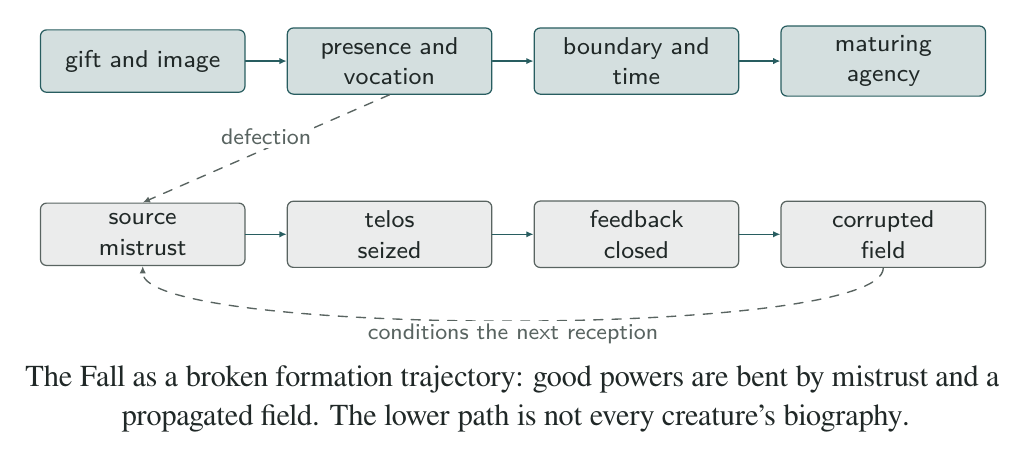
How the rupture travels
Shame and hiding close routes of acknowledgment. Adam's accusation recruits the woman and her giver into his defense; Eve's report names a real deceiver. A victim's withdrawal and an offender's concealment can look similar while belonging to different histories.
An enacted wrong gives its defense something to preserve. Repeated concealment can make reputation appear necessary to belonging, worth, and any possible future. A truthful account then threatens what the offender experiences as the self. This dependence is acquired: the same person can belong, act, and have a future through relations that no longer require concealment.
Correction can consequently be heard as personal ruin, making further concealment seem a defense of life. John describes believing authorities withholding confession for fear of expulsion and love of human praise. Healing reaches this false dependence by making truthful belonging practicable. The victim's protection and redress remain independent requirements; preserving the offender's position cannot condition them.
The transmitted environment carries fear, painful work, mortality, domination, and damaged trust into later lives. Body, household, language, ritual, and institution preserve what earlier people did. Path dependence raises the cost of correction: lies need concealment, violence invites retaliation, and domination rewards its extension.
Later people receive this world without having authored it. Their unequal powers allow different responses: ratification, resistance, deepening, or repair. Forgiveness of guilt must therefore be joined to healing capacities, relations, records, and common arrangements.
A damaged ecology
Each formative function can be bent: inputs exclude corrective witnesses; boundaries protect abuse; references model successful deception; community conditions belonging on assent; feedback rewards concealment; testing intimidates; withheld rest exhausts resistance; ceremonial repair declares closure without change. The required response addresses whichever function actually fails. More information cannot substitute for safety, a truthful reference, or an enforceable hearing.
Judgment brings this whole history into the light: what a person trusted, understood, chose, concealed, suffered, and passed on. A victim's inherited condition can require healing and protection without being treated as the victim's guilt; an offender's formed desire can explain a wrong without making it unreal. Judgment therefore distinguishes what must be forgiven, what must be repaired, and what must be prevented from reaching another person.
Cain and the next act
Cain receives a damaged history but is addressed before murder. Genesis 4 reports differing regard for the offerings. Anger meets a warning about sin and mastery, and killing is still avoidable.
Abel's blood cries from the ground despite Cain's denial. Judgment changes the murderer's relation to land and settlement, while the protective mark restrains further killing. The victim's loss, the offender's responsibility, and protection of the guilty remain distinct.
Livestock keeping, music, and metalwork develop within the genealogy. Cultural goods persist alongside violence. Lamech turns language associated with restraining retaliation into magnified vengeance. Inheritance can become a new culpable enactment while the arts remain good.
Noah and the preservation of a world
The flood narrative widens violence to pervasive corruption and joins God's grief and judgment to Noah's favor and obedience. Its terrible losses include creatures not described as culpable human agents, and the moral question their loss raises still stands.
Preservation uses material means: ark, food, gathered creatures, work, and eventual emergence onto habitable earth. God's remembering marks renewed possibility. The covenant gives durable restraint through seasons, a boundary concerning blood, protection grounded in the human image, and an explicit inclusion of living creatures and the earth (Genesis 6–9).
This is preservation, not completed moral healing. Evil in the heart remains, and Noah's later drunkenness and divided household disclose continuing vulnerability. The curse names Canaan, and no ancestry inherits lesser dignity or private guilt from it.
Babel and organized power
Babel's coordinated speech, technology, and building seek a name and security against dispersal. God's descent exposes the disproportion of a tower said to reach heaven; confusion and scattering interrupt the project by altering its coordination. Cities and shared language remain goods (Genesis 11:1–9).
The arts, settlement, and common speech survive within these histories as real goods. Their power to build a shared world makes their direction consequential: the same capacities can restrain violence or magnify it.
What the competing models explain
Craig's deep-progenitor proposal places Adam plausibly before 750,000 years ago and associates him with Homo heidelbergensis; a fossil designation cannot identify divine address. Swamidass's genealogical proposal depends on population connectivity, with Tasmania exposing a disputed isolation assumption. Walton retains historical persons while giving archetypal functions priority. Enns reads Adam through Israel's land, command, disobedience, and expulsion, accepts that Paul believed Adam historical, but treats Paul's Christ-centered use as sufficient without Adam's actuality.
Enns's proposal makes the strongest literary alternative clear: Paul can use a received story to teach the actual inclusion of Jew and Gentile in Christ without thereby certifying every feature of the story as history. Typology alone therefore cannot decide the question. The difficulty is the explanatory role Paul gives the one trespass, antecedent to the many later sins, and the embodied sequence in First Corinthians 15. Under the apostolic authority considered in Chapters 21 and 24, these carry more weight than an illustrative use alone. A real beginning can also retain the archetypal significance Walton emphasizes, with its population setting and genealogy answerable to their own evidence.
A common condition before our own acts
Romans 5's reign, condemnation, and constitution of the many as sinners exceed independent imitation. The received condition is objective covenantal and participatory solidarity. “Covenantal” does not make descendants private authors of Adam's choice; “participatory” does not make inherited conditions optional memberships.
Federal imputation, exemplified by Westminster VI, joins conveyed corruption to imputed guilt. Its Larger Catechism calls Adam a public person whose covenant concerns his descendants. Hodge carefully distinguishes the resulting judicial obligation to satisfy justice from personal criminality: the descendants did not perform Adam's act, but his sin grounds their penalty through their natural and federal union with him. This account gives full force to Romans 5's condemnation and to the Adam--Christ parallel. The disagreement concerns inherited punitive liability, distinct from personal authorship.
Accounts emphasizing deprivation and inherited death distinguish that condition from personally enacted fault. Athanasius emphasizes corruption and the need for the Word's restoring life. The Catholic catechism describes original sin as a received state and explicitly denies personal fault in descendants. Trent nevertheless teaches propagation of sin as each person's own and baptismal remission of its guilt, including in infants. These claims distinguish inherited sin from personally choosing Adam's act while placing the inherited condition within a sacramental and judicial relation of sin and its remission. Denying descendants' personal fault supplies common ground; it does not establish agreement on inherited guilt or its sacramental removal.
God judges Adam's rupture of a relation entrusted for common life; descendants enter its loss under Sin and death before their own choices. This consequential headship preserves Romans 5's one-act origin of a shared plight together with Ezekiel's distinction between father and son and Jesus' proportioning of accountability to knowledge and entrusted responsibility. The received consequence is real, but does not by itself create an individually owed penal debt. Social transmission explains part of its reach; a better example alone cannot rescue its members. Present possession of what is owed, continuing harm, or entrusted office can still impose duties of repair, as Chapter 16 explains.
The federal reading claims that divine appointment warrants the further punitive liability. Ezekiel and Luke do not expressly adjudicate that exceptional claim, so the disagreement concerns how the texts belong together. Romans 5 itself stresses the gift's superiority to the trespass: sharing Christ's unearned benefit establishes generous representative action without by itself establishing a reciprocal right to punish nonauthors. The narrower account retains a real shared need for Christ's new headship while keeping personal blame answerable to the same conditions for every recipient. Infants need His life; victims can resist the practice that injures them; neither owes retributive suffering simply by descent.
Historical tests for the beginning
Ancient injury requires an evidential sequence. Fresh-bone fracture patterns, repeated blows, and experimental comparison can support lethal interpersonal violence, as the Sima de los Huesos and Cioclovina studies argue. They establish injury and probable intention; the agent's understanding, freedom, and culpability before God are beyond the bone.
Earlier hominins without responsible agency pose no prior moral defection; earlier responsible persons without culpable wrongdoing leave the claim intact. Evidence of culpable wrongdoing before a proposed Adamic date would first send the date earlier, as Craig's proposal does. If that route failed, the claim would become an inaugural Adamic covenantal rupture within an already sinful history, with a renewed reading of Paul. Earlier persons, if there were any, possessed full dignity. What would count against the historical pair itself is textual rather than genetic: a demonstration that Paul's argument requires no causal antecedence of the one trespass, or that the sequence of First Corinthians 15 is typological throughout. Genetic evidence bears on the pair's setting, not on its existence.
Corruptibility and bodily death
Patristic accounts make incorruption a received gift: Theophilus describes movement toward mortality or immortality, Irenaeus created growth, and Athanasius participation in the Word sustaining corruptible creatures.
Genesis's guarded tree, return to dust, and repeated genealogical deaths put the warning into an unfolding material history. The death warned of therefore reaches the body as well as the relation to God, and resurrection's promise makes dissolution provisional while the rupture remains real.
Death under Sin's reign
Biological death ruptures embodied life. Within Adamic history, that same death belongs to a condition of alienation from the Source of life, judgment, corruption, and lost access to life. The distinction concerns the relation and future of the dying person. Paul describes Death already reigning before the Mosaic law, even over those whose sins differ from Adam's. Its rule exceeds the imitation of a first act or an individual's present feelings about dying. A person can receive its damaged conditions before being able to understand or ratify them.
Fear can extend that rule through the good desire to live. A threat to life, home, recognition, or belonging can make betrayal seem like the price of survival. The acquired defenses just described can then become instruments of bondage: truth seems lethal because life has come to be imagined as depending on concealment or control. Genesis first names Adam's fear after the transgression, within hiding from God. It gives no basis for making fear of mortality the cause of the first sin. In the history that follows, fear is both an effect of the rupture and a means through which its damage can spread.
Hebrews 2:10--18 joins death's power, enslaving fear, the devil's agency, and release through Christ's actual sharing of flesh and blood. Death is the enemy He enters; fear is one means by which its power binds lives. Chrysostom accordingly includes submission to anything rather than death among his readings of the bondage, alongside captivity to death itself. The saving act reaches the objective enemy and the ways it governs action.
The desire to protect life remains good. Avoiding danger, fearing injury, and grieving a death can answer real creaturely goods; their presence establishes no culpable allegiance to Sin. Christ's own anguish before death belongs to His sinless humanity, as Chapter 22 develops. His actual death also rules out treating the fact of dying as proof of personal guilt. Liberation renews the person's freedom to receive life and act truthfully even amid distress. Romans 8 therefore joins present freedom from condemnation and servile fear to groaning bodies still awaiting redemption. First Corinthians 15 identifies sin as death's sting and answers mortality with actual bodily resurrection. Pardon, released allegiance, and raised life address connected dimensions of the same human plight.
Prior biological deaths remain losses, with experienced suffering wherever sentience existed, whatever their place in an Adamic chronology.
The second death and the groaning creation
Revelation 20–21 places the second death after the dead are yielded, books opened, and works judged; Death and Hades themselves are cast into the lake of fire. This sequence sets it apart from the ordinary dissolution that resurrection reverses, and Chapter 40 takes up its meaning.
Romans 8:18–25 extends the hope beyond culpable humanity: creation is subjected unwillingly, groans, and awaits liberation alongside embodied redemption. That hope answers creaturely loss without assigning Adam's private act to every sufferer.
Spiritual creatures and their good
Psalm 103 names hearing, obedience, strength, and worship among angelic goods; Hebrews 1 names service; Revelation 4–5 places praise around the Creator and Lamb. Colossians 1 includes visible and invisible authorities among what is created through and for Christ.
Gabriel's announcement to Mary and angelic ministry to Jesus exemplify commissioned service. Hebrew mal'akh and Greek angelos name messenger function. Cherubim, seraphim, archangels, and authorities are named without a systematic hierarchy. Their good points toward the Lord served.
Personal hostile agency
Genesis's deceiver, Job's accuser, Zechariah's rebuked accusation, and Revelation's dragon contribute to a synthesis while retaining different genres and episodes.
The Gospels also present agents addressed and expelled by Jesus. Matthew 12:22–29 connects this deliverance to the kingdom and binding the strong adversary. Reducing the claim to a description of distress changes it.
Hostile agency can exploit testimony, desire, fear, worship, and institutions while remaining distinct from them; a corrupt organization remains a human organization. Christ's wilderness obedience refuses sonship proved through the tempter's bread, spectacle, and rule; Irenaeus receives this as recapitulating victory.
Colossians 2 and Hebrews 2 locate victory in the cross and embodied death. Ephesians 6 and 1 Peter 5 direct resistance through truth, righteousness, faith, prayer, and steadfastness rather than hostility against human opponents. Luke 10 directs joy from displayed power toward belonging before God.
Discernment within one reality
Six commitments govern application: hostile powers are real personal agents; created and dependent; privative in rebellion; unable to erase human agency; distinct from the diverse causes of suffering; and subject to Christ's final victory. James 1 and Mark 7 preserve the person's own desire and action.
Phenomenology identifies no invisible agent by itself; sleep, neurological and psychiatric conditions, trauma, substances, coercion, and abuse are investigated alongside moral action, prayer, and ecclesial testimony, and neither inquiry waits for the other to fail.
Protection and competent care follow urgent need. Formal deliverance requires the relevant Church's authorization, assessment, consent, and safeguards. Trauma is injury, never culpable consent or proof of spiritual access. Ephesians 4:27 warns against giving the devil opportunity and founds no system of demonic legal rights; Christ's name is the living Lord's authority, never a verbal token.
What the early witnesses attest
Justin claims observable expulsion of spirits in the name of Jesus crucified under Pilate. Irenaeus associates deliverance with recipients joining the Church and gifts exercised without payment, contrasting prayer with magic. Tertullian proposes a tribunal demonstration within an apologetic challenge.
These witnesses establish historical confession, claims, and practice.
Patience before the end
Removing hostile agents would leave acquired human dispositions still to be healed.
Luke 22 distinguishes Satan's intended destruction from Christ's intercession and Peter's restoration. First Corinthians 5 and 1 Timothy 1 name severe discipline with corrective or saving ends. The wheat-and-weeds parable delays final separation to avoid damaging the wheat; its weeds represent people, not simply demons. Second Peter 3 associates delay with repentance.
Along the actual providential path, patience serves restoration and repentance without commissioning anyone to produce or prolong evil, and protection need not await final judgment.
Peter's restoration answers his denial and repairs the damaged relation. The history gives the repair its particular object: the one who denied Christ comes to acknowledge the denial, receive forgiveness, and strengthen others. Providence works with this real person and these real relations; grace makes their truthful renewal possible. Chapter 23 explains how the same person's damaged history can become a history of communion. A permission still answers for the affected persons and for the costs through which a good is pursued. The good of repair alone supplies no reason to inflict the damage.
The filial character of repair
The Son receives His mission from the Father without rivalry, refuses the shortcuts of bread, spectacle, and rule, and returns the gift in faithful human love. Where temptation casts dependence as deprivation, His obedience makes it communion. His obedience is not servility before arbitrary power; it is the human form of filial communion, in which what is received becomes love returned. Paul places this lived history against Adam's trespass, and John and Hebrews follow it through suffering to Paschal completion.
Galatians 4 and Romans 8 identify adoption through the sent Son and the Spirit of His Son. The Spirit does not merely make the Son an example to imitate from outside; He joins creatures to the Son's filial life, so that likeness is received as participation rather than seized independence. The person is healed into dependence without being absorbed, and into freedom without being released from the giver.
The Spirit carries that life into memory, desire, agency, and common practice. A person learns to receive correction, return a gift without grasping, and act for a neighbor through habits and communal forms. Confession reopens truthful speech; restitution changes possession; worship and service give love new ways to act. Grace changes what formation receives and where it leads.
Forgiveness answers guilt; healing restores powers; liberation ends bondage; restitution changes unjust possession; resurrection answers bodily death. Together these acts restore persons and the shared world their acts have formed. Israel's covenant makes the relation between divine gift and public formation historically explicit.
Related research
Compare this chapter with source documents or study its biblical references.
Chapter comments