A living being performs some of the work that makes its further activity possible. It produces boundaries, regulates exchange, replaces constituents, develops capacities, and repairs damage. These activities sustain a particular life through changing material. Nourishment can strengthen that life, a wound can impair it, and a repair can restore one activity while leaving another loss.
Continuity through turnover
Membranes selectively regulate movement through channels, carriers, and pumps. Maintained chemical and electrical gradients support transport and ATP production; metabolism supplies energy, synthesis, maintenance, and disposal. The machinery maintaining these relations is itself produced and replaced through them.
Montévil and Mossio describe this reciprocal dependence as closure of constraints. A constraint channels a process while retaining its relevant structure over that process's timescale: an enzyme catalyzes a reaction without being consumed; a vessel channels blood without being rebuilt during every passage. Over longer times the structures need maintenance. In closure, constraints help produce or maintain one another through the processes they organize. Vessels supply cells whose activities maintain the vessels. Closure can occur at cellular and organismic levels; the authors explicitly deny that it alone defines an organism.
Such autonomy depends on nutrients, energy, and surroundings. Mossio, Montévil, and Longo distinguish maintaining a particular arrangement from conserving organization through changed arrangements: a new constraint can alter others and become integrated into a viable whole, or instead destroy it.
A material pool can remain constant while its contents change. A simple input--removal model makes the distinction visible:

With unlabeled input and no recycling, initially labeled material follows Q(t)=Q(0)e^(-kt). The pool can therefore stay at M_* even as its individual contents are replaced. Biological turnover further distinguishes molecules from cells and varies greatly across tissues. Sender and Milo find daily cell replacement concentrated especially in blood and intestinal populations, undermining a universal fixed-time “replacement of the body.”
Organizational continuity requires useful connections, not merely retained shape. New tissue in the wrong location can obstruct function; an apparently intact body can lose responsiveness. Autonomy is organized activity within environmental dependence. Dormancy also belongs within life histories rather than requiring every capacity's continuous display.
Regulation and acquired capacity
Negative feedback opposes a deviation, but proportional correction need not remove it. A simple model is

and a constant disturbance gives x_*=r+d/a: proportional correction leaves a shifted steady state rather than restoring r exactly. Real effectors add saturation, delay, and costs. A changing target and anticipatory preparation coordinate responses with activity and expected demand. Sterling develops this under allostasis, and broader homeostatic accounts include similar features.
Producing components and coordinating their use are different achievements. Bich develops this difference into an account of biological purposiveness: regulatory mechanisms select among available activities as conditions change, directing them toward conditions that maintain the living system. This connects what the organism needs with how it adjusts its activity.
Timing is internally organized too. Konopka and Benzer's fruit-fly mutations produced arrhythmicity or periods near nineteen and twenty-eight hours in emergence and locomotion, tested in darkness after light--dark cycles. Altered internal components changed rhythms beyond immediate external stimulation.
Immune exposure changes future responses through expanded and persistent populations. B-cell affinity maturation combines mutation and selection; memory lymphocytes retain response capacities without conscious recollection. Other forms of cellular memory operate through chromatin and DNA-methylation states that stabilize expression through cell divisions.
Partners can also supply causal conditions: introducing segmented filamentous bacteria into germ-free mice induced intestinal Th17 cells. This defined intervention establishes a microbial contribution to an internal response. Hormonal calibration, immune populations, chromatin states, and microbial partners thus preserve different histories. Similar inherited sequences need not yield identical capacities.
Sequence and its molecular interpretation
Replication, transcription, and translation are distinct physical processes. To isolate the mapping from coding sequence to peptide, consider this artificial region under standard-code eukaryotic translation and with the required initiation context:
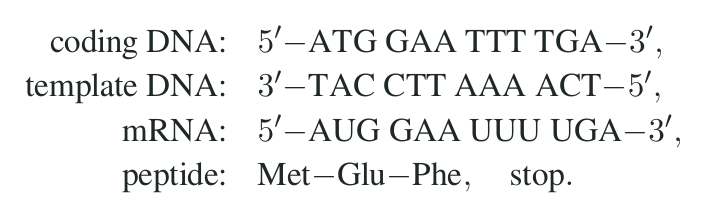
The standard mapping assigns sixty-one of sixty-four triplets to amino acids and three to termination; other tables differ, including mitochondrial UGA as tryptophan. The reading frame, surrounding context, and particular substitution determine a change's effect.
Aminoacyl-tRNA synthetases recognize amino acids and tRNAs, spend ATP on activation, and attach cargo. Anticodon recognition and correct charging are separate requirements. Ribosomes organize messenger, charged tRNAs, elongation factors, GTP-driven steps, peptide formation, and release factors. Ribosomal RNA forms the catalytic core, as Nissen and colleagues' archaeal structures demonstrate.
RNA can be template, adaptor, catalyst, structural component, regulator, or hereditary sequence in viruses. Reverse transcription does not refute Crick's central dogma, which concerns detailed sequence-transfer directions, particularly the absence of reverse translation from protein sequence into nucleic acid.
Protein activity further depends on folding, chaperones, partners, modification, cofactors, and location. A chain's exact sequence alone cannot specify its bearer's behavior; the metabolizing and developing cell supplies conditions for its use.
Fidelity through fallible processes
DNA replication combines initial selection, exonuclease proofreading, and mismatch repair. If the stages are treated as conditional filters, a schematic path is

within the broader reported 10^(-9)--10^(-11) range per copied base per round. The latter factors are conditional escape probabilities, so the illustration need not assume that all error pathways are independent. Error types and damage pathways still require separate accounting.
Transcription corrects through selection, backtracking, and cleavage, assisted for polymerase II by factors such as TFIIS. Chung and colleagues used repeated copies of circularized RNA fragments to distinguish existing RNA errors from many sequencing errors. Their polymerase-II substitution estimates were approximately 2.9×10^(-6) in yeast, 5.69×10^(-6) in flies, and 4.7×10^(-6) in untreated primary human fibroblasts. Fidelity-factor changes altered the measurements, which concern surviving cellular RNA rather than isolated initial enzyme selection.
Synthetase double-sieve selection uses distinct activation and editing sites to discriminate similar amino acids, exemplified by isoleucine and smaller valine. Editing before or after transfer protects the tRNA--cargo relation; correct ribosomal decoding cannot repair every escaped charging error.
Ribosomal kinetic proofreading separates selection stages across GTP hydrolysis. Relative binding stability and reaction rates determine acceptance and rejection. Common missense estimates near 10^(-3)--10^(-4) per codon conceal large variation: Kramer and Farabaugh's lysine reporter gave about 3.6×10^(-3) for AGA and 3.8×10^(-4) for AAC, with controls for altered-protein activity.
Replication, RNA, and peptide errors have different denominators, persistence, and amplification. Under hypothetical independent uniform error probability e across L positions,

For e=10^(-4),L=300, this is about three percent, not a probability of lost function or cell death. Reliability belongs to a driven, layered working system, including its remaining errors.
Genomes and their reference resources
Sequence completeness, population representation, regulatory annotation, and developmental explanation answer different questions. T2T-CHM13's 2022 assembly supplied about 3.055 billion base pairs and gapless autosomes plus X, adding nearly 200 million bases and 1,956 gene predictions, ninety-nine protein coding. Its nearly homozygous hydatidiform-mole source aided assembly; it lacked Y.
The 2023 HG002 Y assembly added a 62,460,029-base sequence, over 30 million bases beyond GRCh38-Y and forty-one additional protein-coding genes, mostly TSPY. Together with CHM13, it covers twenty-four chromosome types drawn from different samples.
The 2023 draft pangenome used forty-seven phased diploid assemblies, adding 119 million bases of euchromatic polymorphic sequence and 1,115 duplications relative to GRCh38. Alternative paths reduce single-reference limitations without exhausting human diversity.
ENCODE's 2020 synthesis added 5,992 datasets and registered 926,535 human and 339,815 mouse candidate cis-regulatory elements, covering 7.9 and 3.4 percent respectively. Biochemical signatures and sampled contexts define these candidates; sparser mouse sampling affects coverage. These percentages are not estimates of total functional DNA. Accessibility or transcription establishes activity; perturbation establishes a causal contribution; conservation and selection address evolutionary retention. References improve inquiry into the organism rather than replacing it.
The origin of complex cells supplies a large-scale example of integration rather than a simple ladder of additions. Santana-Molina and colleagues' 2025 phylogenomic analysis of central-carbon-metabolism enzymes found a chimeric pattern in the last eukaryotic common ancestor: archaeal and alphaproteobacterial contributions were joined by additional prokaryotic inputs, then remodelled through gene loss, horizontal transfer, and subcellular retargeting over more than two billion years. The authors read this history, reconstructed from extant genomes and model-dependent gene histories, as support for symbiotic and syntrophic models in which metabolic exchange became organized inheritance.
Mechanics in embryonic regulation
Development requires an account of changing organization as well as maintained organization. Cuciniello's critique grants closure's explanation of physiological self-maintenance but asks how regulatory goals originate and change, and what makes the developing whole the same organism. A caterpillar's present requirements do not by themselves explain its transformation into a moth.
Caldarelli and colleagues studied the early quail epiblast. Its posterior contracts while its anterior marginal territories stretch, yet the territories retain roughly stable proportions as cells move posteriorly toward the primitive streak. Their model couples locally reinforced actomyosin contraction with longer-range inhibition through transmitted tension, surrounding resistance, and an initial posterior bias.
The interventions then separated movement from its developmental consequences. Reducing contractility with H1152 suppressed marginal GDF1 and brachyury (BRA), while increasing it with calyculin A expanded expression. Ski-1 inhibition of SRC-associated mechanosensitive signaling preserved tissue flow but impaired expression, separating mechanical motion from its developmental coupling through the proposed β-catenin pathway.
Laser-isolated anterior halves initially failed to form the predicted new streaks. Continuing epiboly kept stretching them as they migrated over the supporting membrane. When that edge was uncoupled, contraction centers appeared within one to two hours, GDF1 around four and a half hours, and one or two SNAI2-marked streaks. All five halves without epiboly formed streaks, whereas the eight that retained it did not; H1152 blocked the response in four tested released halves. Calyculin could overcome continuing stretch.
The failed prediction identified an omitted boundary condition. Posterior halves then tested rescaling: reattachment to the vitelline membrane rebuilt tension and restored proportions, whereas free borders broadened contraction. Continued cuts that maintained freedom eventually produced an elongated streak at the expense of ectodermal territory. Cooling and removal of excess medium favored attachment; subsequent cuts could release it.
At about three hours, GDF1/BRA territories were narrower in attached halves and SOX3 ectoderm allocation differed, but expression had not fully rescaled when instantaneous contraction had. Accumulated deformation of tracked marginal segments better predicted GDF1. Logarithmic strain,
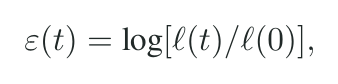
distinguishes current rate from retained shortening. Across normalized, stage-matched conditions, intermediate deformation and expression were approximately linear, with saturation in consistently stretched or contracted regions.
Hair or nylon obstacles tested whether cutting's wound response explained the result. Friction slowed intact tissue and created new anterior contraction centers in thirty-three of thirty-four embryos, with GDF1 preceding ectopic streaks and redirected BRA/SOX3 territories. Ski-1 again separated contraction from the ectopic developmental response. One-sided obstacles prevented an extra center in five of seven embryos; two formed one. Changing effective tension propagation by twenty percent reproduced the alternative simulated outcomes.
Force generation, transmission, deformation history, molecular signaling, and tissue allocation form one developmental sequence. The quail's present activity carries a capacity for further formation under definite conditions, including the boundary conditions exposed by the failed prediction. Physiology explains the maintained dependencies; development explains how their exercise changes the whole. Evolutionary history then asks how those inherited capacities arose.
Integration and individuality
Cooperation alone does not make a new biological individual. West and colleagues emphasize division of labor, communication, dependence, and reduced conflict within an integrated reproductive life cycle. A single-cell bottleneck aligns inherited interests differently from aggregation of unrelated cells. In either case, “alignment” concerns reproductive consequences, not conscious calculation.
West's account limits active repression's role in several origins already characterized by alignment, while recognizing exceptions such as worker policing. Bourke stresses conflict across transitions' subsequent elaboration: clonal origins may introduce little conflict, but later somatic mutations and sexually reproducing colonies create different possibilities. Origin and later development require separate explanations.
Potential conflict can remain unexpressed when discrimination or action is unavailable; a shared survival--reproduction trade-off need not be conflict between parts. These distinctions make biological unity investigable through actual inheritance, dependence, and constraints.
Destructive organization and repair
Cancer lineages acquire capacities for sustained proliferation, resisting death, vascular access, immune evasion, and invasion. Plasticity and epigenetic reprogramming contribute alongside sequence changes. Recruited fibroblasts, vascular cells, and immune cells can support a local environment whose persistence damages the host.
Biological corruption thus includes highly organized activity that undermines the integrity supporting it. Obstruction, invasion, altered architecture, and resource use make the harm specific. In this biological sense, corruption names destructive function, not moral fault.
Wound repair has several achievements that can come apart. In axolotls, early depletion of macrophages allowed epithelial wound closure but prevented limb regeneration, leaving fibrotic stumps. When macrophages had returned, a new amputation farther up the limb could reactivate regrowth. Closure was a real local achievement, while the missing limb remained a loss. The persistent result also differed from the animal's remaining capacity under renewed conditions.
Regeneration, compensation, and maintenance therefore need distinct descriptions. Regeneration replaces lost organization; compensation enables activity through other capacities; maintenance preserves an existing structure through turnover. Their value concerns what they enable in the recipient's life. Tissue amount, a closed surface, or a stable appearance cannot by itself establish that the relevant activity has been restored.
Resilience changes through interacting genome maintenance, protein quality control, mitochondria, stem cells, communication, inflammation, and microbial relations. Aging hallmarks organize these interacting processes into intervention targets. Recovery can also fail entirely. Reuse of a dead organism's materials is not repair of that organism; lineage or ecosystem productivity cannot conceal its loss.
The standards supplied by living form
A causal role contributes to a specified process; a selected function explains evolutionary retention; a regulatory target guides adjustment; a developmental endpoint results from formation; a flexible goal permits varying means while maintaining an outcome. A heart's sound and its circulation are both effects, but they do not equally explain why hearts are retained. An animal's future food does not cause present movement backward through time; current organization makes pursuit possible.
Selective history explains why an impaired heart can still have circulation as its function. Godfrey-Smith's historical account retains this distinction while recognizing causal-role explanations alongside it. Explaining why a capacity was retained and how this organism exercises or recovers it are complementary tasks. The quail experiments show why development must join them: tissue tension and its history direct formation before the mature organs exist. One need not imagine a mature body acting backward in time, or suppose that naming closure has already explained every transition. Nor does changing the formal boundary of a model establish when a living subject begins or ceases to exist.
The distinction reaches into the mechanisms of repair. In planarians, Durant and colleagues briefly disrupted gap-junction communication and found persistent changes in later regeneration, including in worms whose visible anatomy appeared ordinary. Lo and Petersen identified another route to unusual anatomy: inhibition of map3k1 allowed migrating eye progenitors to differentiate prematurely, producing ectopic eyes while original regeneration sites remained available. The displayed form therefore underdetermines whether a retained regenerative disposition has changed or its execution has been disrupted.
A working organ and a recoverable organ can also differ. Hill and Petersen found that eyes outside an altered regeneration site could continue receiving new cells and support light avoidance, yet fail to regrow after removal. During ordinary rescaling after amputation, existing eyes and the sites at which replacements would form could likewise become temporarily displaced. Atabay and colleagues independently connected stable ectopic eyes with positional targeting and cell incorporation. Maintenance, present function, and regenerative competence are separate capacities.
The comparisons identify three different explanatory tasks. Maintenance asks what keeps an existing organization working. Development asks how coordinated activity brings a form into being. Regeneration asks what determines the reconstruction after loss. The quail experiments test formation through tissue mechanics; the planarian interventions distinguish retained regenerative disposition, execution, and present function. Successful shape recovery therefore needs a separate functional test. Light avoidance establishes one activity, and neither that result nor rebuilding alone establishes an internal representation of the whole body.
Biological repair is evaluated through the continuing organism's activities and needs. An unusual form can work; an apparently normal one can conceal a failure of regeneration. Nourishment, coordination, movement, and future repair can support or obstruct one another, so improving one requires checking the others. Cancer's local success and ecosystem productivity cannot measure away an injured organism's loss. Chapter 13 develops the further identity and standing questions; here living organization establishes why the relevant unit of benefit is not simply the most productive part or the largest system.
These biological explanations are available to naturalism and the account of creation alike. Within the latter, they specify the powers through which the Logos's gift becomes a living recipient's own activity. Their origin and historical transformation require the evolutionary account that follows.
Related research
Compare this chapter with source documents or study its biblical references.
Chapter comments