Nuclear reactions made elements, stars dispersed them, and planetary assembly created settings in which new material powers became available. Stable laws describe possibilities; states, boundaries, flows, and retained history determine which become actual. A planet's chemistry depends on stellar generations, while its atmosphere and surface cycles enable activities unavailable in the stars that supplied its material. Each level changes what can happen next and keeps depending on the earlier conditions.
Reconstructing the hot universe
In the statistically homogeneous and isotropic large-scale model, proper separation is D=a(t)χ for fixed comoving separation χ, with today's scale factor set to one. The basic relations are

The last relation isolates cosmological redshift from local motion and gravitational effects. A measured redshift therefore supplies a scale-factor ratio, while an expansion model is needed to infer the emission date. Cosmic time follows the homogeneous flow's proper time rather than imposing universal distant simultaneity.
Nonrelativistic matter dilutes as a^(-3); radiation dilutes as a^(-4) because its wavelengths also stretch. A cosmological constant retains its energy density. For a flat model with these constituents,
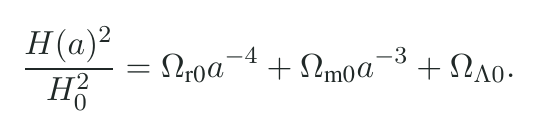
Each present fraction is measured against the critical density 3H_0^2/(8π G), with energy expressed as an equivalent mass density. Curvature, evolving dark energy, and changing constituent regimes require modifications.
The supported reconstruction reaches an early hot, dense state. During its first minutes, nuclear reactions produced primordial helium, deuterium, and other light nuclei through the interplay of reaction rates, neutron decay, baryon abundance, and expansion. Helium and deuterium broadly agree with both nuclear calculations and the baryon density inferred from the later microwave background. Lithium inferred from old stars remains below the standard prediction; depletion and other explanations remain under study.
Around 380,000 years, neutral-atom formation reduced free-electron scattering and let existing radiation travel far. The microwave background is therefore principally surviving radiation, not newly emitted light from recombination. Its near-thermal temperature is 2.7255 kelvin; T∝ a^(-1) connects last-scattering redshift near 1100 with temperature near 3000 kelvin. Temperature and polarization variations preserve acoustic information about constituents, perturbations, and geometry, once calibration and foregrounds are modeled.
Planck's corrected 2018 analysis supplies a dated baseline: its flat six-parameter ΛCDM fit implies about 13.8 billion years, H_0=67.4±0.5 kilometers per second per megaparsec, and roughly 5 percent ordinary matter, 26 percent cold dark matter, and 69 percent dark energy. These are model-conditioned inferences; allowing curvature and combining other observations tests near-flatness independently of assuming it in the baseline.
Expansion, thermal radiation, primordial abundances, and evolving structure probe different epochs through different processes. Their convergence supports the hot history without establishing an absolute beginning. A classical singularity marks the description's failure; inflation proposes an earlier accelerated regime whose mechanism and deeper origin require further grounds.
The production of structure
Density perturbations grow when gravity overcomes pressure, particle motion, and expansion. For small pressureless perturbations well within the horizon,

A matter-dominated flat background has a∝ t^(2/3) and a growing solution δ∝ a. Nonlinear collapse requires another description once contrasts become large.
Cold dark matter develops structure without the photon pressure that restrained early ordinary matter. Gas falls into concentrations, but contraction also depends on cooling, angular-momentum transport, turbulence, and feedback. Stars then couple gravity, pressure, nuclear production, and energy transport. Different elements and isotopes have distinct synthesis routes; winds and explosions return some products for later generations.
Accretion, mergers, heating, and expulsion alter galaxies. Early luminous sources ionize the surrounding hydrogen; observations constrain the reionization history without yet fixing every stage. Planetary disks then introduce condensation, collision, migration, fragmentation, and differentiation. A planet's orbit and surface history depend on these processes as well as on its elemental inventory. Bound structures need not follow the homogeneous expansion flow at every separation.
JWST spectroscopy has now made the early-galaxy tension more precise. Carniani and colleagues confirmed two luminous galaxies at z=14.32^(+0.08)_(-0.20) and z=13.90±0.17, placing them roughly 300 million years after the hot beginning. Their ultraviolet continua favor stellar emission; the extended morphology of JADES-GS-z14-0 argues against a dominant active nucleus, while the compact JADES-GS-z14-1 cannot exclude one from morphology alone and is interpreted through its steep ultraviolet slope. A separate FRESCO study of thirty-six dust-obscured galaxies with spectroscopic redshifts 5≤ z≤9 found no sample-level tension with ΛCDM, although three objects with stellar masses above 10^(11) M_☉ require an exceptional conversion of about fifty percent of their available baryons into stars. The current pressure therefore falls chiefly on early star-formation efficiency, dust, mass estimates, active-nucleus fractions, and feedback models.
Gravitating matter can clump while releasing energy and increasing total entropy. Early local thermal equilibrium therefore need not mean maximal gravitational entropy. A universally accepted entropy formula for arbitrary gravitational fields remains unavailable. Thermal gradients sustain later activity, but dispersal, disrupted structures, and failed formation belong to the same history.
Dark sectors and changing fits
Dark matter denotes a gravitational contribution constrained through motions, lensing, cluster gas, and structure growth. Within general relativity it exceeds visible matter and cannot simply be additional ordinary baryons. In the Bullet Cluster, the lensing mass lies nearer the galaxies than the collision-slowed gas that contains most ordinary matter. Any alternative must explain that separation together with the wider evidence.
Modified gravity offers a serious alternative through the relation between galactic baryons and measured acceleration. Skordis and Złośnik's relativistic MOND theory adds scalar and vector fields and reproduces microwave-background and linear matter spectra; its 2021 analysis leaves the connection to nonlinear structure as a further task. General relativity with dark matter remains the working reconstruction here because it jointly accounts for expansion, acoustic structure, and lensing while retaining independently tested gravitational dynamics. The dark particle itself remains unidentified.
Dark energy concerns accelerated expansion. Corrected Type Ia supernova luminosities connected brightness and redshift to distances inconsistent with simple matter-only deceleration; subsequent probes strengthen the comparison. For w=p/(ρ c^2), a cosmological constant has w=-1. Negative pressure affects gravitational dynamics rather than acting like ordinary local gas pressure.
Baryon acoustic oscillations preserve a preferred comoving separation from the early plasma. Their apparent size tests distance and expansion; absolute calibration depends on the sound horizon's history. DESI's tested extension,
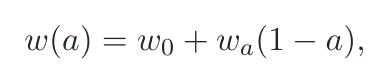
includes the constant at (-1,0).
The 2025 DR2 analysis preferred this extension at about 3.1 standard deviations with microwave-background data. Adding Pantheon+, Union3, or DESY5 supernovae changed that to about 2.8, 3.8, or 4.2 respectively. These are model-comparison preferences for a parameterized extension, not direct detections of a dark-energy field; the combinations are alternative fits, not independent confirmations.
A July 2026 Lyman-alpha-forest full-shape analysis reached approximately one-percent geometrical precision at effective redshift 2.33. Its joint result still preferred evolving dark energy over ΛCDM at 2.7 standard deviations with microwave-background data and 3.2 with selected supernovae, while reducing the DESI--CMB discrepancy from about 2.4 to 2.2 standard deviations under ΛCDM. External data, including DES-Dovekie, were also updated, so the comparison changes more than one input at once.
The Hubble tension compares different inferences of one present H_0, not merely changing expansion across time. The Local Distance Network's covariance-weighted baseline gives 73.50±0.81, accounting for shared anchors and overlapping samples. The Chicago--Carnegie program's preferred red-giant-tip result gives 70.39, with separate uncertainties 1.22 statistical, 1.33 systematic, and 0.70 associated with supernovae. The local methods themselves return different values.
Calibration, dust, populations, selection, and covariance require quantified explanations, while altered early physics must preserve other successes. The evolving-dark-energy extension improves the quoted fits, but their dependence on external data keeps that preference from identifying a physical field. ΛCDM supplies a defined reference against which those changes can be assessed. The hot history is well supported; the dark constituents and the discrepancies remain an active frontier.
Why scale changes explanation
Coarse-graining retains the variables that matter in a given regime. A fluid's mean velocity can identify circulation while discarding molecular arrangements; averaging over too small a region exposes fluctuations, while averaging over too large a region hides the flow. A description can therefore predict well without recovering every omitted detail.
Effective theories encode short-distance effects in coefficients. When the energy of interest is well below the heavy scale, E≪ M, corrections can be organized in powers of E/M. Coefficient size, extra light modes, and failure of the scale separation determine how far the approximation can be trusted.
Renormalization follows changes in description with resolution, not necessarily time. Near a fixed point, a deviation can scale as
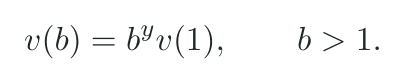
Positive y gives a relevant growing deviation, negative y an irrelevant shrinking one; zero requires further terms. “Irrelevant” is technical and regime-specific. Different microscopic systems can approach common large-scale behavior while relevant differences remain controlled.
Near continuous transitions, correlation lengths can exceed microscopic scales and diverge in an ideal infinite limit. Universality explains shared critical scaling across, for example, a suitable magnet and a liquid-gas system. Symmetry, dimension, interaction range, and relevant variables determine the class; dynamical comparisons additionally depend on conservation and relaxation.
This is explanatory stability across different realizations, rather than convenience alone. Anderson's “More Is Different” identifies the new organizing concepts required to derive collective behavior. Changing a boundary changes stresses and flows through constituents. The whole's explanatory role requires no detached force, but it requires more than a parts list.
Thresholds and retained history
Convection appears when buoyant amplification overcomes viscosity and thermal diffusion. For a horizontal layer,
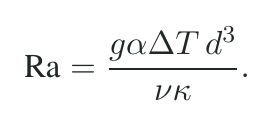
The quantities are gravitational acceleration, thermal expansion, temperature difference, depth, kinematic viscosity, and thermal diffusivity. Rigid fixed-temperature boundaries in a laterally extensive layer give onset near 1708; changing boundaries changes the threshold. Depth's cubic contribution can alter the regime without changing molecular kinds. Continued driving sustains the pattern; higher driving does not guarantee the same rolls.
A scalar Landau model makes the same history dependence visible in a simpler setting:

has m=0 as its zero-field minimum for r>0, and m=±√(-r/u) for r<0. A realized magnetization breaks a symmetry retained by the zero-field expression. Spatial fluctuations, domains, and dimension limit the mean-field law.
For rescaled r=-1,u=1 and relaxation ṁ=-Γ ∂ f/∂ m, free energy decreases at fixed h. Slowly increasing h from the negative minimum can retain a metastable state when local relaxation is fast but noise-driven escape is slow. The metastable state disappears when the stationary point and its stability boundary coincide:

giving h=2/(3√(3))≃0.385 on the increasing branch. Returning h to zero can leave positive magnetization. The same control therefore supports different states depending on history; the control was never the complete state.
A Lean-checked result from the October 2026 release described in Chapter 5 makes the local-to-collective step more concrete than this scalar model, if its formal statement captures the claim. For the nearest-neighbor isotropic quantum Heisenberg ferromagnet on ℤ^d, every d≥3, every positive integer or half-integer spin S, and all sufficiently low positive temperatures, there exists a translation-invariant zero-field quantum equilibrium (β-KMS) state whose one-site magnetization is at least S/4. The result concerns a selected infinite-volume state. A finite-volume Gibbs state can retain rotational symmetry, and averaging the selected states over rotations can remove the magnetization, so the order parameter depends on the limiting and state-selection procedure as well as on the local interaction.
The proof tracks that dependence rather than assuming the macroscopic order. It represents spin interactions through exchange loops, controls how a boundary pin influences the system, and bounds how that influence can be lost through the intervening geometry. These estimates carry a positive magnetization through the thermodynamic and vanishing-field limits; the resulting state is then checked for translation invariance and quantum equilibrium. The theorem therefore ties a nearest-neighbor law to dimension, temperature, boundary control, and thermodynamic state selection. Together with the preceding metastability example, it shows two distinct ways that history and state preparation matter: an equilibrium phase can be selected in the infinite limit, while a driven system can retain a path-dependent metastable state.
Collective magnetization is a stable behavior of the spins' constrained relations in a specified regime. Dimension, temperature, coupling, boundaries, and state selection help constitute that behavior without adding another force. The physical account makes organization causally intelligible: changing those relations changes what the system can do.
Real hysteresis requires domains, defects, nucleation, fluctuations, and rates beyond the scalar Landau model. Complete equilibration would remove its particular metastable cycle. Multistability, metastability, hysteresis, thresholds, and smooth crossovers name different behaviors rather than interchangeable kinds of novelty.
Descriptive emergence concerns unexpected patterns; epistemic emergence concerns prediction or compression limits; organizational emergence concerns capacities constituted by arrangement. Causal-emergence comparisons depend on partitions, timescales, intervention distributions, and scoring rules. Hoel's effective-information comparison can favor a macrodescription partly because uniform macro interventions do not induce uniform micro interventions. Under one unchanged probabilistic experiment, however, summarization cannot increase Shannon mutual information.
Strong ontological emergence adds fundamentally novel powers or laws not obtainable from the complete lower-level account. A defensible emergence claim specifies base, variable, resolution, timescale, mechanism, and intervention. The retained-history models also identify why repair may require changing a sustaining configuration, rather than merely removing the original influence.
Quantum gravity and dual descriptions
The Planck scales are derived combinations,
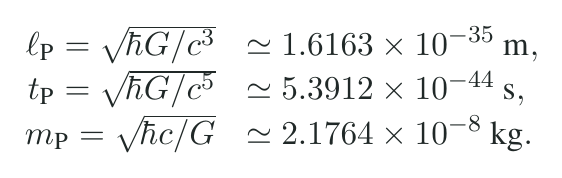
Comparing Compton wavelength with Schwarzschild radius similarly locates a Planck-order regime. Whether that regime contains a minimum length or a discrete dynamics is a question for physical theory and measurement.
Loop quantum gravity constructs discrete area and volume spectra in a specified representation; physical measurement after full dynamical and gauge constraints remains a further task.
For a nonrotating uncharged black hole, semiclassical theory gives
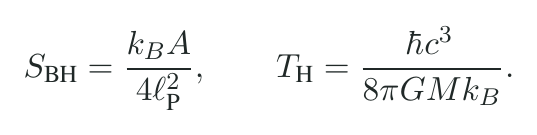
Doubling mass quadruples entropy and halves temperature. The relation is established theory; direct detection of astronomical Hawking radiation and a complete microscopic identification remain ahead. Strominger and Vafa's state count reproduces leading entropy for specified supersymmetric extremal systems, rather than every astronomical hole.
AdS/CFT relates type IIB string theory on AdS_5× S^5 to four-dimensional N=4 super-Yang--Mills theory through a dictionary of states, observables, and parameters. Controlled limits make different sides tractable; proposed exact equivalence exceeds any one calculation. Our expanding universe has not been identified with this system. The gain is precise preservation of physical content across radically different variables.
Sensitivity and probability
Parameter sensitivity is conditional on what is held fixed. Raising positive vacuum energy while fixing matter and fluctuations can inhibit structure; increasing fluctuations can allow earlier collapse. Triple-alpha carbon production has a resonance contribution whose fixed-temperature rate changes approximately as
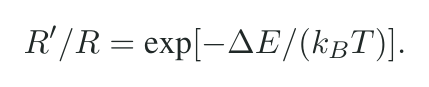
At 10^8 kelvin, a 10-kiloelectronvolt shift gives about 0.31. Stellar response, competing reactions, and correlated nuclear changes prevent reading this directly as final carbon abundance.
Adams finds wider stellar viability than some single-parameter stories imply, including conditional weakless-universe pathways requiring altered primordial composition and baryon abundance. Barnes emphasizes surviving constraints and hierarchies. A probability over universes needs more than local tolerance or fragility.
Such a probability requires an admissible space Θ_H, a target V_H, a measure, and a normalized density:

Dimensionless quantities or fixed unit conventions prevent unit artifacts. Stable nuclei, stars, terrestrial chemistry, organisms, and conscious observers are different targets.
On 1≤ x≤100, the interval 1≤ x≤2 has probability 1/99 under uniform x, but log2/log100 under uniform log x. These are different priors, not a coordinate transformation of one prior. Likewise, |x-y|<0.01 occupies 1.99 percent of an independently sampled unit square but every possibility if a deeper theory confines states to y=x. Dependence assumptions can determine apparent fragility.
Observer selection can yield a conditional prediction. Martel, Shapiro, and Weinberg weighted a smooth prior for positive vacuum energy by the fraction of matter collapsing into galaxies, with other constants and the fluctuation spectrum specified. A small positive value became reasonably likely within that model. The explanatory gain depends on its prior, galaxy-based weighting, and background conditions.
Sensitivity remains informative before a global probability is established. It identifies which relations sustain stars, chemistry, and later living powers, and which correlated changes preserve them. The low-entropy past adds a condition on history: laws allowing energy exchange also need a state or wider cosmological dynamics supplying the gradients through which sustained activity becomes possible. Time symmetry by itself does not select the observed direction. Penrose's estimate of how special a low-entropy initial state must be illustrates the size of this condition, whatever its ultimate explanation; some proposals claim to derive the direction from dynamics and typicality without a special first state, and they must be assessed on their specified dynamics and typicality assumptions.
A successful multiverse model would explain local conditions through production and selection; a demonstrated deeper necessity would remove apparent alternatives. Both would reduce the unexplained physical specificity. Taking the natural order as basic gains ontological economy while leaving its life-supporting laws and history as basic facts wherever no further account is supplied.
Two points keep the comparison honest. The recipient-directed account expects a world in which creatures receive good through real, mutually enabling powers. That purpose constrains how laws, usable gradients, and living conditions must work together while leaving many life-permitting orders available. It supplies no numerical prediction for the constants on its own. The measured vacuum energy, far smaller than naive field-theoretic estimates, is the sharpest single case in which a deeper physical explanation would earn credit against both accounts; a multiverse that explains it must also pay for its measure problem and for the risk that typical observers in it would be fluctuations rather than evolved creatures.
Observer selection also tests the history through which a cosmological model becomes known. A fluctuation could reproduce present data and apparent memories without reproducing the events those memories describe. If a model makes such observers dominant even among those sharing our data, its apparent agreement leaves the evidential history unsupported. The reasoning and physics apparently learned are among the things it leaves without that history. Carroll argues that accepting such an explanation removes the grounds for accepting the inference itself.
A model's account of observers must therefore preserve a credible route from the world to their evidence. The difficulty depends on its dynamics, lifetime, quantum account, and observer weighting. Carroll's objection is an epistemic reason to reject specified fluctuation-dominated models. Producing observer states and explaining warranted access to a history are distinct achievements.
The recipient-directed giver argued in Chapters 3 and 4 has a reason to provide dependable powers, usable gradients, and conditions for creaturely life together. That is the positive fit of the cosmic history with the proposal. Its severe creaturely losses supply adverse evidence, and its particular realization still requires the physical account. Chapter 42 weighs both sides alongside the grounds for personal giving and its identification in Christ.
Consequential creation
A star's nuclear history makes new material available; a planet's atmosphere, chemistry, and cycles create conditions in which later organization can persist. Life receives those conditions and helps supply them to descendants, partners, and ecosystems. The novelty is real because each stage changes the space of possible activity for the next. Creation through history gives later capacities through the exercise of earlier powers.
Lawful generativity gives creatures both material support and the capacity to contribute. Earlier powers help bring later powers into being, so dependence can become productive rather than merely received. This identifies a purpose of the connected history without making its exact stellar sequence indispensable.
Given capacity can also develop into acquired maturity. Theophilus and Irenaeus make that distinction in their accounts of experience and response to God. Material history supplies conditions for such growth, while living organization brings the further relation of benefit or injury to a particular bearer.
Disruption belongs to this history too. A subsystem's success can damage another being; physical order alone cannot justify that loss. Neither a sufferer's smallness nor the history's vastness makes that life expendable. The next chapter follows the living organization through which a part of the cosmos can receive nourishment, develop powers, and undergo repair.
Related research
Compare this chapter with source documents or study its biblical references.
Chapter comments