The marks 01000001 can mean 65 in binary, A in ASCII, or an image value within a specified format. Reading them requires a relation between the carrier and its interpretation. That relation is exact: 66 and B are wrong in the first two cases. A perfectly transmitted image introduces another relation, between what the image shows and its actual subject.
Finite creatures meet an ordered world through representations they can learn, check, and correct. Mathematics makes the relations exact. Information theory measures differences and dependence. A proof, a physical model, and a meaningful report each connect something represented with a finite means of access. Following those connections shows how different procedures can make the same truth available.
Structure, proof, and application
Consistency, derivability, and physical instantiation are different questions. Consistency alone does not establish every desired conclusion, and a valid derivation describes nature only where nature instantiates the specified structure. Measurement and physical theory establish that connection.
Geometry makes the last distinction exact. A Euclidean triangle has an angle sum of 180 degrees. On a sphere, two meridians a quarter-turn apart and the intervening equatorial arc form a triangle with three right angles, because great-circle arcs play the role of straight paths there. The results differ because the geometries differ; measurements then determine which geometry is a useful approximation for a physical application.
An existence axiom need not supply a construction. The Axiom of Choice asserts a selection function for a family of nonempty sets without requiring a specified selection algorithm. Identifying that dependence clarifies what a proof requires.
Representations preserve selected relations. A quarter-turn about the origin is

The square's four rotational symmetries form a group under composition. The equations show that a representation can preserve the way operations relate to one another: applying the quarter-turn four times returns the original point. A different coordinate system changes the description while preserving those invariant relations; changing coordinates is not physically rotating the square.
Differential equations similarly expose the consequences of a proposed dependence. If excess temperature θ decreases at a rate proportional to itself,

The solution says exactly what the assumed dependence predicts: k has units of inverse time, and 1/k is the time for the excess to fall to 1/e of its initial value. The model can fail when one temperature inadequately represents the body, the surroundings change, or heat transfer requires a varying coefficient. Solving the equation therefore exposes the empirical assumptions that make its neat answer possible.
Finite access to general truths
Abstraction isolates relations across unlike instances: three cups and three footsteps can be matched one for one. Zero represents an empty counted collection and occupies a distinct role in place-value notation. Neither concept requires that its inscription physically resemble its objects.
A finite argument can establish a claim beyond any inspectable collection. Suppose someone proposes a finite list of all primes:
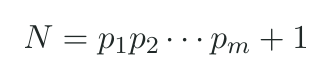
has a prime divisor absent from the list, because division by each listed prime leaves remainder one. A prime divisor exists: the smallest divisor greater than one must be prime, or a smaller proper factor would contradict its selection. Hence no finite list exhausts the primes. N itself need not be prime.
The distinction between approximation and proof also appears in numerical cognition. Cantlon and colleagues tested two olive baboons choosing between sequentially stocked peanut caches. Their choices shifted toward the second as its quantity reached or exceeded the first; timing and experimenter-cue controls tested simpler explanations. The authors interpreted the result as components of approximate counting, while retaining general-magnitude tracking as a possibility. Approximation, exact arithmetic, and proof therefore have different requirements.
Understanding develops through attention, memory, language, teaching, and practice. Copying a valid proof can occur without understanding it; understanding its method can coexist with a computational error. Public notation makes reasoning available for criticism beyond one person's attention. This historical formation explains access, while inferential validity explains why the conclusion is warranted.
The reach of mathematical representation
Practical selection explains part of mathematics' usefulness: investigators develop models that work and discard ones that fail. The harder datum is that a relation developed in one setting can transfer to another and generate a novel prediction. Wigner identifies that unexpected reach.
The exponential form can represent cooling or a capacitor's discharge because different mechanisms can instantiate the same rate relation. A stronger example is Dirac's prediction of a new particle. His first interpretation associated a missing electron with a proton, but the mass constraint defeated that reading. In 1931 he proposed an anti-electron with equal mass and opposite charge. Anderson's 1933 cloud-chamber report then found fifteen positive tracks among 1,300 photographs whose curvature, ionization, and energy loss were inconsistent with proton mass. The initial mass bound was still less exact than equality with the electron. The derivation constrained what could count as an interpretation; the experiment established that nature realized the predicted kind of object.
Many coherent structures have no known application; multiple models can fit available observations. Idealization can support accurate inference without literal detail, and beauty remains a research heuristic vulnerable to experiment.
The philosophy of mathematics asks what these achievements disclose. Platonism treats mathematical discovery as contact with mind-independent abstract objects. Indispensability arguments connect commitment to those objects with their role in successful physical theories. Structuralism locates mathematical objects through their positions and relations, with realist, modal, and nominalist versions differing over what a structure is.
Nominalism pursues the same physical claims without abstract entities. Field treats mathematics as a conservative instrument: adding it should yield no new nonmathematical consequences beyond the underlying theory. That demand is stronger than consistency and requires reconstruction at the relevant scope. Yablo's fictionalism likewise explains real content conveyed without literal commitment to every apparent abstract object; the representation's usefulness depends on exact constraints, rather than freedom to invent its consequences.
Formalism identifies the symbolic rules; pragmatic, evolutionary, and cultural accounts explain how investigators select representations and acquire the ability to use them. These contributions can coexist with several mathematical ontologies. The established result is common ground: specified relations determine consequences that different investigators can discover and check. The recent theorems make the power of those relations unusually clear.
Recent structure theorems and the work of representation
In additive combinatorics, the polynomial Freiman--Ruzsa theorem starts with a finite nonempty set A of binary vectors in 𝔽_2^n, where addition is coordinatewise modulo 2, and measures its additive expansion by the condition
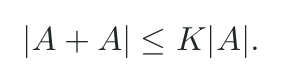
Gowers, Green, Manners, and Tao proved that if the displayed condition holds, then A can be covered by at most 2K^(12) translates of a subspace H with |H|≤ |A|. Here A+A={a+a':a,a'∈ A} and K is the doubling constant: it records how much addition expands the set. The 2K^(12) figure is the original published bound, not the current sharp exponent; a 2024 preprint by Liao reduced the exponent to 9 for 𝔽_2^n. The conclusion is not that A is itself a subspace; it is that small additive growth forces a quantitatively controlled approximate linear structure.
The Gowers--Green--Manners--Tao 2024 extension gives a corresponding bound (2K)^(O(m^3)) for abelian groups of bounded torsion m, where O(m^3) denotes a universal constant times m^3 in the exponent. The 2026 ITCS paper gives randomized classical and quantum polynomial-time algorithms that learn an explicit subspace cover in the characteristic-two case, assuming access to samples from the set and queries testing membership. Its stated guarantees depend on those access conditions. A further April 2026 preprint extends the algorithmic framework to equivalent formulations.
The simple case A=H makes the point visible: A+A=A, so K=1 and the relation itself exposes the hidden linear object. The theorem's force lies in the converse direction, where a small observable statistic constrains the possible underlying organization. It therefore shows that mathematical representation can discover structure.
When relations can recover an object
Relational reconstruction asks how much of an object a sufficiently rich network of relations determines. Several examples come from the October 2026 OpenAI mathematics release; the following accounts distinguish its selected Lean-checked statements from wider manuscript claims. The release's manuscripts and formal proofs were produced by an internal OpenAI model. A kernel check establishes the formal proposition actually checked, within its stated environment; whether that proposition captures a manuscript's informal claim is a separate judgment, and this book reports the formal scope from the public records without replaying the checks. If any result is withdrawn, the illustration changes; the claim it illustrated stands or falls on the other grounds given for it. Chapter 11 examines the discovery process and release corrections, while Appendix F records the revision and checking scope. The Bogomolov--Pop manuscript claims that certain Galois data recover function fields of transcendence degree at least two over algebraically closed constants of characteristic different from a prime ℓ. The data include a topological pro-ℓ abelian-by-central group and its commutator bracket. The selected formalization proves uniqueness: two isomorphisms of the fields' perfect closures preserving their constants and inducing the same Galois-data isomorphism modulo ℓ-adic unit scaling agree modulo Frobenius. Existence, that every admissible data isomorphism comes from a field isomorphism, is a further manuscript claim outside that target. Uniqueness specifies what the relations fix; existence establishes whether an admissible relational description is realized.
Rigidity of the Turing degrees gives a second result from the release, with a Lean-checked proof of its selected statement, about the strength of relational structure. Turing degrees group sets of integers according to mutual computability and order those groups by what each can compute from another. Every order automorphism of this full structure is the identity: no nontrivial relabeling preserves the entire order, even without a definability or genericity restriction. The manuscript's proof represents an arbitrary automorphism by a Borel map, recovers an irrational parameter from four values using a bounded averaging recurrence, and removes auxiliary reals through a category argument. The result fixes positions through their place in the complete order. It does not require an efficient finite procedure that identifies each position.
A different result shows why the properties of a presentation must be distinguished from the structure presented. The release reports a Lean-checked proof that all interpolated free group factors with parameters greater than 1, including the infinite parameter, are normally trace-preservingly *-isomorphic. In particular, the operator algebras L(F_2) and L(F_3) have the same abstract tracial structure even though their initial free-group presentations use different numbers of generators. The manuscript further derives that four free-entropy dimensions take every integer value at least 2 on suitable finite self-adjoint generating tuples of the single factor L(F_2). Those values belong to the tuple and its joint distribution, so they cannot classify the underlying factor. The positive lesson is about what a chosen description preserves: structural equivalence can be proved while presentation-dependent complexity changes.
The geometric Langlands program supplies a different kind of representation. In the de Rham and Betti settings over characteristic zero, the five-paper series by Gaitsgory, Raskin, and collaborators presents a proof of an equivalence between an automorphic side, which studies sheaf-valued data over parameter spaces of bundles on a curve, and a spectral side, which studies local systems for the Langlands dual group. A Hecke eigensheaf is roughly a sheaf whose response to a local modification of a bundle follows the pattern encoded by the corresponding local system. The final paper states the multiplicity-one step: for an irreducible local system, that eigensheaf exists uniquely up to tensoring by a vector space, the expected scalar multiplicity. This is much stronger than changing coordinates. The functors here are structure-preserving translations that carry objects and relations between the two sides. The proof succeeds by analyzing the geometry of the parameter spaces on which those descriptions live. The result shows why structural realism is more than a slogan about interchangeable descriptions: the representation must carry enough relations for theorems on one side to constrain the other.
The OpenAI release's irrational-level quantum geometric Langlands manuscript sharpens the requirement of coherence. It claims an equivalence of twisted D-module categories at dual inverse shifted levels, for non-rational complex levels, smooth projective connected curves, and connected simple groups, retaining global forms and components. Its local comparisons must fit together as marked points move and collide, under coordinate changes, and when separate pieces are assembled. Agreement at isolated points would not suffice: the comparison must preserve the operations and transitions that make each side one structure. This is the substantive proposed advance, while the family remains an unformalized manuscript at the cited revision.
Constructive discovery and public certification
AI-led discovery makes the relation between a new construction and its warrant concrete. AlphaEvolve's 2025 white paper reports a rank-48 tensor decomposition for multiplying two 4×4 complex matrices, improving the rank 49 supplied by Strassen's recursive construction in characteristic zero. Its output is a finite algebraic certificate: the decomposition can be expanded and checked against the multiplication map.
The search produced a new mathematical construction, and the certificate makes that discovery available to others. Selecting useful representations, preserving invariants, diagnosing failures, and transferring a method also demonstrate functional mathematical understanding when achieved. The further question of experienced understanding belongs to the account of the subject in Chapter 10. Here the new construction has a public warrant independent of the discoverer's confidence or manner of discovery.
Ordinary entry-by-entry multiplication of two 4×4 matrices uses 64 scalar products. AlphaEvolve's savings reorganize which linear combinations are multiplied and how their products contribute to the answer. The certificate has the form
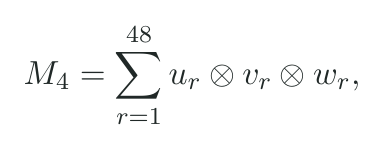
where u_r,v_r specify linear combinations of input entries and w_r distributes their product among output entries. Expanding the coefficient triples verifies the bilinear map entry by entry over the stated field. A decomposition over ℂ need not give the same rank over every field. The cap-set construction in Chapter 11 has the same logical shape: a discovered finite list is checked against the requirement that no three distinct vectors sum to zero.
An August 2026 collaboration takes this further. Dupont and colleagues report an upper bound ω<2.371177 on the asymptotic matrix-multiplication exponent, improving the previous 2.371339. They reformulated an existing mathematical optimization problem and built a gradient-based solver; AlphaEvolve then improved the solver's code, reusing successful candidates across generations. A separate verification rounded the final candidate to rational numbers and bounded logarithms in the required directions, turning numerical search into a certificate satisfying the theorem's inequalities. The search need not find the global optimum to establish a better upper bound. This is a cumulative discovery in which mathematical formulation, learned search, and exact checking make different indispensable contributions.
The Kakeya theorem shows public checking extending through a large proof. Wang and Zahl's 2025 argument establishes full Minkowski and Hausdorff dimension for Kakeya sets in ℝ^3, even though such sets can have zero volume. Guth, Wang, and Zahl supplied a streamlined proof in January 2026. By September, Project Numina's collaborative formalization provided a Lean proof path to Hausdorff dimension 3 for compact sets containing a unit segment in every direction. Its core theorem assumes a precise sticky-Kakeya estimate; an additional linking library proves that input from the Nankai and ByteDance formalization and reaches an unconditional target. The bridge matters because the two developments express their geometric assumptions differently. Shared truth becomes reusable only when the actual interfaces agree.
Finite access depends on the carrier and the formalism
Finite routes to an objective structure differ in capability. A formalized memory--precision theorem studies a one-pass learner receiving exact noiseless Gaussian linear observations of a uniformly random unit vector in ℝ^d. For each fixed A>0, a learner retaining at most Ad^2 persistent bits needs at least c_A dlog(1/ε) observations to attain angular error ε with success probability at least 2/3, for sufficiently large d and 0<ε≤1/10. Computation between observations is unrestricted. More calculation therefore cannot replace the information that this limited persistent state fails to retain. The result identifies a precise condition of access even when the observations themselves have no noise.
Choiceless counting gives the complementary lesson. The OpenAI paper constructs an isomorphism-invariant consistency query for a finite linear system over 𝔽_3. An ordered encoding decides it in polynomial time by Gaussian elimination, but full choiceless polynomial time with counting cannot decide it, even when its hereditarily finite objects have arbitrary finite rank. Stronger order-free logics with rank or solvability operators can decide it. The truth therefore belongs to the unordered structure, while access depends on which operations a finite procedure is allowed to use. An external order is a coordinate frame and a computational resource, not the source of the query's truth; the stronger order-free operators expose the same invariant through a richer formalism.
Gaussian elimination can choose different pivots and still reach the same consistency answer. Witnessed symmetric choice makes a related possibility exact for an order-free formalism: certifying permitted symmetry strictly increases the expressive power of choiceless counting. A computation may select among symmetry-related candidates if it supplies explicit transformations that preserve the input, parameters, and earlier intermediate states while connecting the permitted alternatives. The constructed program returns a true-or-false answer on every finite input, with the same answer across admissible runs, and defines a query that no program in the original counting formalism can define. Its single occurrence of the choice operator may make repeated selections. Particular intermediate choices thus enable a new route to an invariant result. The certificates explain why variation in the route preserves what the answer says.
An inverse problem makes the relation of access exact. In the smooth scalar conductivity problem, Sylvester and Uhlmann proved that complete boundary response determines the interior coefficient in dimensions at least three. The October 2026 OpenAI release supplies a formal proof artifact for a contrasting result: on the ball B(0,3)⊂ℝ^3, two uniformly positive bounded measurable scalar conductivities can differ on a set of positive volume while producing exactly the same full weak Dirichlet-to-Neumann operator. Both equal one near the boundary, and each boundary trace has a unique weak solution. The measured operator assigns the boundary response to every permitted boundary input at zero frequency.
This pair of results gives successful inquiry a positive requirement: its access must distinguish the features its question asks about. Repeating the same complete boundary experiment cannot distinguish the two rough interiors. A new kind of observation or an independently justified restriction of the admissible class may do so. Yet their common response already supports the same boundary predictions. Truthful knowledge can therefore be exact in its proper object while remaining incomplete about the system carrying it. Identifiability, an effective reconstruction method, and reliability under measurement error are further questions with distinct requirements.
These results answer different questions about one relation between an object and its representation.
- Constraint Small additive growth restricts the possible organization of a set.
- Identity of structure Rigidity fixes positions; an isomorphism preserves abstract structure while a presentation can change.
- Reconstruction Uniqueness, existence, an effective procedure, and stability under error are separate requirements.
- Access Memory bounds and permitted operations can restrict discovery even when a truth is determinate.
- Certification A construction or proof supplies publicly checkable reasons for its stated conclusion.
The connections become useful when their requirements are carried into a new problem. A theorem about uniqueness cannot supply an existence proof, and an exact observation channel need not identify every feature of its source.
Formal checking fixes the proposition and permitted axioms alongside the proof that establishes it. The OpenAI release separates these roles in its target specifications and solution modules; the manuscript and formal claims above retain their respective scopes.
From structure to knowing
A finite representation can preserve what a question requires while leaving much about its object unknown. The witnessed-choice result supplies one exact case: different permitted histories reach the same invariant answer. The conductivity example supplies another boundary: distinct causes can agree throughout a specified observation channel. These results make adequacy a precise question. Which differences must the representation retain for the conclusion being sought?
Action adds a further requirement. Two possible causes can admit the same useful remedy, so complete diagnosis need not precede justified help. Yet a model that matches present observations can still misdescribe what an intervention will do. To guide action, it must preserve feasible choices and include the relevant possible outcomes; its success condition must concern the actual recipient and the goods at stake. Chapter 43 develops that requirement through a concrete repair problem.
Received powers can therefore sustain a real contribution without giving a finite knower an exhaustive view. A new construction, proof, instrument, or method can make a previously inaccessible truth available to others. The discovery changes the history of knowing; its warrant rests on the relations the successful procedure preserves. Within the account of creation developed here, this is a determinate form of participation: creatures can learn and act through their own powers, and their achievements become means by which others receive a good.
Statistical information
For specified alternatives x with probabilities p(x), Shannon entropy measures uncertainty in the distribution:
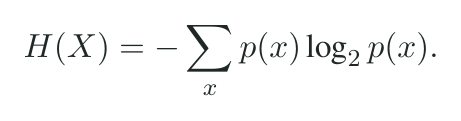
Zero-probability terms contribute zero. An equally likely binary choice has one bit of entropy; a source always emitting one fixed byte has zero entropy despite using eight positions. Equal selection among all 256 bytes has eight bits. Entropy describes a distribution, not inscription length, semantic importance, or felt confusion.
For an equally likely binary input X and a channel independently flipping it with probability 1/4, the received Y leaves conditional uncertainty

Mutual information is the reduction,

A perfect channel gives one bit; independent flips with probability 1/2 give zero, although the output remains unpredictable. Mutual information is symmetric and cannot itself establish causal direction: two correlated records may share another cause.
Coding and compression
Encoding 0 as 000 and 1 as 111 permits majority decoding to correct any single flip, at three channel uses per source bit. Two flips can defeat it. Error protection spends redundancy; its effectiveness depends on the channel's error structure.
For a fixed finite-alphabet memoryless channel without additional input restrictions,
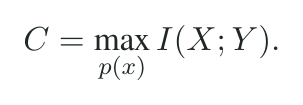
Here the channel's conditional output probabilities stay fixed while the input distribution varies. The symmetric binary channel above reaches approximately 0.189 bits per use with equally likely inputs. Rates below capacity admit arbitrarily small decoding-error probabilities over sufficiently long blocks, but the theorem promises neither zero error for a finite message nor a practical code for every device.
Lossless compression exploits source redundancy. For independent selections from a fixed finite distribution, entropy limits the average rate of uniquely decodable coding over long blocks. No method can shorten every possible string: distinct inputs need distinct descriptions, and there are too few shorter strings. The decoding information must be shared or included. Compression and error correction can coexist because predictable source redundancy and protection against channel noise are different resources.
Description, use, and meaning
An algorithmic description asks about an individual finite string: the shortest program, in a fixed universal language, that produces it and halts. A long sequence of zeros can have a short generating instruction; program length differs from execution time and memory use. Exact shortest-program length is not generally computable. A practical compressor supplies an achievable description, not proof of optimality. Algorithmic complexity and ensemble entropy are related but begin from different objects.
Physical implementation further requires distinguishable states, preparation, persistence, and access. Quantum information, thermodynamic reset cost, biological coding, and propositional meaning introduce different constraints; calling all of them information does not make them one measure.
Kolchinsky and Wolpert make one functional notion precise by disrupting system--environment correlations and asking which information is causally required for specified viability. Their entropy-based criterion depends on system, dynamics, horizon, and chosen viability measure. It establishes functional significance within that model, not conscious intention or propositional truth.
A valve report makes the remaining distinctions concrete. A perfect channel can transmit a faulty sensor's false report. A reader can decode the report correctly while identifying the wrong valve; a speaker can knowingly falsify it or use a true report harmfully. Carrier, code, reference, truth, intention, and responsible use mark different failure points in one system. Repair begins by identifying which relation failed.
Truthful participation
Finite investigators discover necessary relations, apply them to a contingent physical world, and transmit what they learn. Human and artificial discovery can produce different routes to constructions answerable to the same exact constraints. The causal history that produces an answer and the reasons that warrant it meet in successful inquiry.
Evolutionary and cultural histories explain much of that meeting. Millikan assigns proper functions through what earlier reproduced items successfully did and how those performances explain the present item's existence. A malfunctioning organ or unsuccessful representation can retain a function it fails to perform. The account extends to learned behavior, language, and artifacts, giving correctness and error a place within their actual histories. Selection, inherited practice, instruments, and criticism can extend reliable access beyond the tasks for which capacities first developed.
The further source question concerns the actuality of objects, powers of access, and the good of knowing. Tegmark identifies physical reality with mathematical structure and observers with self-aware substructures; applicability belongs to their shared structure. Craig instead assigns physical realization to a rational creator's intentional action. Their disagreement concerns why the structure is actual and contains knowers, beyond the demonstrated usefulness of its mathematics.
On the Logos account, necessary mathematical relations constrain possible orders, while creative willing gives one permissible order a concrete history. The proposed gain is a reason for the coordination of knowable objects and knowing subjects: their truthful activity is a good intended in the act that gives them existence. This depends on the personal-source argument in Chapter 3, including its account of free creative willing. An impersonal account explaining that coordination earns the same credit for what it explains; taking it as basic supplies a different stopping point. Chapter 42 weighs the gain against the commitments required by rational giving.
That intended end gives the means their unity. Distinct creatures knowing a shared world need determinate objects, powers of contact, and ways to distinguish genuine discovery from convincing error. Finite learners also need recovery from failure. Stable objects, bodily learning, public evidence, and correction belong together because each serves the recipients' own knowing. Plantinga develops this relation between a truth-directed purpose and properly functioning capacities.
Novel prediction sharpens this unity. Dirac's constraints reached beyond the observations used to construct his theory and specified a previously unknown kind of particle; Anderson's cloud-chamber work found it independently, and the theory then supplied its interpretation. Choosing successful models helps explain their retention; the world's realization of their further consequences explains why that choice can lead to discovery. Unexpected transfer makes the explanatory task more demanding: relations learned in one setting can disclose features of a world beyond the learner's original experience. Shared laws, evolved abstraction and public correction give the impersonal account resources for explaining that reach. The personal-source account understands the same connections as means of a known good: finite creatures can grow in truthful contact with what exceeds their present familiarity. Their comparative force belongs with the wider source argument, where both accounts must explain the whole relation.
Truthful participation also identifies what is lost when access is destroyed. Injury, exclusion, and deception deprive a subject of the good these powers can serve. Finite difficulty can belong to learning; a world systematically organized to defeat every correction would frustrate the intended end. The suffering and restoration chapters return to that deprivation as a loss to the actual knower.
A mathematical relation enters physical inquiry through states, boundaries, interactions, and records that realize it. The next chapter follows those conditions: the physical world gives representations their concrete objects and gives finite knowers the means to encounter them.
Related research
Compare this chapter with source documents or study its biblical references.
Chapter comments