The person raised is the person who lived: the child who received care or endured neglect, the adult who exercised entrusted powers, the neighbor whose acts helped or harmed others. Judgment brings that history to truth. It distinguishes the good creature from corrupted works, ends domination, and answers the neighbors those works affected. The powers sin bent have a fitting good, and injured people have a good of their own.
A correct record can leave victims wounded and perpetrators powerful. A verdict can answer desert while leaving the injured without relief. Truth, responsibility, effective opposition to evil, and restoration of damaged goods must therefore belong to the same account. The judge is the Creator and incarnate restorer already identified, rather than a new source of value introduced after death.
Traces, formation, attribution and divine action are distinct. A scar does not identify its cause; fear can be injury rather than guilt; confession can be false. The final appearance of a life likewise cannot erase its earlier relations. Judgment according to truth can contradict both imposed self-condemnation and comfortable self-acquittal.
Entrusted power and enacted history
Luke's steward is appointed to feed others, then abuses them while exploiting apparent delay. Greater knowledge and entrusted power deepen responsibility; the master's return also includes serving watchful servants. Many and few blows preserve differentiation. More tolerable judgment for less-instructed cities and stricter judgment for teachers make religious proximity a responsibility.
Romans 2 judges according to truth, distinguishing possession of Torah, conscience, persistence, hardness and response to patience. Works include response to received grace rather than autonomous self-salvation. Ezekiel's call to turn distinguishes a son's conduct from his father's and a changed future from repetition of an earlier verdict. Ignorance is not automatically culpable refusal, but what someone should have learned also matters. Earlier contributions to later incapacity require judgment of those earlier acts under their own conditions.
Acts propagate through witnesses, tools, institutions and damaged environments that form later agents. A dissenting officer, intimidated witness and knowing designer of concealment occupy different positions. Inherited benefit can generate a duty without transferring the original deed. Land and animals can bear effects without acquiring conscience. In Hosea the land mourns where emet and hesed, truth and covenant faithfulness, are absent.
Christ's judgment seat concerns embodied deeds. Disclosure reveals hidden fidelity as well as manipulation; verdict determines the act's moral character; recompense supplies a fitting response. Truthful access to one's own deeds is a condition of just judgment, so disclosure belongs to justice and not only to publicity. Revelation's books assert more than storage of accurate information.
Wrath that acts
Wrath is holy opposition made effective, not uncontrolled mood or an automatic mechanism. Romans 1's repeated paredoken, handing over, assigns God a judicial act within chosen corruption without making Him its author. Romans 2 joins accumulated exposure to wrath with patience inviting repentance. Other judgments restrain, remove office, dismantle power or destroy; regret alone leaves domination operative.
Desert, protection, correction and restoration have different objects. Restraint can protect without reforming; deserved punishment can leave lost capacity unrestored; repentance can be sincere without making reinstatement fitting. Offender suffering is no independent good merely because the offender suffers.
Judicial forfeiture has a definite object. An entrusted asset can be taken away, a commission transferred, or its attached share withdrawn for culpable unfaithfulness. Luke makes the disposition concrete: the servant's mina is removed and given to another. Such a penalty answers misuse of an actual entrustment; merely receiving a different gift or lacking an opportunity is no offense. Ending a supposed right to dominate also differs from withdrawing a legitimate responsibility: the former claim was never rightful.
The result can outlast the suffering through which it is received. A particular charge can remain with its new holder while the former holder becomes truthful, capable, and welcome in communion. Healing supplies the person's good; it does not by itself transfer that same charge back. This gives enduring punishment a stronger meaning than the permanent truth that a temporary penalty once occurred: an adverse disposition of an entrusted good still holds. An everlasting forfeiture requires a continuing object, rather than an earthly office whose term has ended for everyone. If the identical title is reinstated, its forfeiture has ended in that respect. A different new commission can instead give further service while respecting the earlier judgment. The loss must remain warranted and proportionate; its permanence cannot be inferred simply from the fact of a past failure.
The builder, the work and the temple
First Corinthians 3 concerns a divided church attaching itself to ministers. Paul plants, Apollos waters and God gives growth. Grace enables Paul to lay the one themelion, Jesus Christ; the builder's achievement does not produce its foundation.
The Day makes work phaneron, manifest, and fire dokimasei, tests its quality. Gold, stones, wood and straw distinguish durability. What survives receives reward. What burns brings real loss, while its builder is saved as through fire. Work, loss and person have different predicates.
The narrow-escape reading treats dia pyros as surviving with construction lost. Frayer-Griggs instead argues for an instrumental saving function through grammar and probable Malachi 3 allusion, where purification enables righteous offering alongside judgment on injustice. This is a serious purgative proposal, and both readings preserve salvation with lost work.
The surviving work matters too. Paul distinguishes a worker's reception of salvation from the tested good of the work and its reward. Judgment can therefore preserve a person's future while making a real difference to what that life contributes. Healing restores the worker; truthful assessment identifies what can endure. The kingdom's promises of further responsibility give this distinction a positive direction: faithful participation can become the beginning of a greater entrusted task. Chapter 41 connects that prospect with Jesus' teaching on service, capacity, and reward.
The saving life and the reward consequently answer different questions. The builder's future rests on Christ; the reward recognizes what the builder actually contributed upon that foundation. Grace can give new powers and new work without crediting the condemned construction as faithful achievement. Paul thus supplies a direct case of salvation with loss, rather than making restoration itself the reward for successful building.
Verse 17 adds a personal warning: the plural community is God's temple; if someone phtheirei, corrupts or destroys it, God phtherei that person. The object is a person, in a case distinct from that of verse 15's saved builder. The adjacent warning shows that destructive judgment can fall on a person as well as on a work.
Paul also describes personal judgment directed toward salvation. First Corinthians 5 gives the offender's handing over a saving purpose in the Lord's day. Chapter 11 makes the bodily cost explicit: within the assembly whose meal humiliates poorer members, many are weak or ill, and a considerable number have died. Paul then distinguishes being judged by the Lord from being condemned with the world: the former is discipline directed against the latter. Death within this judgment therefore need not mean that the Lord has abandoned its subject. The same letter that proclaims embodied resurrection supplies this distinction within its account of Christ's rule. The saving purpose concerns the person undergoing judgment, while the practice that injures neighbors must end. The stated purpose concerns these judged members; extending it to everyone requires the scope argument of Chapter 40.
A mother saved through loss
Consider one mixed history. A mother suffered terror as a child and genuinely wanted healing. In adulthood, affection, musical skill, and service coexist with coercive control of her daughter: disagreement counts as betrayal and generosity creates permanent debt. Suppose both receive saving communion. The case tests whether healing can preserve the same people while ending a relationship through which they formerly understood themselves.
The mother's claims to control her daughter must end. She answers as their agent, not an innocent replacement that inherits only attractive memories. Her preferred account of sacrificial parenting loses authority. These were substantial parts of her adulthood; salvation cannot convert them into achievements.
The earlier willingness and the later coercion belong to one person. Healing can fulfill the child's desire to love without fear while condemning the adult's use of control. The daughter's independent good determines what changed conduct must respect. Earlier reception supplies a real beginning whose fulfillment includes truthful judgment. Grace can also awaken a first willingness in someone whose history supplies no such beginning.
Removal alone is insufficient. If she cannot receive safety or worth except through control, healing must enable truthful reception of love and another's independence. Safety, belonging, affection, and agency were real goods before she sought them through domination. They remain goods when that pursuit ends. Christ's life supplies a positive source of their fitting relation: receiving love without owning its giver, giving without manufacturing a debt, and acting without making another's subjection a condition of worth. Musical skill partly acquired through seeking admiration can serve gratitude and delight. The historical occasion of a good need not remain its future sustaining condition.
The daughter's restoration is independent of completing her mother's story. Her imposed shame, restricted agency and injured trust need an answer; renewed communion grants no restored entitlement to surveillance or control. Present forgiveness leaves contact voluntary and office a separate question.
Future patience cannot become care already given in a lost childhood. Yet fulfilled powers do not require every possible achievement: the mother can love without control, and the daughter can trust without reinstating the arrangement that injured her. Both receive a healed order within their actual histories.
The mother's culpable omission and the daughter's unreceived care are different losses. The former can warrant judgment against an entrusted responsibility; the latter is an injury to answer. Healing gives both a future without assigning the daughter a penalty for the care she was denied or entering the mother's neglect as care she actually gave.
Gregory of Nyssa gives this distinction a striking image: wheat and weeds growing within the soul. In his dialogue, Macrina explains that misdirected desire shares the powers through which a person can love the good. Uprooting desire itself would remove the capacity needed for communion. The cure must distinguish the power from its distorted direction. Origen likewise develops an inward reading in which destructive opinions are removed from people who come to recognize what they had received.
The common structure is a power with competing acquired directions. Healing preserves the capacity for desire while ending its corrupt rule. That ending can be experienced as personal ruin even though the person receives it and the freedom that follows. The weeds need no separate consciousness to make their removal costly.
Truthful memory and effective redress
Gregory of Nyssa compares removal of deeply attached evil to painful surgery, distinguishing created nature from acquired corruption. His dialogue through Macrina culminates in participation of the whole human race after differing cures. Augustine likewise distinguishes knowing past misery from undergoing it again and bodily honor from renewed wounds, but explicitly retains eternal suffering of the lost. They share these distinctions while reaching opposed terminal outcomes.
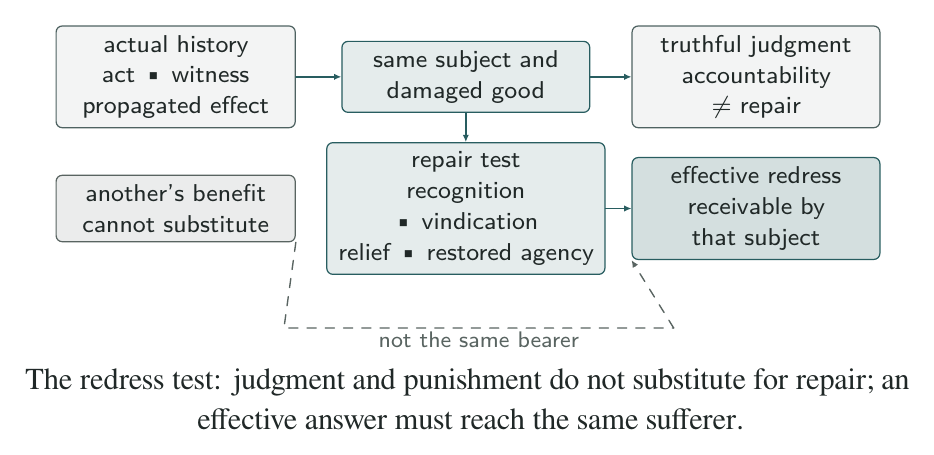
Redress has distinguishable objects: recognition answers denial; vindication answers false blame; relief addresses affliction; restored capacity enables action; communion renews participation. Their combination matters because a truthful reputation can coexist with terror, and punishment of an offender can leave coercive dependency intact.
The recipient determines what adequate repair requires. Safety must become receivable by the person whose trust was damaged; belonging must leave her free to answer. Another person's flourishing can accompany her healing, but it cannot be her healing, and an unrelated benefit cannot substitute for the good whose loss is being answered. Nor can a preference shaped by renewed domination establish that the deprivation has ended. Restored powers, fitting relations, and the person's own reception converge in one life, while the original injury remains truthfully condemned: healing never turns the event into a right.
Historical truth and present experience accordingly differ. The unreceived childhood good remains a loss; renewed agency and belonging change what that loss now does to the person. Remembering an injury need not mean undergoing it again.
Stump's second-personal account offers a relational way to frame this proposal: a sufferer's good may include being met by someone who knows the suffering and addresses the sufferer. This chapter draws a further inference: divine presence can answer relational deprivation while preserving the truth of the earlier absence and the wrong of the original cruelty. This identifies one dimension of personal restoration whose adequacy must be considered alongside bodily, practical, and social losses.
From a disordered good to its fulfillment
The distinction between a good power and its corrupted exercise also explains how a desire can be fulfilled through a changed form. What a person presently demands can differ from the good that makes the demand attractive. The standard is the person's fitting created good under the Logos: truthful knowledge, bodily integrity, agency, love, and communion. Present preference supplies evidence about that person's formation, while the nature and relations of the good supply the standard by which the preference can be healed. Fulfillment can consequently preserve a real good while ending the demand that distorted it.
Stump's fuller response to her critics offers a useful comparison. She distinguishes a desire's immediate object from the deeper good expressed through it. A desire can change its form without simply being abandoned; fulfillment can include particular creaturely goods within communion with God. This distinction illuminates the relation between created good, acquired desire, and healed participation.
A longing to speak without fear may initially take the form of wanting a parent's approval of every decision. Its underlying goods include being heard, loved, and free to answer. Truthful relation to God, restored confidence, trustworthy friends, and freely given maternal love can realize those goods in a previously unimagined form. Praise that leaves the fear intact, or a revised preference imposed to protect the parent, fails the same test.
Changing the form counts as fulfillment only if it preserves a deeper good that actually informed the original desire. That good is more than a later preference assigned to the sufferer: being loved truthfully and having one's agency honored are fitting goods of this person. Unavailability cannot authorize substitution. The daughter can regain the capacity to love her mother without regaining her mother's freely returned love. Those are two goods with different conditions. Truthful recognition, protection, and communion with others can restore the daughter's agency and belonging, but they cannot make another person into her mother or make refusal into reconciliation. Love concerns this other person's good, not merely the agreeable state the relationship produces.
Recovered independence and reconciliation remain distinct. Another's refusal cannot hold the injured person's agency hostage, yet that particular person's freely returned love is a further good. Where reconciliation belongs to the promised fulfillment, separate safety does not fulfill it.
This also changes the comparison with a life that never suffered. Maikki Aakko's 2026 argument distinguishes a redeemed life's positive worth from its being better than every suffering-free alternative. She proposes that differently fulfilled lives can resist a common ranking: their good lies in their distinct integration around God. A life's fulfillment can be affirmed without demonstrating that its every loss produced a uniquely superior result. The daughter can receive her actual life as good while still judging that the coercion should not have happened. The history's redemption concerns what her life has become; a judgment about the coercive act concerns what was done to her. These are compatible appraisals of different objects.
A redeemed life can therefore be affirmed as a whole while its cruelties remain condemned. In the language of the horror debate, the horror is defeated when truthful integration within divine communion removes its power to make that life meaningless. The same person can finally affirm the life received because healing and belonging are actual in it.
Redress and responsible answerability
An injured offender can receive treatment, vindication against false blame, and restored capacity while still owing an answer for a separate offense. What was done to a person and what that person did keep their own moral character. The mother's childhood terror, for example, never becomes deserved because she later terrorized her daughter. Nor does her claim to healing remove her daughter's claim against her. Justice addresses both relations in the same bearer.
The good received through care remains part of the person's actual history. Its continuing enjoyment requires the living recipient. Adams's whole-life criterion concerns more than a pleasant interval: the actual person must be able to receive the life as good, with its losses truthfully answered. That requires restored powers, fitting relationships, and a secure future. Chapter 40 distinguishes this person's continuance from the painful ending of the acquired organization through which she formerly experienced herself.
What makes a restorative good complete?
Completion follows the good's conditions. Vindication, restored powers, and continuing communion illustrate three different forms.
A verdict has a possible point of accomplishment. False blame is overturned when truth is established, the attribution is corrected, and the affected subject can receive that recognition. If an institution corrects its private database while the person remains publicly condemned, the relevant vindication has not occurred. Once it has occurred, a later answer for a genuinely different offense does not make the former blame true. This is a finite good that can be complete in its own respect, while each other injury in the life requires its own answer.
A healed capacity to speak makes truthful expression available under conditions in which this person can exercise it. Recovery from coercion includes a usable field of action and personally received safety. The capacity can be whole before every possible conversation has occurred. The time and opportunities needed for recovery nevertheless follow from the actual injury; merely naming a power restored gives its bearer no lived good.
Participatory goods have a different condition. Friendship involves the actual friend's freely given presence and activity; communion with God involves the person's continuing relation to the actual giver. A finite friendship is a real good, but its having once occurred is not the same as its continuing. Where the promise is secure communion, a finite episode followed by its permanent removal fails the promise. Aquinas's argument for the stability of perfect beatitude gives a reason: assurance belongs to that fulfillment, and assurance that is destined to become false would itself introduce defect. Chapter 41 therefore treats secure consummation as enduring participation, not as a pleasant state that can expire.
No completed repair automatically supplies the others: corrected blame does not restore friendship, and usable agency does not supply a friend's presence. Whole-life fulfillment must meet the conditions of every good it promises.
Aquinas supplies useful grammar. He distinguishes imperfect happiness, which can be lost through a changed will, from perfect beatitude, which cannot be lost, and distinguishes natural powers and inclination from grace and ordered act. Applied here, that distinction separates actual redress from secure consummated communion, which a beatified subject cannot lose. His own account includes alleviation within damnation. Adams's stronger demand concerns a life whose worth for its bearer is threatened, answered through relation to God; Sutherland retains the other sufferers and evil's continuing condemnation.
The mixed-history case now has a precise result. Childhood injury calls for vindication and healing; later coercion calls for acknowledgment and its termination; renewed relation calls for freely returned love. These changes can advance together because they answer different objects in the same history.
Holy encounter and its limits
Holy encounter brings a formed person and a mediated history before the Judge. A false account of the giver can make dependence feel degrading; repeated refusal can make corrective truth threatening; a defended identity can make another person's freedom feel like loss. Under unveiled truth those patterns meet the good they misread. The same disclosure can expose the mother's defended innocence and free the daughter from false blame. Their different responses arise within their different histories, while the Judge and the good remain the same.
Some anguish can arise within that resistance to God's objective action. Mercy heals the person's reception and response; it does not change the reference until domination counts as love. Divine judgment also restrains, dispossesses, and establishes a boundary, so the experiential account is one relation within God's active answer. Imposed shame and injured trust hurt as well, so pain proves no guilt. Chapters 26 and 40 retain the distinction between injured incapacity and responsible refusal.
The judgment of resistance requires knowledge of the person's actual powers and access to truth. Chapter 40 follows how those powers can be rebuilt, why surrender of a defended life can be feared, and how the person can come to own the resulting change.
Justin proportions account to entrusted power while affirming eternal punishment. Irenaeus describes loss of light under active judgment and unending deprivation, with blindness not always self-chosen. Origen's conscience encounters its own deeds after resurrection through divine power; his surviving Rufinus transmission also affirms bodily resistance to dissolution and stronger medicinal direction. These witnesses supply relations without agreeing on destiny.
No creature can disconnect from the Logos and remain independently existent; sustaining dependence and saving communion are different relations.
The life that receives justice
Effective justice joins a truthful verdict to a changed reality: domination has ended, injured powers are restored for use, and each person receives the good of a fitting relation. Historical truth is preserved while corruption's continuing authority is removed.
The contrast within restoration concerns how each person receives the good. A love already directed toward its fitting end can welcome fulfillment as continuity. A life organized around corruption may need a painful beginning again before its own history can be received truthfully. Both concern the actual person; neither makes her past disappear. Chapter 40 develops that distinction and its place within the judgment texts.
Related research
Compare this chapter with source documents or study its biblical references.
Chapter comments