Hebrews locates deliverance in the deliverer's solidarity: those He saves share flesh and blood, and He takes part in the same life, suffering temptation and entering death. The Son enters the whole human condition, lives its faithful answer to God, and brings that life through death into incorruption. Pardon, healing, and resurrection come from the one who shares the life He restores.
The extent of the assumption
The assumption must reach body, rational soul, understanding, affection, and will, with their actual operations. These name the complete humanity and its powers, not additional personal subjects alongside the Son. Gregory of Nazianzus's argument against replacing Christ's human mind with divinity connects complete assumption to complete healing: excluding the mind excludes part of the humanity needing restoration. Sin is no necessary constituent of that nature. Hunger, anguish, love, obedience, and death can be fully human without rebellion. Ignatius's opposition to apparent birth and suffering likewise protects the reality of the passage through death.
The concrete subject is the eternal Son; His humanity is not another person beside Him. Chalcedon preserves the properties of both natures in their inseparable union. The Son hungers and dies humanly without divinity becoming deficient or ceasing to exist. The distinction makes suffering personally His while identifying how it is true. Created ancestry and bodily organization provide His real human relations; they cannot generate an uncreated subject.
Mary hears, questions, assents, conceives, bears, tends, and ponders. Her motherhood supplies actual human descent rather than a passage for a ready-made heavenly body. Theotokos identifies the person born as the divine Son; it does not make her the source of His divinity. Irenaeus's Eve--Mary comparison gives her trusting obedience a real place in the undoing of disobedience while locating saving efficacy in Christ. Cooperation matters because grace enables it.
Gethsemane presents natural dread of death and genuine human consent. Constantinople III's two natural wills and operations preserve the human power through which the Son obeys; deification does not abolish it. His human will needs no conversion from prior corruption. He lives its proper faithfulness and communicates that life to those whose willing is disordered.
John of Damascus identifies this shrinking from death with the creature's natural attachment to being. The Son's anguish witnesses to the good of the human life He freely gives. His consent takes place through that living human affection and will; freedom is present within the costly act of trust. The Paschal victory consequently preserves the desire for life while overcoming the rule that would make fear its master. A frightened person can receive His aid without first achieving emotional fearlessness.
Growth in wisdom and stature gives this humanity a temporal history. Hebrews' learning obedience through suffering concerns faithfulness enacted at cost, not recovery from disobedience. In temptation, bread, safety, and kingship are offered detached from rightful trust and worship. Adam's grasping is answered by the Son's reception of created goods from the Father. The goods themselves remain good: feeding others, protecting life, and exercising rule can be enacted in the filial relation that the temptation tried to sever. His long obedience supplies the faithful human life communicated in restoration, as well as its example.
Irenaeus's recapitulation heads humanity anew through birth, growth, obedience, and death within the same Creator's world. Paul's last Adam establishes representative efficacy beyond an admired example. Ephesians' gathering of all things supplies cosmic reach. This unique assumption grounds saving participation.
Distinct relations within one Pascha
Pascha carries Passover into Christ's death and resurrection. Paul identifies Christ as the sacrificed Passover; Jesus gives bread and cup through His coming body and covenant blood. Passover's deliverance and the sanctuary's cleansing converge without their earlier actions becoming identical. Melito joins captivity, lamb, blood, and risen victory in the Lord's person. His association of Pascha with a Greek suffering verb is homiletic wordplay, not etymology.
Isaiah's servant bears sickness, pains, transgressions, and iniquities; chastisement brings peace, wounds healing, and his life is made an asham, reparation offering. Bearing, judging, healing, offering, and interceding are different relations joined in the righteous servant. First Peter receives both example and effective sin-bearing: people are enabled to cease from sin and live to righteousness. Its counsel to persons under unjust masters names their suffering unjust and calls them to follow Christ in entrusting themselves to the One who judges justly; the sin-bearing that brings peace remains His alone.
Hebrews' priest shares human life and offers Himself through the eternal Spirit. Priest, offering, and recipients remain distinct. The offering cleanses conscience for service and opens confident approach. Its once-for-all sufficiency is joined to ongoing sanctification. Hilasterion names the mercy seat in Hebrews 9:5; its application to Christ in Romans 3:25 has debated mercy-seat, expiatory, and propitiatory emphases.
Ransom names costly release in the same saying that rejects domination; it names no payee and grants Satan no title. Hebrews joins deliverance to the overthrow of death's power and the release of people bound by its fear. Changed lordship opens real possibilities for action.
The release has its ground in what happens to the deliverer. He is betrayed and killed, yet neither the executioners nor death acquire final possession of His life. The Father raises Him, and the living Son gives others a future that threats cannot finally confiscate. This changes the terms on which life can be received: preserving an advantage at a neighbor's expense need no longer appear the only way to have a future. Courage and truthful love can grow from a belonging secured by the risen Lord. They receive their warrant from His resurrection, whose reality remains necessary even when no observer feels reassured.
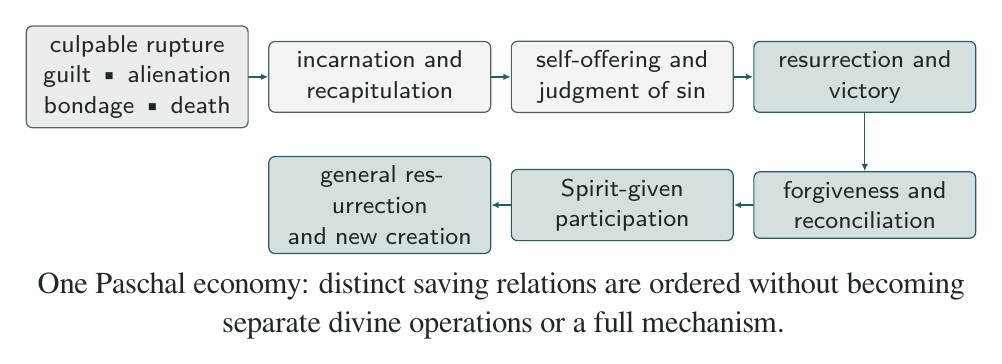
The Pascha is one undivided Triune saving action. The Father sends the beloved Son for the world's life; the Son freely offers Himself through the eternal Spirit; the Father raises Him, and the Spirit gives resurrection life. Reconciliation in Christ and Christ's offering to God describe ordered personal relations within one divine will. Human betrayal and wrongful condemnation retain their culpable objects and intentions. God's restorative purpose does not make the executioners faithful agents of it, and the Son's willing gift is never the Father's hostility toward an unwilling victim.
Judgment, substitution, and their limits
Romans 3 connects redemption and Christ's blood to God's righteous justifying action amid prior forbearance. Galatians 3 locates curse-bearing within violated covenant and Abraham's blessing reaching Gentiles. Romans 8 specifies sin as what God condemns in the flesh. Second Corinthians makes the sinless one sin for others within reconciliation and its summons. None requires Christ to acquire sinful character.
God's gracious verdict of righteous standing in Christ is distinct from regeneration and sanctification. The verdict is a real relational act grounded in representative obedience and received through faith; renewal is inseparable without becoming its ground. This scope is contested: Catholic teaching includes inward renewal within justification itself, locating its formal cause in received righteousness, as Chapter 23 explains.
Christ's saving answer takes a covenantal-representative form. He fulfills the covenant's fidelity as its appointed human head, undertakes for others what they cannot supply, and enters the curse and death that give the act its penal dimension. His substitution receives its meaning from this identity, solidarity, and faithful act.
Christ remains personally innocent and beloved and undergoes no post-resurrection second death; Scripture sets no numerical equivalence between His suffering and every sinner's terminal penalty.
The head's offering is an act of faithful human agency. The incarnate Son fulfills the obedience humanity owes and gives His own life for those whose relation to God has been broken. The Father and Son act from saving love, while betrayal and execution remain the wrongful acts of their human perpetrators. Aquinas distinguishes these intentions within the same death.
The ordinary court's objection makes the difference clear. An innocent volunteer's consent cannot turn a false conviction into justice, because authorship of a wrong remains the offender's. Another person can nevertheless bear its consequences and supply a genuinely reparative answer. Christ's relation gives that possibility a particular form: the covenant's giver bears the cost in His own incarnate life; His human fidelity answers the breach from within the humanity He represents; and the Spirit communicates His accomplished life to distinct receivers. Curse and death are both judicial consequences and conditions from which this humanity needs rescue. The chosen economy joins a truthful judgment of sin to the faithful, incorruptible life its recipients need.
Headship has three connected grounds: actual human solidarity through descent from Adam, appointment directing the act toward others, and the Spirit's effective joining of receivers to the living head. Together they explain why His faithful act can answer for others. A label alone could not make unrelated suffering count as their obedience.
The judicial dimension remains real. Curse and death name consequences of breach under God's judgment. Christ enters that condition without a false attribution of personal guilt. Athanasius places its remedy within the Creator's continuing regard for His handiwork. Freedom not to create differs from abandoning the rational creatures already made, even when their own negligence helped bring their ruin. Those creatures remain the recipients of the good now damaged; corruption changes the help they need rather than making them cease to matter. The Word therefore acts to reclaim the humanity He made while meeting the death sentence. Repentance alone cannot restore incorruption; His assumed body can truly die for others and be raised into the life they need. This supports restorative action without by itself establishing every person's final reception. Anselm likewise argues that the restoring agent must be both divine and from Adam's race, because humanity owes the answer that God alone can supply. His account is satisfaction, rather than every later version of penal substitution.
The positive judicial claim is that the covenant's giver accepts the faithful head's human answer for those He represents. Sin is condemned, its rule is broken, and the relation it violated is truthfully reopened through the Son's obedient self-offering. A change of verdict therefore has an enacted ground: this representative has fulfilled the fidelity humanity failed to render and has entered its judicial mortality, which He did not owe, to overcome it. His answer cannot make the sinner's past acts innocent, cancel a victim's standing, or discharge restitution by pretending it occurred. It provides pardon and restored standing while making truthful acknowledgment and repair possible. Romans 8 consequently joins the condemnation of sin in Christ's flesh to the law's righteous requirement being fulfilled in those who walk by the Spirit.
A stricter retributive account would require each offender's identical penalty to be borne; the scriptural relations instead locate adequacy in who acts, what He fulfills, and the life He gives. The decisive normative premise is that the covenant's just claim can be answered through representative fidelity, judgment of sin, and restored communion, rather than only by each offender's suffering an identical penalty. The texts and the person acting support that premise; a theory restricting justice to the latter demand disputes it.
The abandonment cry remains real; Psalm 22's later praise does not cancel its opening anguish, and the suffering Son still addresses His God.
Bounded satisfaction means that Christ's obedient offering fully answers sin's just covenantal claim, expiates guilt, deals with wrath through God's provision, and reconciles. Pain has no saving value detached from the person, love, obedience, and restoration.
Aquinas addresses adequacy directly: satisfaction's worth follows the charity of the offering, the dignity of the divine-human person, and the suffering actually borne. Christ's act can therefore be superabundant without numerically reproducing every consequence each sinner would undergo. Headship explains whose answer it is; satisfaction explains its sufficiency; resurrection and participation explain its effective reach. These relations give the reason for accepting the answer.
Craig's September 2026 objection to annihilationism assumes a stricter rule: Christ must bear the same just desert as the finally condemned. He allows intensity to stand for the duration of conscious punishment but argues that no intensity can substitute for ceasing to exist. His challenge concerns strict terminal equivalence. The faithful head's actual death and superabundant satisfaction answer the judicial claim on the different grounds just developed. Clark's earlier reply to Craig's July formulation disputes treating bodily death and final destruction as identical in every respect. Chapter 40 compares extinction with the ending of a corrupt acquired life within a continuing person. Its restorative conclusion retains the distinction between Christ's sufficient offering and an identical reproduction of every recipient's judgment.
Why not simply forgive? Pardon answers guilt, while the people pardoned also need freed agency, reconciled belonging, and life stronger than death. The Son's faithful humanity, self-offering, and resurrection accomplish those goods together, and His Spirit makes them the recipients' own life. Aquinas distinguishes absolute necessity from the fittingness and necessity of God's freely chosen way. No external law forces this economy upon omnipotence. The actual way manifests love, enacts obedience, strengthens hope, and grants participation. Its fittingness explains the confession's relations.
Penal judgment, victory, healing, recapitulation, participation, and moral influence answer distinct questions. Athanasius joins sentence with corruption and renewed existence; Irenaeus joins obedience with victory and Spirit. A simple legal-West/therapeutic-East division misreads their integrations. Catholic and Westminster formulations both join several relations but differ over scope and effective application. Participation must not absorb curse-bearing, nor verdict absorb renewed life.
The completed act and the living Lord
Burial establishes actual human death. Acts' use of Psalm 16 and Revelation's keys of death and Hades identify victory over the realm of the dead, not Christ's entry into an impenitent terminal state. Ephesians' descent and First Peter's proclamation passages have disputed audiences, timing, and effects. They furnish no complete itinerary, and the question of postmortem opportunity returns in Chapters 27, 38, and 40.
Christ's accomplished incorruptible life is firstfruits, distinguished from the awaited harvest. Athanasius argues that repentance cannot itself give incorruption to mortal humanity: the life-giving Word acts upon the body needing life. Believers' continued illness, decay, and grief belong to the interval before the harvest.
The same embodied death can therefore have a changed place within a human history. For the person joined to Christ, dying still tears apart embodied life and brings loss to those who love them. It no longer decides that person's final exclusion from life with God. John joins the believer's real dying to the promise of continuing life; Paul joins mortality to a future raising in the Spirit. The enemy is overcome through the recovery of the one it held. The distinction is relational and eschatological, and its completion is bodily: Christ gives the actual person incorruptible life.
Colossians joins forgiveness, the removed adverse record, vivification, and disarmed authorities. Revelation's conquering lion appears as a standing slain lamb. Victory preserves the identity of the self-giving Lord; present opposition possesses no ultimate sovereignty over the life He gives.
Ascension and session confess enthronement of the risen human Lord, with His humanity retained. Psalm 110's royal priesthood and Daniel 7's dominion are received into this mission. Acts redirects demands for a timetable toward Spirit-empowered witness and identifies Pentecost as the exalted Jesus' gift.
Christ's continuing intercession rests on His completed offering rather than another death persuading God anew. Churchly worship receives an already active Lord. His reign remains directed toward the defeat of the last enemy, death, and the kingdom's fulfillment in relation to the Father.
How His life reaches distinct persons
The completed account distinguishes five relations.
- Created dependence Every person receives existence through the Logos.
- Shared humanity The Son's solidarity is real without making humanity one numerical person.
- Hypostatic union His humanity belongs uniquely to the eternal Son as its personal subject.
- Representative headship His faithful human act is appointed for others.
- Saving participation The Spirit makes its good actual in distinct receivers.
The first relations establish who acts and for whom; the last explains how His accomplishment becomes another person's life.
John of Damascus distinguishes human nature raised in Christ from every human person already raised. Gregory's complete-assumption argument establishes the necessary extent of healing, not every person's reception.
The bridge is the living giver's action upon the people He represents. What is complete in Christ is a faithful human passage through judgment and death into incorruptible life. He gives damaged recipients pardon, filial access, the Spirit's indwelling, and renewed powers for their own action. Each gift becomes actual in the recipient's history: pardon grants standing, healing renews operation, and communion joins that person to the living head. Romans 6 therefore directs incorporated persons to present their actual bodily members to righteousness; Romans 8 directs the gift toward the vivification of their mortal bodies. Sharing His life is this effective relation between distinct persons, rather than a transfer of one numerical history or a declaration that every receiver's consummation is already complete.
First Corinthians joins communion to differentiated members' care. Cyril reads John 17 through Christ's body and one Spirit joining people who remain distinct in soul and body; their unity differs from the Son's natural unity with the Father. The same bearer whose acts require forgiveness and whose powers need healing receives both, without a new person taking the old person's place.
Faith, repentance, baptism, Eucharist, and obedience receive and express this relation rather than originate resurrection life. Gifts can be received at different times within one saving history: Hebrews relates the death to earlier covenantal transgressions. Accomplishment and application are distinct.
Forgiveness, access, reconciliation, and adoption give positive belonging. Renewal enables actual human action; merely removing domination would not teach truthful reception of love or another's freedom. Grace gives the life within which those powers can grow. Infants, impaired persons, and late converts need no mature performance as an entrance price. Forgiveness leaves restitution and the protection of victims in force, including limits on an offender's renewed access to them.
Reconciliation reaches peoples and creation. Gentile inclusion requires humility toward Israel's root and irrevocable calling. Melito's collective accusations against Israel require correction even where his Paschal exposition is valuable; responsibility for Christ's death is never inherited across persons and centuries. New creation preserves embodied and common goods as objects of restoration, giving present care a future.
Romans 5:17 names receivers of grace while verses 18--19 give the Adam--Christ parallel universal breadth. First Corinthians joins all dying in Adam and being made alive in Christ to differentiated order. Reception names how Christ's life becomes a person's good; the universal parallel gives reason to expect that saving action to reach every person. Chapter 40 argues for that restorative conclusion through the wider scriptural account of grace, judgment, and the giver's continuing concern for each recipient. Any terminal account must still explain the efficacy and breadth these texts attribute to Christ's act.
The risen Lord gives the life He has accomplished. Pardon answers guilt, reconciliation opens belonging, healed powers enable fitting action, and resurrection answers mortality in the same embodied person. Desire, understanding, love, and agency retain their created goodness as their corrupt ordering is overcome.
This gift can reach a person whose present achievements supply little ground for hope. Christ lives, intercedes, and gives the Spirit; the recipient's future begins in that active relation. Restoration becomes personal participation as the same person receives a new beginning and learns to live from it.
Related research
Compare this chapter with source documents or study its biblical references.
Chapter comments