A truthful act can change the conditions of the next act: it supplies practice, exposes a fear, creates a record, or makes another person's courage more practicable. Concealment can likewise supply a reusable rationalization. Agency operates within a history that its exercise helps form. Freedom is therefore not escape from formation; it is a person's growing power to answer within a history and, by answering, alter what can be answered next.
Formation can therefore alter both competence and motive. Teaching an honest answer may require removing a threat, correcting a belief, and practicing a response. These changes work on different parts of the same act.
Formation changes what a person can do
Formation changes a continuing person's powers, dispositions, and available courses of action. Learning, injury, neglect, practice, and care can all produce durable change without having the same moral character. The person is neither identical to an acquired pattern nor able simply to choose every needed change now.
Words, limits, examples, companions, consequences, demands, rest, and repair all take part in that history. Each of the eight functions described next can cultivate truthful communion or practiced exploitation, so effectiveness and direction must be judged separately.
Eight functions within a life
Inputs make words, examples, sensations, consequences, and testimony available for interpretation. Selection and intelligibility matter; repetition can make falsehood familiar.
Boundary protects the conditions of an activity. Limits on intimidation can enable speech, whereas limits on reporting can protect abuse. The constraint must answer for what it protects and whom it burdens.
Reference supplies an orientation for correction: a worked example, a trustworthy practice, or the actual good of those affected. Christian formation takes Christ as its decisive personal reference.
Community supplies belonging, cooperation, testimony, and answerability. Its distribution of honor and protection teaches alongside its explicit words. Belonging must permit correction of authority.
Feedback returns information about effects. Approval is only one signal and can reward concealment; independent records and affected people's responses can reveal what approval misses.
Testing places a capacity under a demand that exposes strength or limitation. Rehearsal may reveal a difficulty safely. A trial can be informative and still illegitimate, disproportionate, or needless.
Rest sustains and restores embodied powers while permitting attention beyond output. Receiving it acknowledges dependence; exhortation cannot indefinitely replace exhausted capacity.
Repair addresses a specified loss, disorder, or falsehood. Treatment, correction, protection, confession, and restitution have different objects. An injured person and a deliberate aggressor both need a response without being equally to blame.
These functions recur together. Rest can make judgment possible; trust can make correction receivable; a changed rule can protect its expression. Consequences then return as memory, habit, testimony, and conditions of later action.
The comparison with learning systems in Chapter 11 identifies three different objects of change: a present frame, a durable disposition, and the environment supporting action. In a person, each also bears on experience, responsibility, and communion. The formation state below locates these differences more precisely.
Learning to receive and live the good
Deuteronomy 30 joins choosing life to God's transformation of the heart within covenant, exile, and return. Philippians 2 joins willing and acting to God's work, gives Christ's self-giving as the orientation, and names Timothy's care and Epaphroditus's costly service. Theological formation includes material, personal, and communal action rather than competing with it.
The Didache's two ways concern speech, anger, generosity, work, relationships, and confession. Clement distinguishes exhortation, training, and teaching under the same Logos: knowing what to do and becoming able to do it differ. Their ancient social prescriptions still require judgment, including household relations presupposing slavery.
Irenaeus joins voluntary response to created growth. The uncreated giver is complete; creatures begin and mature. His infant-and-nourishment image makes good immaturity intelligible. His further claim, that encountering evil can deepen appreciation of good, concerns what experience teaches; whether each particular injury was necessary is a separate question.
Finite goodness includes development. A capacity is received before its fitting exercise is learned; practice stabilizes that exercise into a disposition that can be offered freely. Language acquisition and learning to tell a difficult truth differ in object, but both require this passage from available power to personally exercised good. Immaturity is therefore compatible with created goodness.
Nourishment, sleep, imitation, correction, and forgiveness are real causes in that development. When injury has formed an expectation of danger, trustworthy encounters can make a different response practicable. Healing works within this actual history and changes its future.
Trust can make such learning possible before comprehensive understanding. A child can have good reason to follow a reliable carer's fitting warning before understanding all the dangers it prevents. This is already a limited exercise of judgment: the child recognizes a speaker, recalls care, understands an instruction, and acts within available control. Mature wisdom grows through that supported exercise. Responsibility concerns what this child could then understand and do, including the trust warranted by this carer and instruction. The good of formation gives the more capable person a duty to make truthful response practicable.
What changes, and how quickly
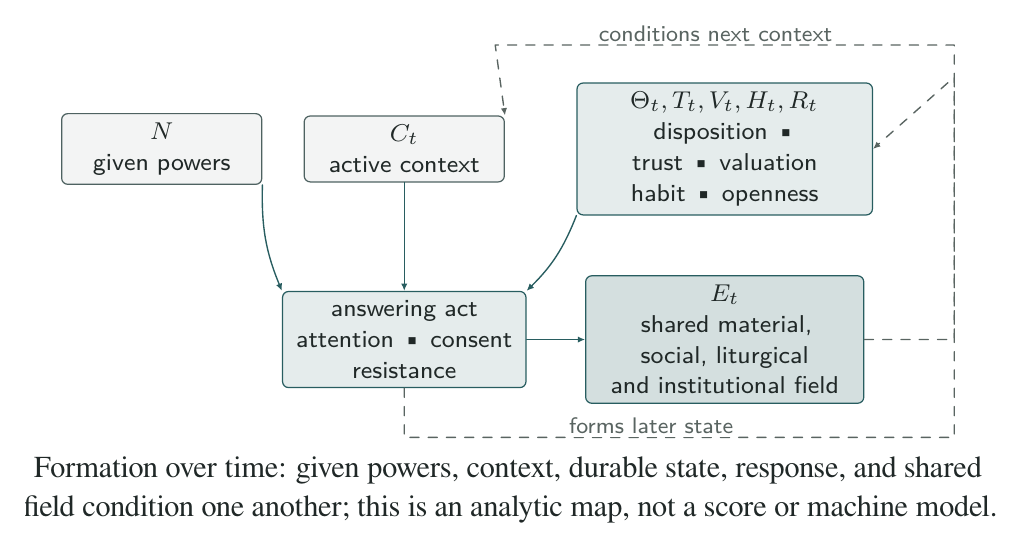
The eight functions describe formative activity. A separate analytic map, the formation state, distinguishes the conditions through which a person acts:

Here N names given human nature and its kinds of powers; Θ_t, durable dispositions; C_t, the active context or frame; T_t, source trust; V_t, valuation and love; H_t, embodied habit; R_t, relational openness or defensive closure; and E_t, the shared material, social, liturgical, and institutional environment. The subscript specifies a time. Present ability depends on the changing dispositions, circumstances, and supports across these terms.
The terms overlap without being interchangeable. Someone can believe testimony while valuing security more than acting on it, or desire correction while lacking the practiced ability to remain attentive under stress. A changed frame can alter today's answer without removing a settled fear. Context, durable learning, habit, and environment need not change at the same rate.
Rapid learning, automaticity, and preference change occur through distinguishable processes and on different timescales. The distinctions earn their place by identifying a specific obstacle and a possible intervention.
The will participates in its future
Agency extends across four horizons. Immediate response includes impulses, fear, recognition, and practiced movement; authorship turns on participation rather than speed. Deliberation includes attending, comparing reasons, inhibiting, seeking information, and deciding. Upstream self-formation concerns actions that shape later readiness: arranging assistance, selecting a practice, seeking treatment, or avoiding a recurring temptation. Corporate formation concerns jointly established conditions under which others will learn and choose.
No person invents every inherited condition. Nor do participants in a shared arrangement possess equal control or guilt. A leader imposing retaliation and a child receiving its effects occupy different positions.
Tracing responsibility upstream requires evidence at the earlier time: what was understood, what control existed, and which opportunities were practicable? Childhood coercion, inflicted injury, deception, and deliberate cultivation can produce similar persistent habits through very different histories. The will can help form future willingness without independently manufacturing itself.
What makes an action attributable
Participatory attribution tracks the person's action through understanding, reasons, intention, consent, love, or refusal. Brain, body, and history belong within those powers' explanation.
Judgment asks what the person knew or could reasonably discover, understood, controlled, and could do with available time and support. It also asks whether relevant information was withheld, a threat imposed, or deliberation bypassed. Coercion can compromise an intentional act; deception can leave reasoning active while falsifying its premises; imposed bodily movement can bypass participation altogether. Severe impairment presents another question. Influence, determination, coercion, and bypass must therefore be distinguished. The same words can have different moral histories: a child repeating a parent's threat, an employee speaking under an explicit threat, and a supervisor choosing the threat's wording are not equally situated merely because the sentence is identical.
Present endorsement also has a history. A person may sincerely defend a demand learned under coercion, so endorsement alone cannot establish adequate ownership. The inquiry must reach access to contrary evidence, the ability to reconsider, and the actual possibility of contesting the demand. Conversely, when someone understands a neighbor's claim, can respond to it, and knowingly defeats it for advantage, the wrong is attributable through those exercised powers. Answerability follows the relation already owed to the neighbor; intelligence and effective planning make that relation more accessible without making the chosen end good.
Luke 12:35–48 connects the steward's entrusted role to care rather than abuse and differentiates knowing from unknowing failure, and so supplies proportionality. Protection may be warranted before the degree of guilt is settled; a duty of repair may be clear while earlier control remains uncertain. Conversely, later acts formed through a history of suffering can still be the person's own.
A formed person is a genuine secondary source of an act without being an unconditioned first cause. Divine primary causation gives actuality to the whole embodied act, including the person's understanding, valuation, deliberation, and consent. Creaturely causation identifies the real agent whose powers are thereby exercised. Reasons are considerations the person apprehends and answers through those powers; their causal role is realized in attention, judgment, and action. Learning that a report was false can change whom one believes and what one does because understanding is itself an activity of this embodied person. Dependence on God therefore includes, rather than displaces, personal action.
These conditions apply to a first wrong as well as an acquired habit. A good but finite agent can attend to a real good while failing to honor another relation that its pursuit requires. Taking a desirable good in a forbidden way can become culpable where the relevant obligation and a fitting response are sufficiently accessible. Mere immaturity, a mistaken appearance, or being deceived does not meet that test. Chapter 17 applies this distinction to Genesis while leaving the first agent's complete psychology undisclosed.
Restoring agency has a positive object: this person's access to truth, ability to attend and judge, and power to answer through an intention that is their own. A frightened witness may first need safety, sleep, reliable records, and a hearing in which correction is possible. Once these supports make truthful speech practicable, speaking remains the witness's act; the help is among the causes by which that act becomes possible. Requiring the unsupported witness already to display the capacity being restored reverses this order. Obtaining a compliant sentence while leaving fear and exclusion intact also fails to restore it.
Freedom, ownership, and answerability
Suppose antecedent conditions and natural laws were sufficient for every feature of deliberation and choice. Compatibilists hold that responsible agency can remain; incompatibilists deny that the relevant freedom survives. This dispute concerns causal sufficiency rather than the mere fact of influence.
Fischer and Ravizza locate responsibility in guidance through an agent's own appropriately reasons-responsive mechanism. Ownership includes a history of taking responsibility, not merely present endorsement. They hold that this control can coexist with determinism.
Leeway accounts require an adequate alternative. Frankfurt's inactive intervener tests that requirement: someone is ready to force a choice, but the agent chooses it for his own reasons, so no intervention occurs. Unavailable alternatives and an actual bypass differ. Critics dispute whether the case eliminates every relevant alternative or assumes the conclusion.
Agent-causal sourcehood, as O'Connor develops it, gives the person a basic power to settle an intention. Reasons incline without determining that exercise. Randomness would not suffice; the agent's power is offered as control.
Pereboom's manipulation sequence moves from neuroscientific control through early programming and determining social training to ordinary determinism. The programmed agent can recognize moral reasons, deliberate without irresistible desire, and endorse the choice. Repeating those capacities therefore cannot answer the challenge: the case was constructed to include them. If deserved blame fails under programming, which difference restores it under ordinary determination? McKenna replies that agnosticism about the ordinary determined case is the neutral starting point, and that once the agent's full moral life is described, the same verdict carries back to the manipulated case. Their disagreement concerns ownership and basic desert, not whether the victim needs protection.
The positive reply begins with a narrower relation. The neighbor's standing gives a person someone to answer to. Where the person understands the claim and acts through usable powers of judgment, acknowledgment and repair address that person's exercised agency. A history of being formed is compatible with this: learning from testimony need not make the resulting judgment the teacher's act. Ownership requires attention to how that history permitted the bearer to engage, question, and revise it. An imposed disposition that bypasses those powers differs from an acquired judgment reached through them. This supplies a relevant distinction in many actual cases of coercion and learning. It does not defeat a stipulated case in which the manipulator determines the whole history, including every apparent reconsideration. Reasons-responsive and agent-causal accounts disagree at that further point; creaturely dependence alone decides neither.
This basis also supports fitting censure of a past violation. Suppose a supervisor understands that a witness has told the truth, can correct the record, and deliberately discredits her to preserve his position. Her complaint concerns the disregard he expressed through those available powers. Truthful protest, a demand for acknowledgment, and a warranted change in trust can answer that violation even when they promise no further improvement in his conduct. Their fittingness depends on what he did to her, not only on what a response might produce. The supervisor's causal history must still be examined for ignorance, coercion, and impaired control; explaining a deliberate violation does not by itself make the disregard unreal. Such censure addresses his act while preserving his standing as someone whose good still matters.
Such answerability and censure do not establish an entitlement to make the wrongdoer suffer, or determine which losses may justly be imposed. Scanlon's distinction between an action's belonging to a person, fitting blame, and changed obligations helps identify why those judgments require separate reasons. If every feature of a refusal were comprehensively programmed, the further argument for punitive desert would remain owed. Calling the programmer divine or the secondary act voluntary would not supply it. This book can affirm the truth of the wrong, the victim's claim, and the fittingness of truthful censure while acknowledging that stronger retribution needs a stronger account. Chapter 40 therefore distinguishes responsibility for a wrong, the losses its correction brings, and the restoration of the person who acted.
Providence adds its own disputed accounts. Aquinas holds that divine motion preserves a cause's voluntary or contingent mode; necessity given God's actual motion differs from necessity simply. The Westminster Confession joins comprehensive ordination to real secondary causes and denies divine authorship of sin and violation of creaturely willing. Molina's middle knowledge concerns what creatures would freely do in specified circumstances, prior in explanatory order to God's creative decision. It requires an account of those conditional truths and of selecting circumstances. They differ over how divine giving and this person's willing relate.
Deliberation in brain experiments
Libet's participants made self-initiated movements and reported when they became aware of wanting to move. The averaged readiness potential began before reported intention. Interpreting its onset as a completed decision adds a premise; generalizing to all reasoned action adds another.
Schurger, Sitt, and Dehaene modeled fluctuating activity accumulating to a threshold. Aligning sequences to movement produced a gradual average. Their model accounted for waiting-time and EEG data and generated a tested interruption-task prediction. The buildup could thus mark an evolving process rather than an already settled decision.
Maoz and colleagues compared arbitrary and deliberate choices concerning prospective donations. One response determined the recipient; another left the organizations sharing the donation irrespective of the response. Comparable visual and motor conditions yielded an expected readiness potential for arbitrary choices without the same reliably detected signal for deliberate ones. Eighteen participants with an interest in social causes were analyzed; support varied by measure and baseline. The study did not repeat Libet's reported-intention measure. It limits generalization from Libet's paradigm.
Pech and colleagues' 2025 experiment adds a useful contrast. Fifty participants were recruited for rewarded choices with easier or harder deliberation and unrewarded arbitrary choices. The rewarded conditions produced a stronger readiness potential, a higher reported sense of volition, and greater exerted effort; easier and harder deliberation were similar on these measures. Its different task yielded a different relation between meaningful choice and the neural signal. The joint lesson is that goal, task, and measure matter: neither the presence nor absence of one readiness signal identifies morally responsible choice.
Instructions and earlier intentions also configure a later response. Measuring its final moments leaves out part of the history of voluntary action. Neuroscience can refine mechanisms and limits while ultimate authorship remains a further philosophical question.
Addiction tests the distinctions
Alcohol use disorder can involve rewarding effects, conditioned cues, withdrawal relief, distress, and impaired planning or inhibition, with genetic vulnerability, stress, and support influencing how they combine. These mechanisms interact rather than forming one compulsory sequence.
Wanting to stop and having intact control are different, and a diagnosis can leave particular deceptions and harms attributable. Attribution concerns a particular occasion, available control, knowingly imposed risks, practicable earlier opportunities, and others' contribution to the conditions. Victims retain claims to protection and repair.
Qualified treatment and practical support can restore opportunities for participation. Dependence may make unsupported withdrawal dangerous and require medical assessment; this is a reason to identify clinical needs rather than turn recovery into a willpower test. Care must distinguish what needs treatment, what can presently be chosen, and what must be protected.
The heart's orientation
Formation of the heart concerns what a person increasingly notices, believes, loves, and chooses. Information can improve while self-excusing cruelty grows more skillful. Ordered love gives genuine goods fitting places: safety and belonging become disordered when another's injury is accepted as their price.
Imagination makes possibilities vivid. Habitually imagining only a superior's anger narrows action; attending to a vulnerable person's life can disclose another course. Courage involves truthful perception and willingness to bear a fitting cost, without requiring fear's disappearance.
Conscience can accuse accurately, become desensitized, or condemn under a mistaken norm. Guilt and shame therefore require inquiry into event, duty, participation, and accusation. Intensifying or numbing a feeling is not repair.
In 1 Corinthians 8, accurate knowledge about an idol does not cancel another believer's formative history or the effect of one's example. Love governs knowledgeable conduct while the weaker understanding remains open to maturation. The heart's integration joins perception, love, judgment, and action; grief, delight, indignation, and hope each keep their own character.
Prayer and ordinary faithfulness
Prayer gathers embodied attention into asking, thanking, confessing, and lamenting before the Father through the Son in the Spirit. Its formative power includes making a failed hope or mistaken interpretation speakable.
Psalm 88 lends words to prayer that remains in darkness. Athanasius describes the Psalter as making the soul's movements recognizable and giving the singer words for them.
Childlike reception in Matthew 18 and Mark 10 challenges competitive greatness and welcomes actual children. Receptivity can remain as understanding matures.
Ordinary acts give love material expression: a meal prepared, honest work, a kept promise, restitution, or needed rest. Their value does not depend on unusual experience or an immediately settled heart.
When facts put meaning under pressure
The Cognitive Resonance Model (CRM) organizes a practical response when an event unsettles a person's understanding. Its first question is what needs repair: a prediction, a claim to trust, a false conviction, an available power, or a damaged relation. A belief can need correction while a true commitment needs protection.
Its two axes distinguish prediction error, an expectation mismatch with the evidence, from meaning pressure on identity, duty, hope, loyalty, or vocation. The mismatch is assessed against evidence and may remain unrecognized by the person whose expectation failed. An unexpected change in a bus timetable may produce surprise with little threat to identity; a long-expected bereavement can deeply disturb a life's meaning without contradicting a prediction. These are qualitative distinctions for inquiry, not measured neural quantities or proven independent dimensions. A meaning frame can also remain true: a vow can still bind when an expectation fails.
Park's meaning-making model is an important antecedent. It distinguishes global beliefs and goals from the appraisal of an event, treats their discrepancy as a source of distress, and distinguishes meaning-making efforts from the meanings eventually made. It includes changing an appraisal and changing a global understanding. The practical decision is which claim, capacity, or relation warrants change, and what would count as its repair? CRM adds an explicit record of that decision under separate evidential and moral standards; it claims no new general mechanism of cognition.
Suppose reliable records establish that a friend has deceived someone. The expectation of this friend's honesty needs revision; the value of truthful friendship does not thereby fail. A change of outlook that makes exploitation acceptable could reduce the discrepancy while surrendering the very good that was injured. A fitting response instead joins corrected trust to protection, acknowledgment, and, where possible, restitution. Grief or uncertainty may remain while action becomes more truthful. The actual person's good and what is owed to the neighbor constrain an acceptable interpretation, so the proposed repair has to name its object.
Three qualifiers cross both axes. Source trust asks how the claim arrived and what warrants confidence. Capacity asks whether safety, time, health, attention, and support permit processing now. Agency asks which truthful action is available.
The qualifiers change the response. An uncorroborated allegation calls first for checking its source; an established deception calls for correcting trust; a threatened person may need protection before a reflective conversation is possible. Similar felt distress can therefore call for different actions, and apparent calm can coexist with a settled false belief. Source, capacity, and agency are proposed selectors of intervention, not additional scores whose sum measures health. Whether this discipline improves on competent existing practice remains an empirical question.
The working practice has five moves: name the event, distinguishing observation from inference; sort failed expectation from threatened meaning; check source, capacity, and action; repair the identified problem; and review subsequent effects. Factual error, bereavement, broken promise, and distorted theology require different repairs. Mixed cases can proceed at different speeds.
Manageable pressure permits reflection; overwhelming distress requires support and a slower pace; immediate danger or acute clinical concern requires protection and qualified help before extended interpretation. SAMHSA's guidance on safety, trust, collaboration, and voice informs this ordering.
A diagnosis and an unsupported promise
A confirmed serious illness can expose two distinct errors: a mistaken medical expectation and a religious assurance that faithful trust guarantees immunity. The diagnosis and the assurance require different evidence.
Clinical evidence determines diagnosis and treatment; the immunity assurance must answer to its own sources. Epaphroditus's near-fatal sickness, Job's rejected accusations, and Paul's unresolved thorn defeat a general immunity promise.
The response can combine clinical decisions, examination of the assurance, lament, and practical support. Acute distress may require short conversations and accompaniment before sustained reflection is possible. Review then measures access, understanding, companionship, and relief from false accusation separately.
False resonance
False resonance reduces discomfort without increased truth. Its forms include denial of facts, identity protection against evidence, premature spiritual resolution before lament or repair, and institutional protection of reputation from correction. Calling an illness a necessary lesson or announcing reconciliation while suppressing witnesses can produce apparent closure of this kind.
Genuine achievement can quiet pressure from a different unresolved wrong. Someone can acknowledge a broken promise and recover confidence through useful service elsewhere. The recipients truly benefit, while the original promise remains unanswered. Meaning-maintenance theory proposes this cross-domain compensation as one way a threatened sense of coherence is restored.
The formative question is what the relief enables next. Repeatedly answering exposure with reassuring achievement can make that diversion easier to repeat. Support can instead make correction practicable: rest, friendship, worship, and successful work can supply courage and resources for returning to it. These goods remain worth receiving when repair is not yet possible. Their contribution to repair is assessed through the capacity and truthful action they enable.
Keep the original person and claim in view. Identify who can act, what would change the operative relation, and when the result can be checked. Review the person's growing capacity and the repair received by those affected separately. Renewed strength can support corrected records, addressed promises, protection, and restitution. The next comparable occasion tests what was learned: is the person better able to face the evidence and act?
CRM's components are drawn from cognitive dissonance, predictive processing, meaning-making, religious coping, and moral-injury research; CBT, cognitive processing therapy, ACT, narrative therapy, journaling, and pastoral discernment are its practical neighbors. Appendix D gives a first protocol for testing whether CRM's required record of dependencies improves judgment over an equally structured ordinary formulation.
Making the next intention practicable
A concrete if-then intention links a recognizable situation to a fitting response: if an important description is softened to avoid embarrassment, compare it with the record and seek trustworthy review. Such a plan can make an intention retrievable under pressure. An unsafe review procedure requires correction rather than greater fidelity to repetition.
Progress can consist in a newly available power: enduring a difficult conversation, asking for help, or resting because responsibility is shared. Confession addresses chosen wrong; care addresses injury or incapacity. Their fit matters more than adherence to one universal sequence.
Freedom fulfilled
John 8:31–36 identifies sin as bondage and the Son's work as liberation. Freedom's perfection is a settled will with good to do; the number of harmful options still attractive to the agent is no measure of it.
Secure fidelity and particular choice differ. A spouse whose fidelity is settled still chooses whether to listen now, speak gently, keep a confidence, ask forgiveness, or protect a vulnerable person. Settled truthfulness leaves decisions about words, timing, privacy, inquiry, making, giving, and attention. Removing betrayal as an attractive end leaves initiative and judgment fully at work.
Augustine calls final inability to serve sin a better freedom, dependent on grace. Aquinas distinguishes willing the complete good from choosing among particular goods. Used together, these resources articulate an active, fulfilled life: the will is secured in its proper end while the person continues to deliberate among fitting finite goods. The result is the same embodied bearer receiving healed powers, truthful memory, and a wider field for love.
Christology supplies a boundary: Constantinople III preserves Christ's complete human will and operation in conformity to God. Perfect conformity is fulfilled humanity. Redeemed persons nevertheless receive life by grace without acquiring Christ's unique hypostatic union.
Gift can precede the good willing it enables. Augustine gives the distinction a personal history: Peter's love was real when he promised fidelity, although too weak to sustain it under fear. His denial exposed that weakness without making the earlier love fictitious. God begins the good willing and strengthens it into effective love, completing with the person what grace began in him. A genuine beginning can therefore precede both grave failure and mature cooperation.
Irenaeus likewise points to the same Paul who was born, persecuted, and then preached. The change belongs to the person whose history it transforms. A restored power is exercised by its recipient: his healed eyes become the eyes through which their owner sees and gives thanks. Earlier reception supplies a real personal beginning for later fulfillment. Its completion includes renewed understanding, affection, and action in the one who received it.
Repentance has a positive object before it has a loss to undergo. A person who sought belonging through control can come to love belonging in which the other person is free. The desired good remains real, while its wrongful condition is relinquished. The neighbor's good must become desirable in its own right. A promise that everything will return to the offender's advantage would leave the old ordering intact.
Aquinas distinguishes the gift of grace, the person's turning toward God, repudiation of sin, and remission. Love of God is naturally prior to rejecting what violates that love. These relations can hold together in one conversion; their explanatory order does not require a long interval between them. Consent is among the gift's effects in a person capable of rational response. The new intention is therefore a real part of the change. Grace reaches the person through powers that understand, love, judge, and act.
The truth of reception matters as much as the truth received. Someone may learn a forgotten wrong from testimony and acknowledge it as her own without remembering it. Giving her an accurate description with a false impression of having recalled the event would invent part of her biography. Healing permits memory, testimony, and new encounter to retain their actual character. It requires neither fabricated recollection nor an exhaustive inventory of every past event.
The same distinction applies to desire. Understanding the victim's claim must help form the repentant intention; it cannot merely furnish an explanation for an attitude installed independently of that understanding. Someone who now desires the victim's good because she apprehends it exercises her own powers in the response. On this account, sufficient causes can explain that act without making it another person's act. A theory requiring an undetermined source of the response will dispute this account of ownership. The reality of healed love should be assessed at that precise point, separately from the control required for deserved punishment.
Infants, impaired persons, and late converts need no mature performance as an admission price. The gift can establish belonging before the recipient has developed its fuller exercise. Where rational response is possible, healing enables the person's own understanding and love; their growth is part of the gift received.
Ownership and authority also differ. Ending domination gives a controller no right to retain another person's subjection. Yet the fact that an intervention could add a good capacity does not itself authorize imposing it on a competent person. Care must answer both what the recipient can receive and who may decide how it is given.
Formation reaches its good in truthful powers exercised with undivided love. Such a life has initiative without needing a live option to commit horrors. The same understanding and control considered here govern the judgment and rebuilding described in Chapter 40. A person may be responsible for a particular refusal while the disposition producing it remains healable. Restored agency includes the capacity to acknowledge that history and act differently.
Related research
Compare this chapter with source documents or study its biblical references.
Chapter comments