Individuals, pastors, mentors, facilitators, and team leaders. turn the model into a live conversation, case record, and next step.
The protocol keeps false resonance from becoming the easy exit.
A model for pressure becomes practical only when it can be run under pressure. The sequence is short enough to remember and disciplined enough to prevent vague introspection. It is not a race to explanation. It is a disciplined order for protecting truth while the person, relationship, or institution is still under strain.
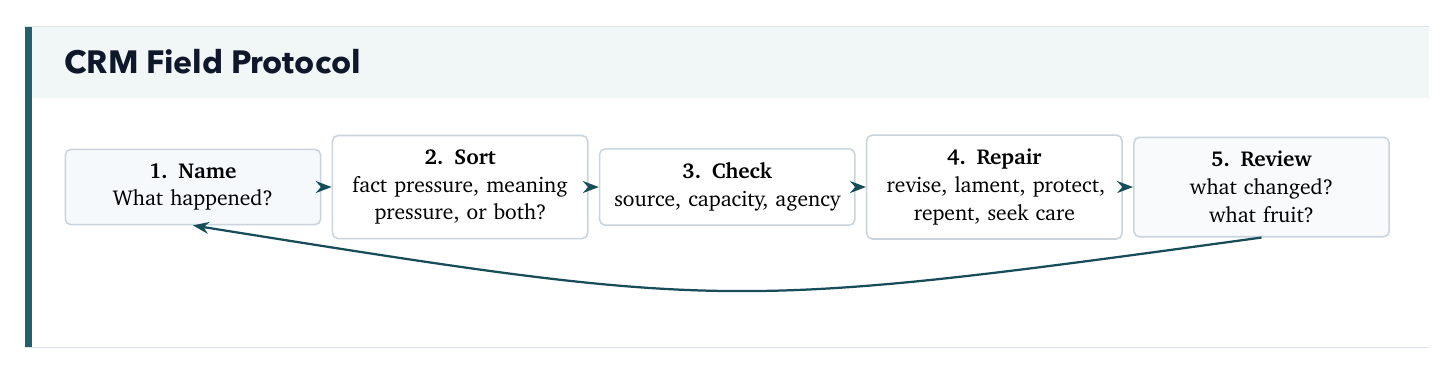
The Five Moves
Begin with the person and the problem. Each move should make the next decision clearer; a person need not complete every field to receive help.
- Name. State what occurred. Separate observation, report, interpretation, and uncertainty. Preserve the original expectation before hindsight changes it. Danger or acute clinical concern calls first for protection and qualified help.
- Sort. Name the failed expectation and the meaning under pressure separately. Either can be absent or unknown. A true vow, a neighbor's dignity, or a sound hope may remain when an expectation fails.
- Check. Examine the source, current safety and capacity, and the actions actually available. Name who has authority and resources to act. The distressed recipient may not be the person who must change.
- Repair. Identify the object: an inaccurate description, unmet need, injured power, chosen wrong, broken promise, unreliable channel, or obstructive rule. Choose a fitting remedy and its responsible actor. Confession addresses one's own wrong; care addresses injury; correction changes a false record. A mixed case can need several remedies at different speeds.
- Review. Record what will be done, by whom, with what support, and when its effects can be checked. Ask whether the intended person actually received protection, care, correction, or restitution. Keep continuing loss and adverse effects visible even when the meeting ends peacefully.
Action rule. A useful next step can be small: book the visit, preserve the report, ask the responsible office to correct a record, or rest with help arranged. For a recurring manageable situation, use an if-then intention: If this happens, I will take this warranted action with this support. Never make disclosure, confrontation, reconciliation, or religious interpretation the price of care.
Locate the Repair Before Changing the Person
A claimant brings a letter showing that promised help was approved, but the service still refuses access. Asking her to accept uncertainty may quiet the conversation while leaving the actual problem untouched. First check whether the approval is valid, which record the service is using, and who can correct it. If the service already grants access, another record change may be needless. Her expectation, the operating record, and the duty of the office are separate objects of inquiry.
For each proposed action, finish this sentence: This actor can change this condition, on this evidence, for this person's good. If the action depends on another fact or office, name that connection. If the connection is unknown, record the uncertainty. A complete worksheet cannot supply a missing warrant or authority.
Ten-Minute Session Script
The protocol is easier to use when the facilitator or writer follows a fixed rhythm. The times below are not strict; they keep the session from turning into either endless analysis or premature comfort.
- Time | Move | Prompt
- 0--1 min | Triage | Is this green, yellow, or red pressure? If red, stop interpretation and move to safety or qualified help.
- 1--2 min | Event | What happened, stated in one concrete sentence without explanation?
- 2--4 min | Two axes | What did I expect? What meaning frame, identity, value, faith-claim, duty, hope, or loyalty does this threaten?
- 4--6 min | Qualifiers | Which source am I trusting? Do I have capacity? What action is actually available?
- 6--8 min | False closure | What would make me feel better while avoiding evidence, lament, repentance, protection, or repair?
- 8--10 min | Output | Write one truthful next action and one review point. If the action is too large, make it smaller and embodied.
Session output. A good CRM session ends with a written sentence, not a mood: Because this happened, and because it pressures this expectation and this meaning frame, I will take this truthful next step with this support by this review point.
One-Page Output
The one-page version is the bridge between insight and use. It keeps the conversation concrete enough to revisit.
Event: What happened? I expected: What model did this violate? This threatens: What meaning frame, identity, value, faith-claim, or hope is under pressure? Source check: How trustworthy is the signal? Capacity check: Can this be processed safely now? Faithful next action: What can be done truthfully? False closure risk: What tempting relief would avoid truth? Revised model/meaning frame: What changed? Review date: When will this be revisited?
The shortest usable version is:
Reality-contact: ________ Meaning-contact: ________ Next truthful action: ________
Case Record Template
Repeated use needs a stable record. A case record keeps the practice from becoming a vague conversation style. It also makes later review, supervision, research coding, and institutional learning possible.
- Field | What to write
- Event or signal | The concrete pressure: diagnosis, testimony, failure, repeated pattern, result, conflict, loss, or discovery.
- Initial expectation | What the person or community expected reality to do before the pressure arrived.
- Meaning frame | The identity, value, faith-claim, duty, hope, mission, or loyalty now under strain.
- Prediction error | Low, medium, or high fact-model strain, with the exact failed expectation named.
- Meaning gap | Low, medium, or high meaning-pressure, with the threatened meaning named.
- Source trust | The channel, its reliability, incentives, limits, and needed verification.
- Capacity | Safety, sleep, support, time, clinical risk, coercion, and embodied stability.
- Agency and repair | Name the responsible actor, warranted remedy, recipient, and support needed.
- False-resonance risk | The most tempting way to feel resolved while avoiding reality, repair, or truth.
- Review point | When receipt, usable access, persistence, adverse effects, and unresolved loss will be checked.
Record rule. If a case cannot be written in concrete fields, it is probably not yet clear enough for confident interpretation. Record the pressure before explaining it.
Breach Profile
The breach profile is a field notation, not a validated score. It lets a person, mentor, pastor, clinician, researcher, or team summarize the pressure without writing a long analysis. Use 0--3 for intensity and green/yellow/red for capacity. The notation is an index of responsible handling, not a measure of worth, blame, sincerity, or spiritual maturity. Write the event, expectation, meaning, source, capacity, and available action in ordinary language first; the profile compresses that work; it does not replace it.
- Code | Question | Notation
- PE | How strongly did reality violate the factual model? | PE0 none; PE1 mild; PE2 significant; PE3 severe.
- MG | How strongly did the event threaten meaning frame, identity, value, faith, or hope? | MG0 none; MG1 mild; MG2 significant; MG3 severe.
- ST | How trustworthy is the source or channel? | ST high, mixed, low, or unknown.
- CAP | Can the person or group process truthfully now? | CAP green, yellow, or red. Red means safety and qualified help before interpretation.
- AG | What truthful action is available? | AG verify, lament, protect, confess, repent, document, repair, refer, practice, negotiate, wait, or correct.
Intensity anchors. Use 0 when there is no real pressure, 1 when the pressure is noticeable but easy to hold, 2 when it changes judgment, emotion, relationship, or action, and 3 when it threatens stability, identity, safety, trust, or major responsibility. Score prediction error and meaning gap separately; a case can be factually small and existentially large, or factually large and existentially small.
Source and capacity anchors. Source trust is high when the channel has firsthand access or competence, records where appropriate, accountability, and exposure to correction; mixed when some supports and some incentives or gaps exist; low when the signal is anonymous, manipulated, rumor-like, or protected from correction; and unknown when the channel still has to be traced. Capacity is green when ordinary reflection is enough, yellow when support and review are needed, and red when safety, protection, qualified care, or formal process comes before interpretation.
Example. PE3/MG2/ST-high/CAP-yellow/AG-refer+AG-lament+AG-adjust: the event strongly violates expectation, significantly pressures the meaning frame, comes through a trustworthy source, can be processed with support, and requires treatment, lament, and care.
Source-Handling Rules
Different channels require different handling. Source trust is not a feeling of confidence; it is a disciplined judgment about how the signal was produced, carried, filtered, and checked.
- Channel | Primary risk | CRM handling
- Measurement or test result | Method error, base-rate neglect, overinterpretation. | Inspect method, context, uncertainty, replication, and qualified interpretation.
- Direct testimony | Fear, shame, retaliation, memory limits, social cost. | Protect the person, record carefully, corroborate where possible, and avoid rumor drift.
- Memory | Reconstruction, emotion, later information, missing context. | Treat as meaningful evidence, not perfect recording; seek context and pattern.
- Rumor or forwarded claim | Status, outrage, fluency, repetition, identity defense. | Slow down, trace the source, do not act as fact without verification.
- Institutional report | Incentives, reputation, omissions, selective framing. | Ask who produced it, who benefits, what records exist, and who could safely contradict it.
- AI-generated output | Hallucination, hidden sourcing, overconfidence, user dependence. | Use for sorting and prompts only; verify facts through independent sources and qualified humans.
Decision Table
- Pressure | Quick test | Distortion risk | Repair path
- Prediction error | What did I expect that did not happen? | Denial, excuse-making, cherry-picking | Gather evidence, check sources, revise the model.
- Meaning gap | What meaning frame, identity, value, or hope is threatened? | Despair, cynicism, false certainty | Lament, seek wisdom, preserve or deepen sound commitments, correct false interpretations, and identify any remedy owed.
- Source problem | Who or what carried this signal? | Rumor, propaganda, false authority, memory distortion | Verify, triangulate, audit the channel, slow down.
- Capacity problem | Can I process this truthfully right now? | Collapse, dissociation, coercion, forced meaning | Stabilize, sleep, protect, involve support, use qualified care when needed.
- Agency problem | What truthful action is available? | Rumination, passivity, performative concern | Repent, repair, protect, confess, ask, wait, document, correct.
- Mixed breach | Are facts and meaning both under pressure? | Panic, overcorrection, spiritual bypassing | Separate the layers, address safety first, then revise facts and meaning together.
Three Scales and a Research Mode
One architecture can be used at different scales, but the output should change with the scale. These scales sit inside the five reader tracks: an individual usually works at the personal scale, a pastor or mentor often works at the interpersonal scale, a board or team works at the institutional scale, and researchers may study any scale. Research is a mode of inquiry across these scales, not a fourth scale of reality.
- Personal scale: write the one-page output, name the breach profile, choose one action, and set a review date.
- Interpersonal scale: each person names their own expectation, meaning pressure, source assumptions, capacity, and available repair without forcing the other person's interpretation.
- Institutional scale: preserve the signal, identify who could distort or suppress it, name the threatened shared meaning frame, correct the structure, and protect those carrying the cost.
- Research mode: define constructs, code cases, compare outcomes, test whether CRM sorting adds value beyond existing measures, and revise the model when it fails.
Facilitator Posture
The helper's task is to preserve both truth and agency. Shared decision-making research fits this posture because it joins evidence, values, uncertainty, deliberation, and action rather than reducing help to either expert control or unsupported autonomy. A facilitator should not supply meaning too quickly, pressure a person into premature peace, or leave a person alone with pressure they cannot carry.
- Ask for the event before the interpretation. What happened?
- Separate fact-pressure from meaning-pressure. What did this violate: an expectation, a meaning, or both?
- Check the channel. What source are we trusting, and how do we know?
- Check capacity without lowering truth. Can this be processed now, or do we need safety, sleep, support, or qualified care first?
- Preserve agency. What truthful action is available, and what support would make it possible?
- Schedule review. When will we revisit this with more light?
Power rule. When the facilitator, leader, employer, parent, pastor, clinician, or institution has leverage over the person carrying the signal, capacity is automatically more fragile. Use independent support, written records, review channels, and safeguarding pathways rather than asking the vulnerable person to accept the powerful party's interpretation.
Severity Rules
- Green pressure: ordinary surprise, disagreement, disappointment, or new information. Use the one-page version alone or with a trusted person.
- Yellow pressure: grief, repeated patterns, moral failure, high-stakes conflict, church conflict, public claims, or institutional decisions. Use notes, counsel, and accountable review.
- Red pressure: abuse, coercion, self-harm risk, medical danger, psychosis, severe trauma activation, credible threats, or institutional cover-up. Interpretation is not first. Safety, protection, qualified care, documentation, and mandated processes come first.
Clinical boundary. CRM is not a crisis plan, therapy protocol, diagnostic instrument, or substitute for medical, psychological, pastoral, legal, or safeguarding care. Its first clinical virtue is knowing when not to interpret and when to involve qualified help.
High-Risk Differentials and Least-Coercive Action
Red pressure requires more than a general referral warning. It requires discipline about what kind of claim the available evidence can carry. A theological conviction, clinical formulation, legal allegation, pastoral impression, and reported experience may all matter without any one of them silently deciding the others. Under uncertainty, the next action should be strong enough to protect but no more coercive or irreversible than the warrant permits. Record what new evidence, elapsed time, qualified assessment, or observed fruit would require review.
- Scrupulosity and compulsive certainty-seeking. Repeated confession, reassurance, doctrinal checking, or moral review can become part of an obsessive-compulsive loop. Seek qualified OCD assessment and a care plan, including cognitive-behavioral therapy with exposure and response prevention when indicated. Helpers should reduce their involvement in reassurance rituals sensitively within that plan. Genuine new evidence and protection concerns still require attention; a renewed feeling of uncertainty alone need not trigger another moral investigation. With the person's consent, a suitable religious adviser can help distinguish religious practice from symptoms.
- Voices, visions, sensed presences, and deliverance claims. The experience is real as an experience; its external cause is not self-authenticating. Spiritual language must not bypass assessment of immediate danger, sleep-state disturbance, medication or substance effects, neurological illness, trauma, dissociation, mania, psychosis, grief, and the person's cultural account. Prayer may accompany care without naming a demon, guaranteeing a spiritual interpretation, or delaying medical and psychiatric assessment.
- Active coercive control. A coercive marriage, family, ministry, or team is not an ordinary mutual-conflict case. Do not begin with a joint reconciliation process when one party can retaliate, monitor, punish disclosure, control resources, or manipulate the shared record. Use separate safety assessment, confidential support, documentation, safeguarding, and legal or specialist help before considering any conjoint process. Forgiveness never by itself restores access.
Common Misuse
- Using the profile as a verdict. The profile summarizes pressure; it does not prove what happened.
- Making meaning before protection. Red pressure requires safety, documentation, qualified care, and formal process before interpretation.
- Letting the powerful close the meaning frame. A leader or institution under question should not be the only interpreter of the signal.
- Replacing investigation with insight. A clear interpretation is not a substitute for records, witnesses, measurements, expert review, or due process.
- Treating uncertainty as paralysis. Honest unfinishedness still needs one truthful next step, even when that step is simply to protect, verify, wait, or seek help.
Related research
Compare this chapter with source documents or study its biblical references.
Chapter comments